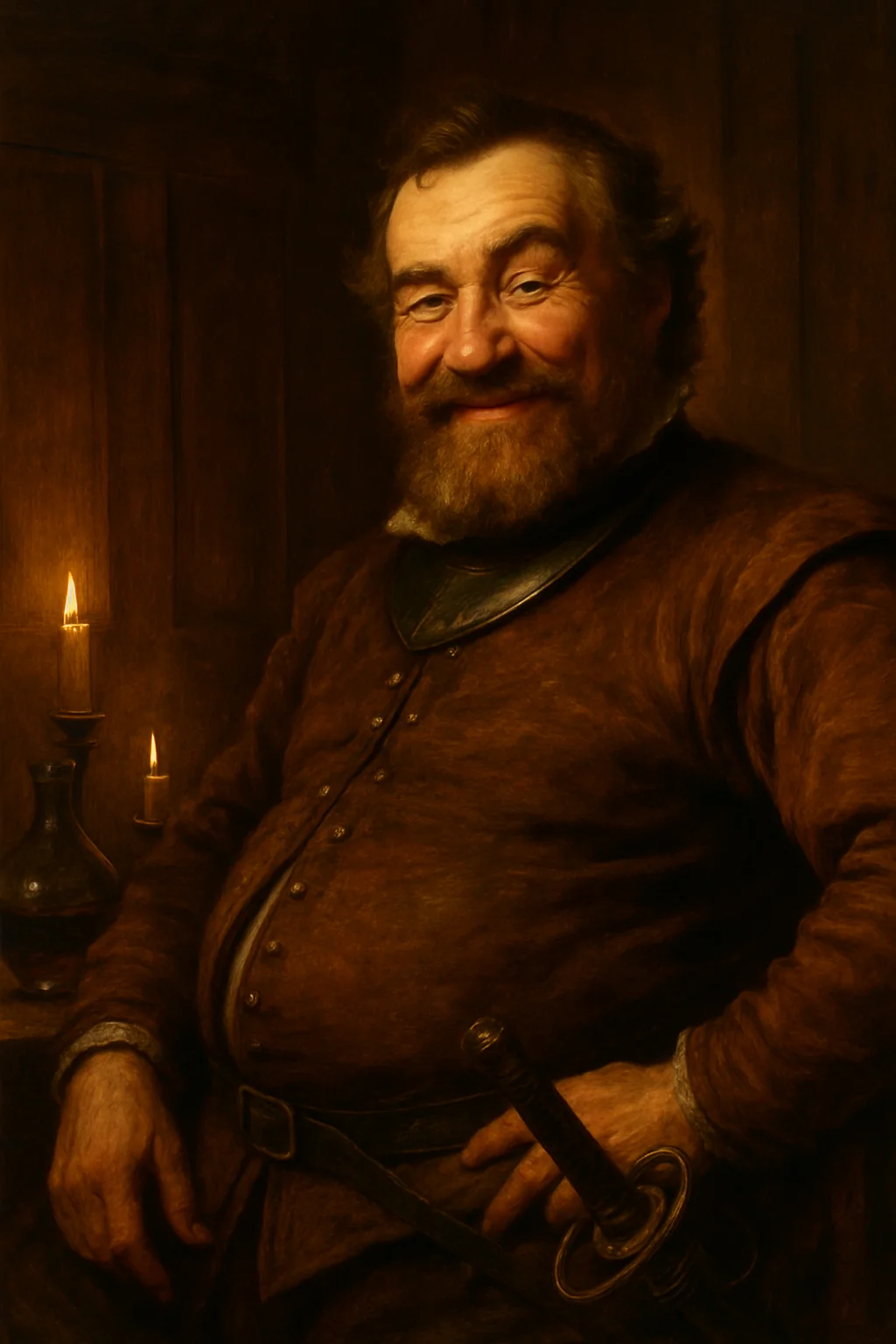
Sir Toby Belch
Sir Toby is the play's lord of misrule — the embodiment of the festive principle that gives Twelfth Night its title, who organises the late-night revelry, exploits Sir Andrew's credulity, and enthusiastically sustains the plot against Malvolio, without ever quite becoming the play's moral centre.
Appears In
Biography
Sir Toby Belch is Olivia's uncle and the presiding spirit of the play's festive subplot — a knight of middle age with an appetite for sack, late nights, and the company of anyone willing to keep him company and pay the bill. He lives in Olivia's house apparently by tolerated imposition, and his relationship with his niece is one of the play's running background ironies: she keeps asking him to reform, and he keeps ignoring her, and the household somehow functions around both of them.
His management of Sir Andrew Aguecheek is the play's clearest instance of exploitation dressed as friendship. Sir Andrew is rich, foolish, and entirely dependent on Sir Toby's social confidence; Sir Toby is happy to extend the companionship as long as Sir Andrew's money holds out, and cheerfully tells the audience as much in Act I. The trick is that Sir Andrew never quite notices, and Sir Toby's evident pleasure in the company — the midnight revels of Act II, Scene 3, the elaborate staging of the duel in Act III — suggests a man who genuinely enjoys the performance, even if he is also running a con.
The letter plot against Malvolio is largely his production as well, or rather Maria's with his enthusiastic support, and his relish in watching Malvolio read the forged letter from behind the box hedge is one of the play's funniest sustained scenes. He ends the play wounded — Sebastian, mistaken for Cesario, hits rather harder than expected — and married to Maria, a match the play mentions in passing as a reward for her wit. He does not get a final scene or a speech of resolution; he is simply absorbed into the ending like a piece of furniture that has always been there.
Motivation
Sir Toby is motivated by a straightforward appetite for pleasure — drink, company, laughter, and the perpetuation of exactly the kind of riotous festivity that Malvolio represents the opposite of.
Personality
Sir Toby is funny, warm in his way, and entirely without conscience about the money he is extracting from Sir Andrew or the suffering he is inflicting on Malvolio — which is precisely why the play puts him in the festive camp without fully endorsing him. His wit is real, his pleasure is real, and his exploitation is real, and the comedy asks us to enjoy all three simultaneously.