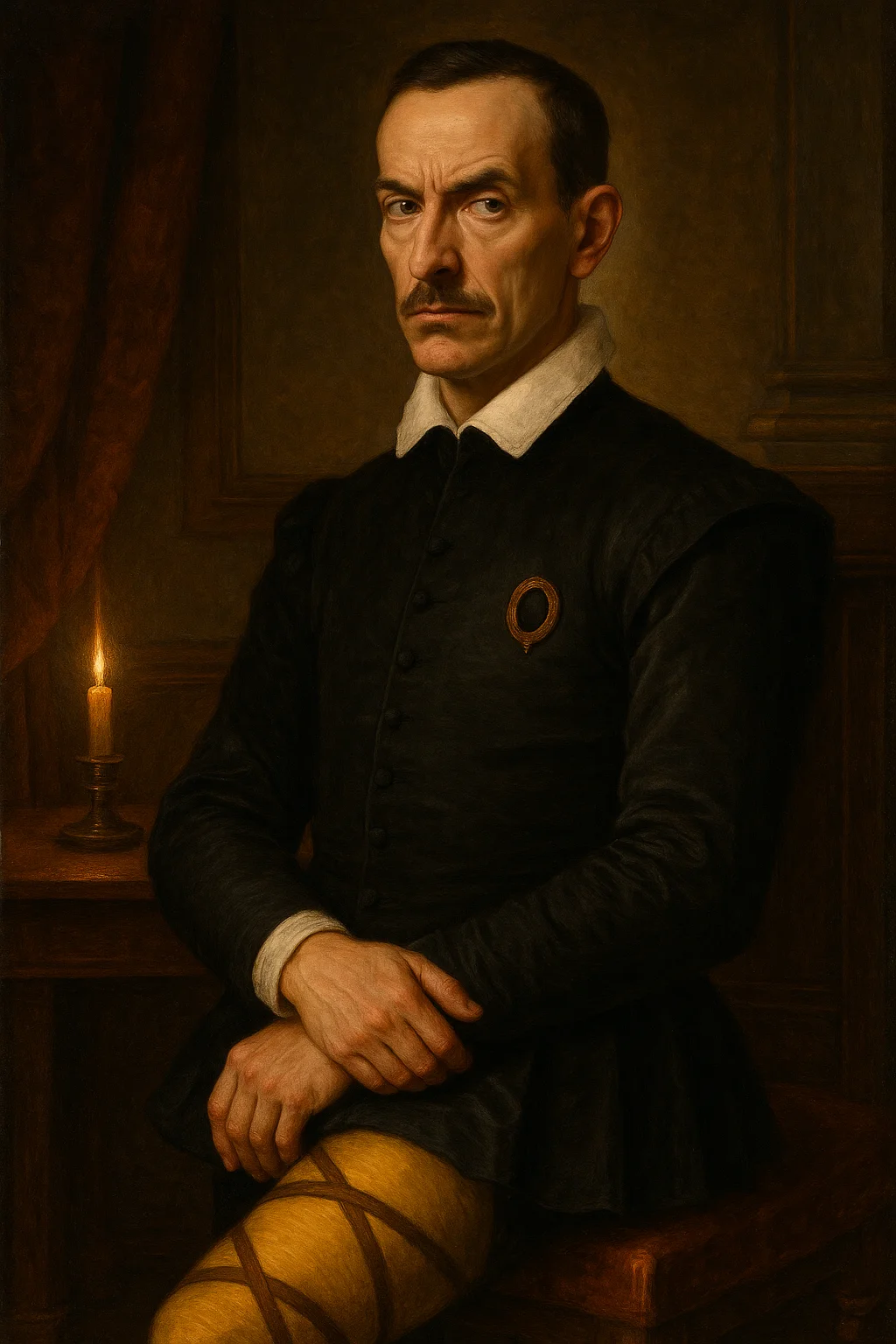
Malvolio
Malvolio is the play's great anti-festive figure, whose humiliation is the comedy's central set-piece and its unresolved moral remainder — the one character who cannot be absorbed into the happy ending and whose parting threat leaves a faint, genuine shadow over the play's final mood.
Appears In
Biography
Malvolio is Olivia's steward — efficient, humourless, convinced of his own superior merit — and the play's most discussed character precisely because the trick played on him sits so uneasily between comedy and cruelty. He is introduced rebuking Feste at Olivia's instruction and earns his enemies in the same scene by coldly telling Sir Toby that Olivia wishes him to reform his habits. He is right on both counts, and that is part of the problem: he is not wrong, he is simply insufferable, and in a comedy built on festivity, insufferability is the cardinal offence.
The letter plot — Maria writes a forged love letter from Olivia designed to make Malvolio believe his mistress loves him — catches him exactly because it is what he already secretly believes. His soliloquy reading the letter in Act II, Scene 5, as Sir Toby and the others watch from behind a box hedge, is a small masterwork of comic self-revelation: we see a man who has been entertaining fantasies of marrying his employer, imagining himself 'Count Malvolio,' and the letter simply gives him permission to act on what he has always thought. He appears before Olivia in the yellow stockings and cross-garters the letter commanded, smiling continuously in the face of her obvious alarm, and the gap between his certainty and her bewilderment is both hilarious and faintly appalling.
What happens next — confinement in a dark room, visited by Feste impersonating a priest — tips the comedy toward something darker, and the play does not quite resolve it. Malvolio's letter from the dark room, read aloud in Act V, has a dignity that is hard to dismiss, and his final exit — 'I'll be revenged on the whole pack of you' — is the one line in the play that does not feel like a resolution. Olivia admits he has been 'most notoriously abused.' The festivity continues without him.
Motivation
Malvolio is motivated by a conviction of his own worth and a secret ambition for advancement — he genuinely believes himself suited to rule, and the letter plot works precisely because it confirms rather than creates those fantasies.
Personality
Malvolio is not a villain but a man whose particular combination of genuine competence and absolute social tone-deafness makes him the natural target of a household that runs on wit and festivity. His tragedy — if it is a tragedy — is that he is exposed at his most vulnerable moment and cannot be reintegrated, while everyone else's similar self-deceptions (Orsino's romantic posturing, Olivia's theatrical grief) are treated with more gentleness.