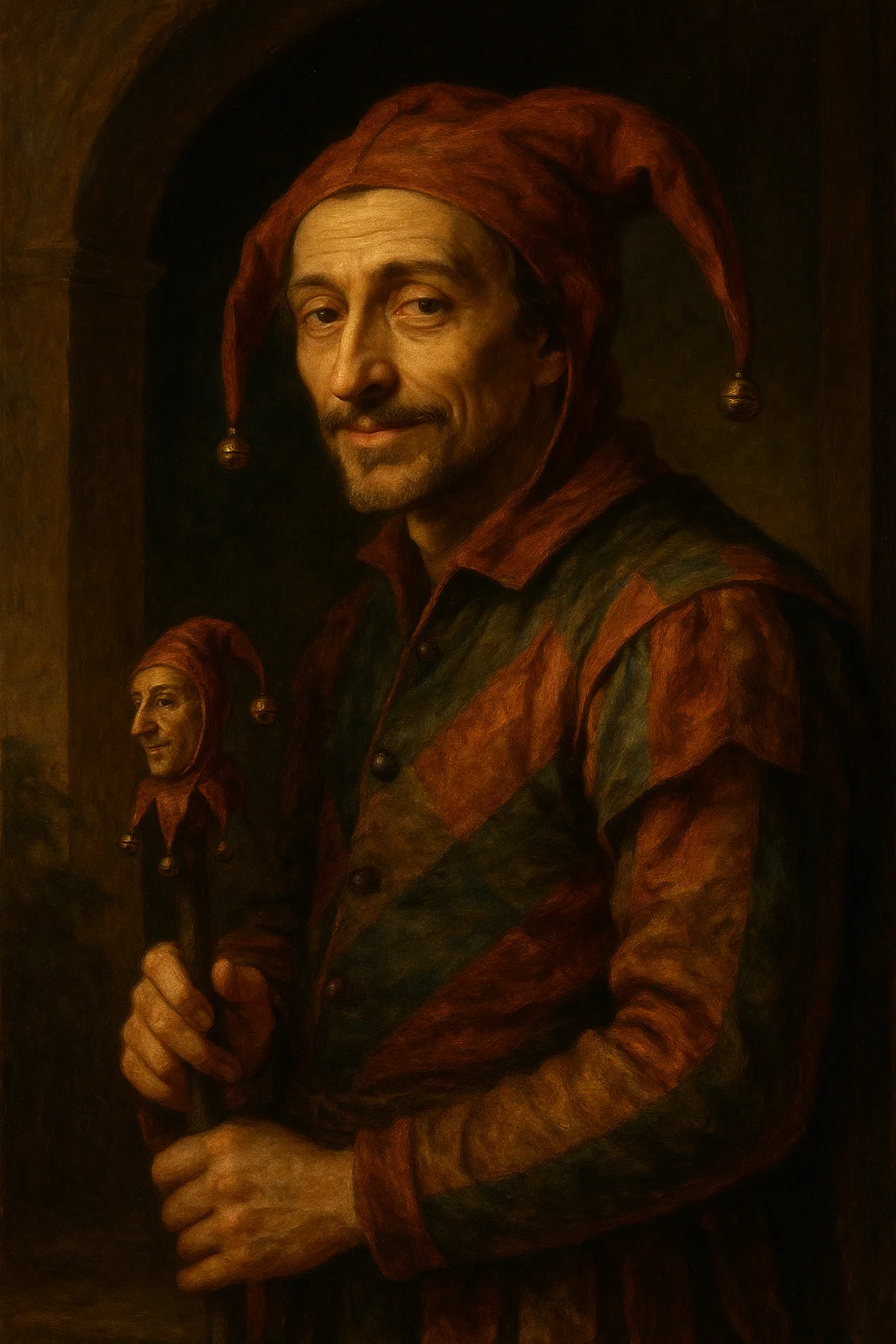
Feste
Feste is the play's licensed truth-teller and most philosophical presence — the fool who is wiser than the wise, whose movement between households gives him the widest view of Illyria's romantic delusions, and whose final song refuses to be absorbed into the comedy's happiness.
Appears In
Biography
Feste is Olivia's licensed fool, though he is at liberty to wander between her household and Orsino's — a freedom that makes him the play's most mobile figure and its most persistent observer. He is first seen returning from an absence that has got him into trouble, and his first act is to talk his way back into Olivia's favour with a demonstration of wit that concludes by turning her grief for her brother into an absurdity: her brother's soul is in heaven, so why mourn? It is cold comfort delivered as logical proof, and Olivia laughs.
Feste's wit is the play's most consistently sophisticated — he is the only character who can match Viola in wordplay, and their exchange in Act III, Scene 1 is the play's most consciously philosophical scene, two people of real intelligence testing each other's understanding of what words do. His famous observation — 'This fellow is wise enough to play the fool, / And to do that well craves a kind of wit' — applies as accurately to himself as to anyone else in the play, and suggests a man who has thought carefully about the role he occupies.
His treatment of Malvolio in the dark room — impersonating the curate Sir Topas, denying that the room is dark, insisting Malvolio is mad — is the moment where the comedy tilts toward something more uncomfortable. Feste mentions that Malvolio once mocked him, and his revenge is proportionate only if you accept that Malvolio's treatment of fools warrants indefinite psychological torment. The play allows both readings and settles neither — his final song, 'When that I was and a little tiny boy,' stands outside the plot entirely, a melancholy coda sung to the empty stage and the audience.
Motivation
Feste is motivated by the professional pleasures of wit and the personal satisfaction of being seen for what he actually is — the play's most perceptive mind — a satisfaction mostly denied him by a world that prefers its fools fool-shaped.
Personality
Feste performs the fool's role with complete mastery while remaining distinct from it — he is always the man who plays the fool rather than the fool himself, and that gap is where the play's most interesting thinking about disguise, identity, and the uses of language takes place. His occasional cruelty — to Malvolio especially — is part of the same character: he sees clearly and responds precisely, which is not always kind.