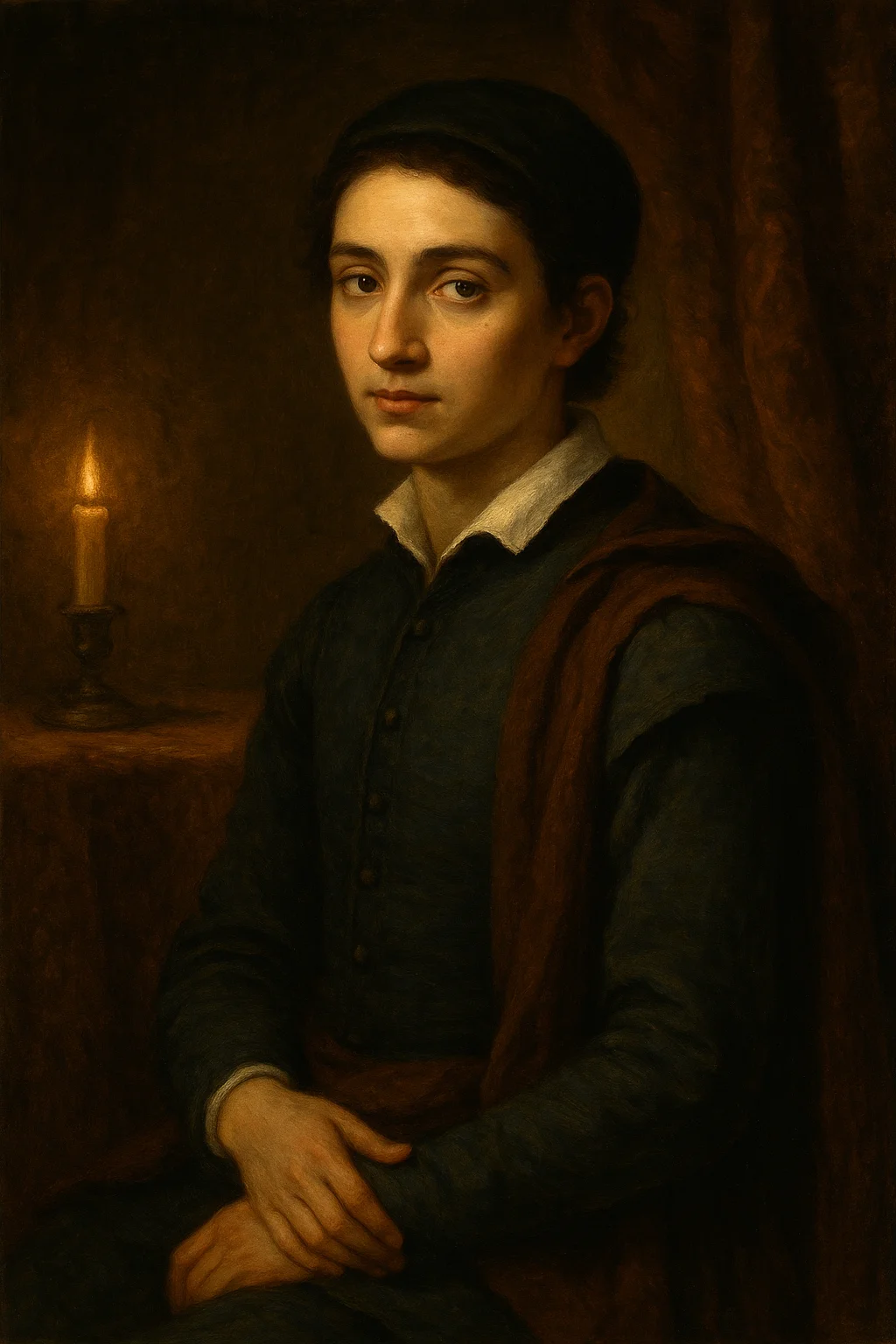
Viola
Viola is the play's protagonist and emotional centre — her disguise as Cesario sets every plot in motion, her wit and warmth drive every relationship, and the patient, contained love she carries for Orsino gives Twelfth Night its undertow of genuine feeling beneath the comedy.
Appears In
Biography
Viola arrives in Illyria as a survivor of a shipwreck, believing her twin brother Sebastian drowned, and within moments of landing makes the most consequential decision of the play: she will disguise herself as a young man, take the name Cesario, and enter the service of Duke Orsino. It is a practical solution to the problem of a lone woman in an unfamiliar country, and it works — within three days Cesario has become Orsino's most trusted confidant and favourite, a closeness the play carefully attributes to qualities that are simply Viola's own: wit, emotional intelligence, and a gift for saying the thing that actually needs saying.
The irony that immediately compounds the disguise is that Orsino sends Cesario to woo Olivia on his behalf, and Olivia falls in love with Cesario instead — while Viola is falling in love with Orsino. The scene between Viola and Orsino in Act II, Scene 4, in which Viola describes her own love obliquely as 'my father's daughter's' love — telling Orsino the truth in a form he cannot recognise — is the play's most quietly devastating piece of emotional choreography, a woman describing her real feelings to the man she loves without being able to say so.
Viola's disguise is never really comic at its core — it is a form of survival that traps her in a triangle she cannot escape until Sebastian's arrival does it for her. Her famous speech at the end of Act II, Scene 2 — 'What will become of this? As I am man, my state is desperate for my mistress' love' — captures the play's tonal mix precisely: funny in situation, genuinely painful in feeling. When the resolution comes in Act V and Orsino turns his love toward Viola rather than Cesario, it is both entirely right and slightly vertiginous, since the man has never actually seen her face.
Motivation
Viola is motivated first by survival — finding a safe footing in a strange country — and then by a love for Orsino she cannot declare, which she navigates with remarkable patience, wit, and an almost willful trust that circumstances will eventually resolve themselves.
Personality
Viola combines quick intelligence with a genuine emotional depth that makes her unlike the other Illyrian characters, most of whom are in love with the idea of love rather than with a real person. Her wit never becomes a defence mechanism; she feels things fully and says so, when she can say so at all, and her restraint comes from circumstance rather than coldness.