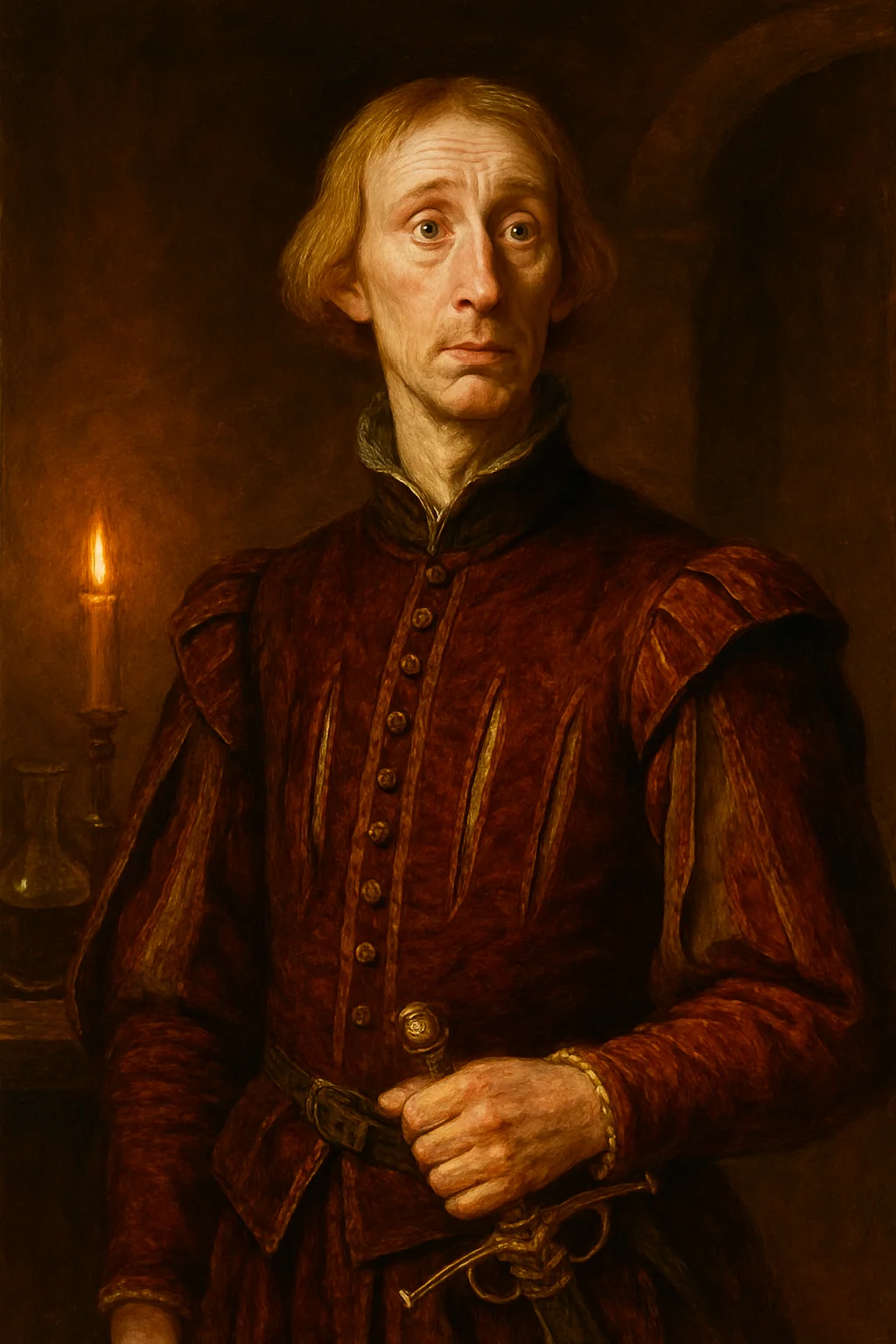
Sir Andrew Aguecheek
Sir Andrew is the play's most purely comic character — a figure of good-natured foolishness whose every scene turns on the gap between his self-perception and reality — and his relationship with Sir Toby quietly illustrates the costs of the festive world's amorality.
Appears In
Biography
Sir Andrew Aguecheek is the play's great innocent — a tall, thin knight with straight, limp hair and no apparent gifts beyond a middling competence on the viol-de-gamboys and a willingness to spend money on Sir Toby's hospitality. He has been in Illyria for three months pursuing Olivia's hand, entirely on Sir Toby's encouragement, and the play makes clear within his first scene that he has approximately no chance of success and that Sir Toby knows this perfectly well.
His comedy is almost entirely a comedy of the gap between his self-image and his actual situation. He misunderstands words, misconstrues compliments, mistakes Cesario's eloquence for a rebuke of his own, and yet maintains throughout a cheerful, puzzled goodwill that makes him oddly endearing. His decision in Act III to write a challenge to Cesario — 'I'll ride home tomorrow, Sir Toby,' followed immediately by 'I'll stay a month longer' — captures his particular quality of resolving and unresolving simultaneously.
The duel scene, in which he and Viola/Cesario are each convinced the other is a terrifying fighter, produces the play's purest farce, and its collapse — when Sebastian arrives and Sir Andrew discovers what an actual fighter feels like — is a fitting puncture of whatever martial self-image he has been sustaining. He exits wounded, bewildered, and still not entirely sure what happened, which is a fair summary of his three months in Illyria.
Motivation
Sir Andrew is motivated by a genuine desire for Olivia's hand and a genuine enjoyment of Sir Toby's company, both of which are being exploited, and his inability to recognise this is both his comedy and his pathos.
Personality
Sir Andrew's foolishness is not malicious — he is simply out of his depth in every situation and too good-natured to resent it for long. His comedy comes from sincerity rather than pretension: he genuinely believes what Sir Toby tells him, genuinely thinks he can win Olivia, genuinely intends to fight the duel. The gap between his faith and reality is the play's most reliable comic engine.