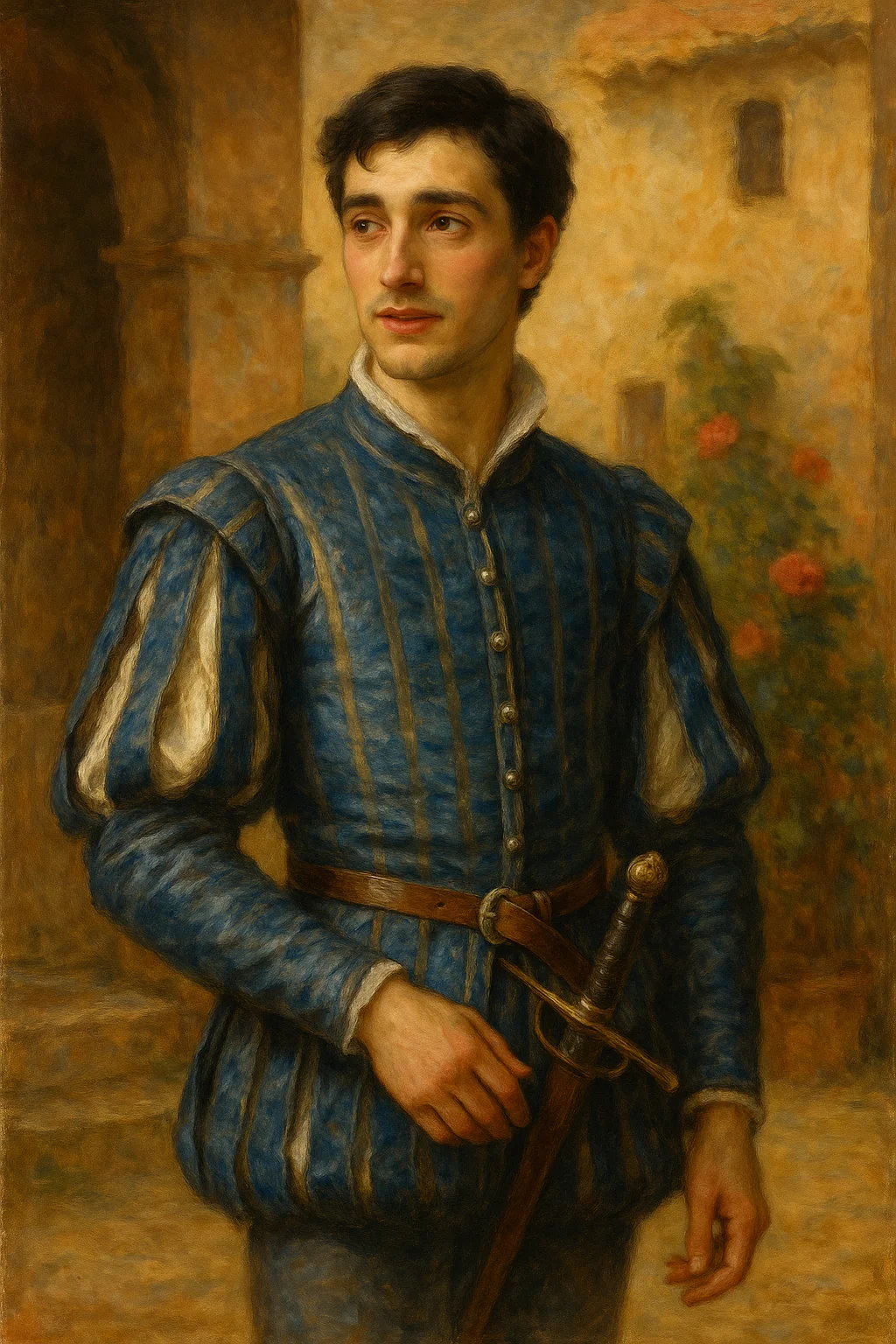
Claudio
Claudio is the play's romantic lead in its darker plot - a young soldier whose genuine but under-tested love for Hero is turned, by Don John's deception, into public cruelty, and whose eventual remorse and reconciliation trace the comedy's narrower escape from tragedy.
Appears In
Who is Claudio?
Claudio returns from war already inclined toward love and, on seeing Hero again, falls silently and completely - so silently, in fact, that he cannot bring himself to court her directly and instead asks Don Pedro to woo her on his behalf at the masked ball, disguised as Claudio himself. The delegation is telling: Claudio's feelings are genuine but his confidence in acting on them is thin, and this same thinness - a readiness to let other men's words and other men's schemes determine what he believes - will prove disastrous later in the play.
That vulnerability to suggestion is exploited with terrible efficiency by Don John, who needs only to arrange for Claudio to witness what appears to be Hero at her window with another man the night before the wedding. Claudio does not investigate, does not ask Hero directly, does not wait for better evidence - he simply believes what he has been shown and converts his love into public humiliation, denouncing her at the altar in front of the entire wedding party: 'There, Leonato, take her back again.' The speed and cruelty of the reversal is the play's darkest moment, and it is entirely Claudio's own doing, however much Don John engineered the occasion.
His path back to sympathy runs through genuine remorse once Borachio's confession reveals the deception - he agrees without argument to Leonato's proposed penance, including marrying a cousin he has never seen sight unseen, as atonement. That the 'cousin' turns out to be Hero herself, restored to him at the altar a second time, gives Claudio a second chance he arguably has not fully earned, which is part of why the play keeps him talking least at the very end: his story resolves in relief rather than in any deep reckoning with what his hasty faith in appearances nearly cost.
Motivation
Claudio is motivated by a genuine desire for Hero and an equally strong desire to avoid being made a fool of - the same anxiety about appearing gullible in love that makes him delegate his wooing to Don Pedro also makes him quick to believe, and violently react to, apparent evidence of Hero's unfaithfulness.
Personality
Claudio loves easily but trusts his own judgment poorly, relying on Don Pedro to woo for him and on Don John's staged scene to convict Hero without ever seeking her own account. His hastiness is not cruelty for its own sake but a kind of emotional cowardice - a preference for public certainty, however wrongly arrived at, over the private risk of being deceived without knowing it.