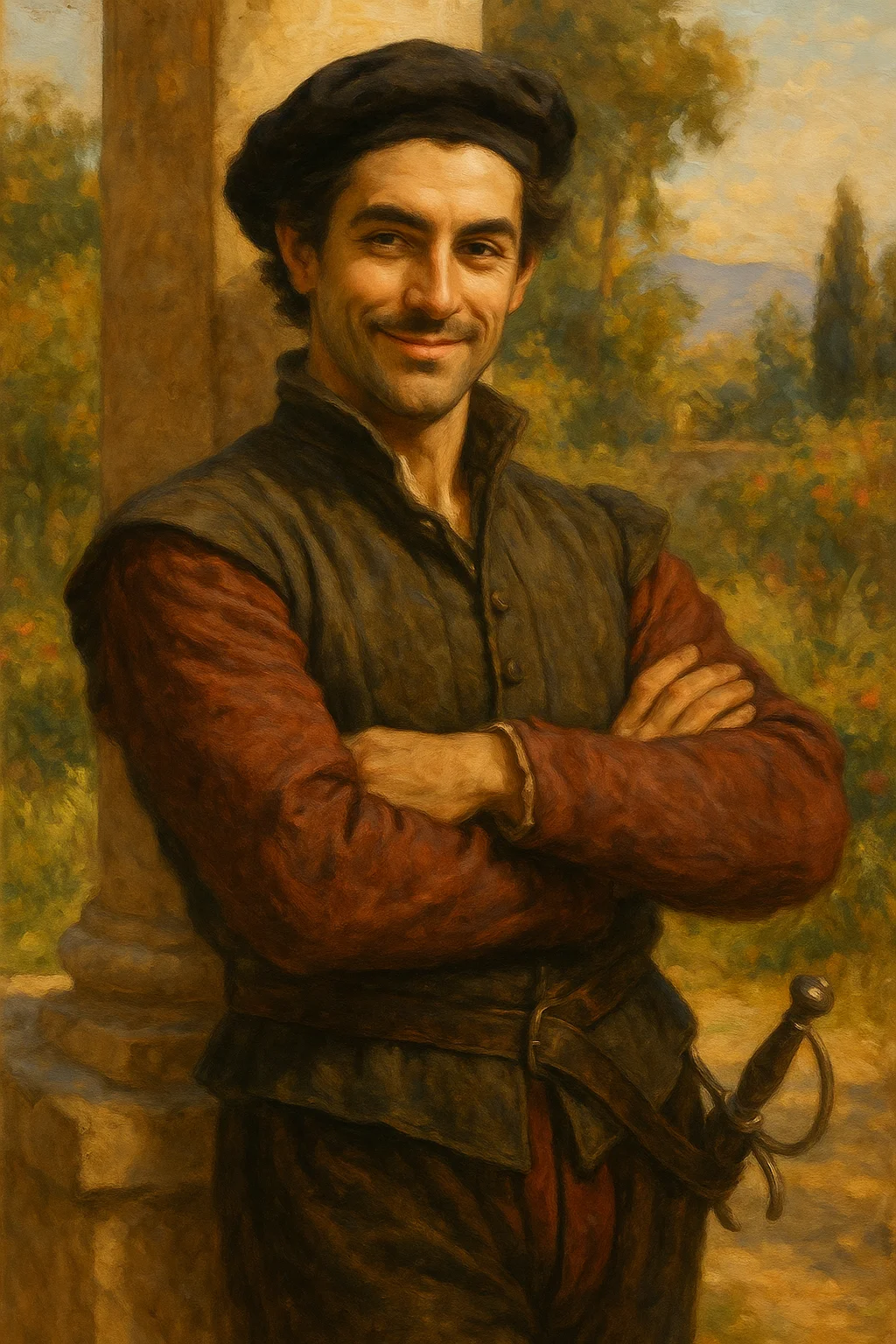
Benedick
Benedick is the play's chief comic wit and, alongside Beatrice, its true emotional center - his declared war against marriage and his eventual, hard-won surrender to it trace the arc from performed cynicism to genuine feeling that the play's comedy is built to deliver.
Appears In
Who is Benedick?
Benedick arrives in Messina already famous for a single, well-worn position: he will never marry, and he says so at every opportunity, with an inventiveness that suggests the boast is as much performance as conviction. His 'merry war' with Beatrice predates the play entirely - Leonato tells us there is 'a kind of merry war betwixt Signior Benedick and her,' and their first exchange in Act I, Scene 1 picks up an argument clearly already years in progress, each of them reaching instinctively for the sharpest available insult. The skill and speed of the wit on both sides is itself the tell: nobody spars this well with somebody they are indifferent to.
The gulling scene in the orchard - Don Pedro, Claudio, and Leonato staging a conversation for Benedick to overhear, insisting Beatrice is dying of love for him - is the play's comic engine, and what makes it work is how little resistance Benedick actually puts up. 'This can be no trick,' he decides almost at once, and proceeds to talk himself into requited love with the same rhetorical energy he had spent maintaining his bachelorhood: 'Love me? why, it must be requited.' Shakespeare is careful to show that the trick does not implant a new feeling so much as give Benedick official permission to admit an old one.
The play's comic register cracks in the church scene, when Claudio publicly shames Hero and Beatrice, in tears, asks Benedick to 'kill Claudio.' Benedick's hesitation and then his agreement - choosing Beatrice and justice over his oldest friendship - is the moment his wit stops being a shield and becomes a genuine moral position. That he never actually has to fight Claudio does not diminish the significance of having said yes; by the play's end, silencing Beatrice's mouth with a kiss and declaring 'a college of wit-crackers cannot flout me out of my humour,' he has traded the performance of invulnerability for something considerably more exposed.
Motivation
Benedick is driven by a need to remain undefeated in every exchange, verbal or romantic - his professed contempt for marriage is less a settled philosophy than a defense against the specific vulnerability of losing an argument, or a heart, to Beatrice.
Personality
Benedick's wit is quick enough to seem effortless, but its constant deployment against marriage and against Beatrice specifically suggests a man protecting something rather than simply entertaining a room. Once given permission to drop the performance, he proves capable of real tenderness and real courage - his willingness to challenge Claudio, his oldest friend, for Beatrice's sake shows that the wit was never the whole of him, only the most visible part.