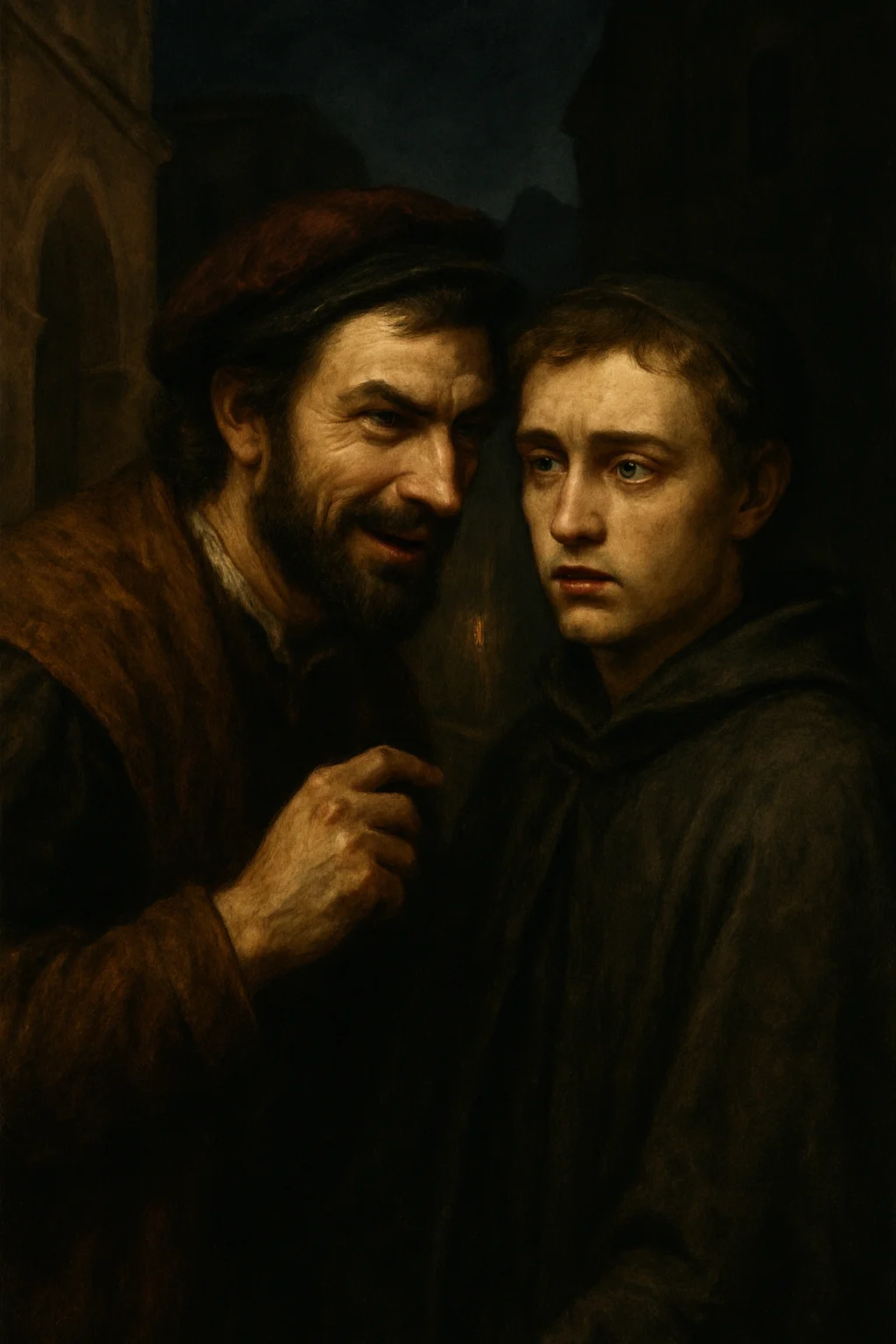
Borachio & Conrade
Borachio devises and executes the staged deception that convicts Hero, while Conrade serves as his companion and unwitting co-conspirator; their capture by the Watch and Borachio's eventual confession together provide the mechanism by which the plot against Hero is finally undone.
Appears In
Who are Borachio & Conrade?
Borachio is Don John's chief instrument and the actual architect of the deception that nearly destroys Hero and Claudio - it is his idea to stage a nighttime scene at Hero's window using Margaret, dressed as her mistress, so that Claudio and Don Pedro, positioned to watch from below, will believe they have witnessed Hero's infidelity with their own eyes. Borachio's plan works precisely because it exploits the era's trust in visual evidence over verbal testimony: nobody thinks to simply ask Hero, because they believe they have seen the truth for themselves.
Conrade is Don John's more passive follower, present largely as a listener and companion rather than an active schemer - his role in Act I is mostly to receive Don John's confessions of temperament, and his role in the plot proper is to hear Borachio's drunken, self-satisfied boasting about the success of the window scheme, unaware that the Watch is listening from the shadows. Conrade's contribution to his own downfall is essentially passive: he is caught not for anything he has done, but for being present when Borachio could not resist bragging.
Both men are captured and interrogated by Dogberry's Watch, and it is Borachio's own conscience-stricken confession, once the plot's success has curdled into guilt over Hero's apparent death, that finally clears her name - 'I have deceived even your very eyes,' he tells Don Pedro, taking full responsibility rather than sheltering behind Don John, who has by then fled. Conrade's chief contribution to the record is his outraged insistence, under Dogberry's absurd questioning, that Dogberry is an ass - accurate, but not the defense he needed.
Motivation
Borachio is motivated by loyalty to Don John and by the promised reward for his scheming, tempered by a conscience that eventually reasserts itself once he learns the plot has driven Hero to apparent death; Conrade is motivated mainly by companionship with Don John and Borachio rather than any scheme of his own.
Personality
Borachio combines real cleverness in devising the window deception with a fatal indiscretion - he cannot resist boasting about his own success to Conrade within earshot of the Watch, and it is this same garrulousness, turned to confession, that later redeems him. Conrade is quieter and more passive, defined largely by his willingness to listen to Don John and Borachio rather than by any independent scheme.