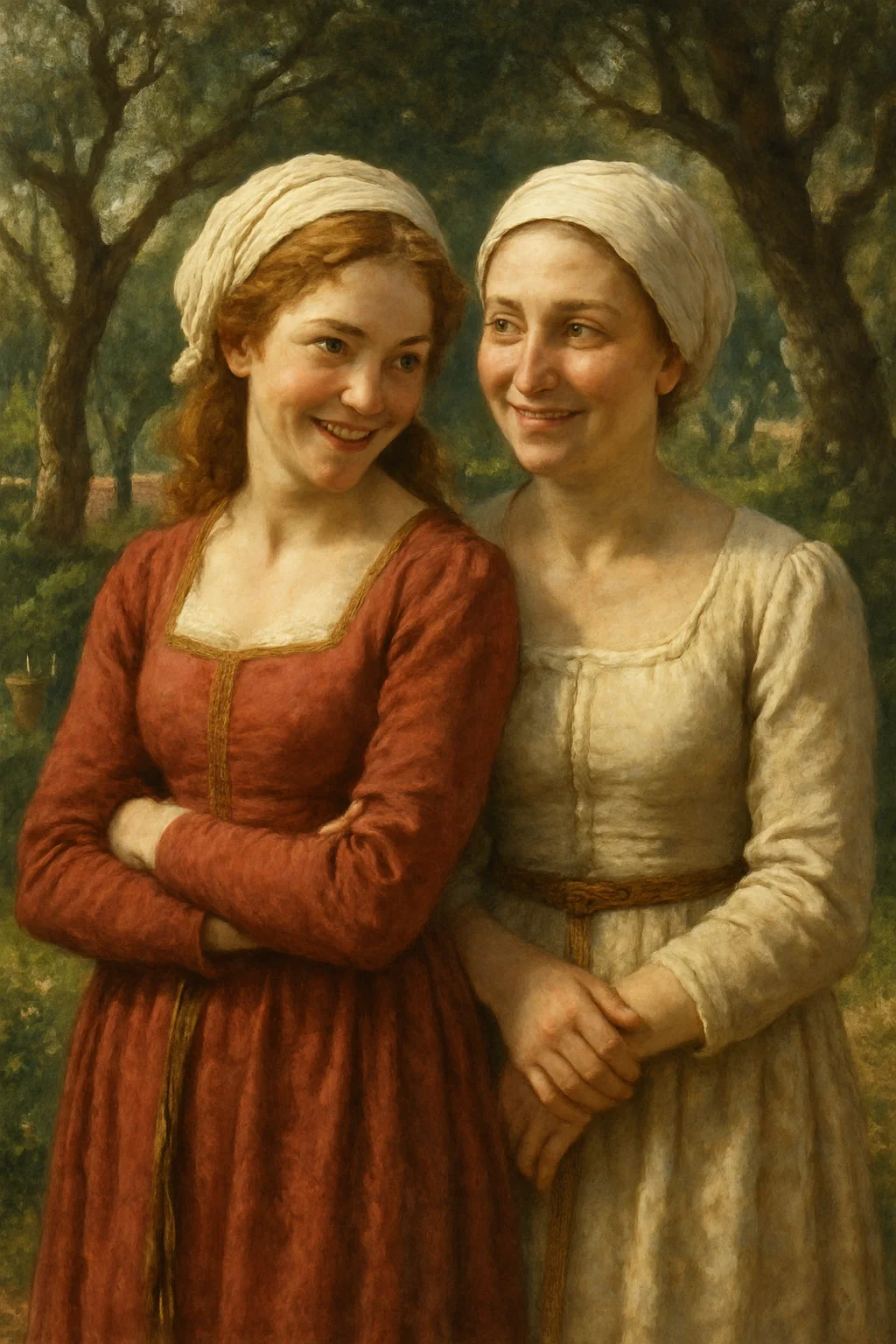
Margaret & Ursula
Ursula is Hero's willing co-conspirator in the gulling of Beatrice, while Margaret is the unwitting instrument of Borachio's deception of Claudio - together they illustrate the play's central preoccupation with the difference between benign and malicious deception, and the difficulty of distinguishing them from the inside.
Appears In
Who are Margaret & Ursula?
Margaret and Ursula serve as Hero's gentlewomen, and each becomes, in her own way, an instrument in one of the play's two great deceptions without ever fully understanding the part she is playing. Ursula is recruited by Hero to stage the garden conversation in Act III that convinces the eavesdropping Beatrice that Benedick is dying of love for her - she plays her scripted role with cheerful confidence, and her evident enjoyment of the performance gives the scene its warmth. Margaret's role in the other deception is far more consequential and far less knowingly undertaken: she meets Borachio at Hero's window dressed as her mistress, believing the encounter simply a romantic assignation, unaware that Claudio and Don Pedro are positioned below to mistake her for Hero herself.
The asymmetry between the two women is deliberate and morally significant. Ursula's deception is benign, consented to by all parties, and produces a happy outcome. Margaret's participation in Borachio's scheme produces near-catastrophe - Hero's public shaming, her apparent death, and the near-destruction of the play's comic world - all on the strength of a scene Margaret never understood she was staging. The play is quietly careful to establish her innocence: Borachio, confessing to Don Pedro, explicitly exonerates her, and the matter is not pressed at the end. But her exoneration depends entirely on Borachio's conscience reasserting itself, and the ease with which she was used raises questions the comedy does not fully answer.
In the final scene, both women appear among the wedding party, their earlier functions largely discharged. Ursula delivers the news to Beatrice in Act V, Scene 2 that Don John's villainy has been discovered, a small but satisfying continuation of her role as a cheerful bearer of information. Margaret appears in the final reconciliation without any direct acknowledgment of the part she played in what nearly went wrong - a silence that is, in its own way, characteristic of the play's determination to end in festivity rather than accounting.
Motivation
Ursula is motivated by loyalty to Hero and evident enjoyment of the performance; Margaret by an affectionate trust in Borachio that she has no reason to question and every reason, in retrospect, to regret.
Personality
Ursula is cheerful and confident, a willing participant in Hero's scheme who executes her role with obvious pleasure and no misgivings. Margaret is warmer and more independent-minded, given to wit and banter even on the morning of the wedding that will nearly destroy her mistress - her ease and good humour make her vulnerability to Borachio's scheme all the more pointed, since it requires nothing more sinister than her trust.