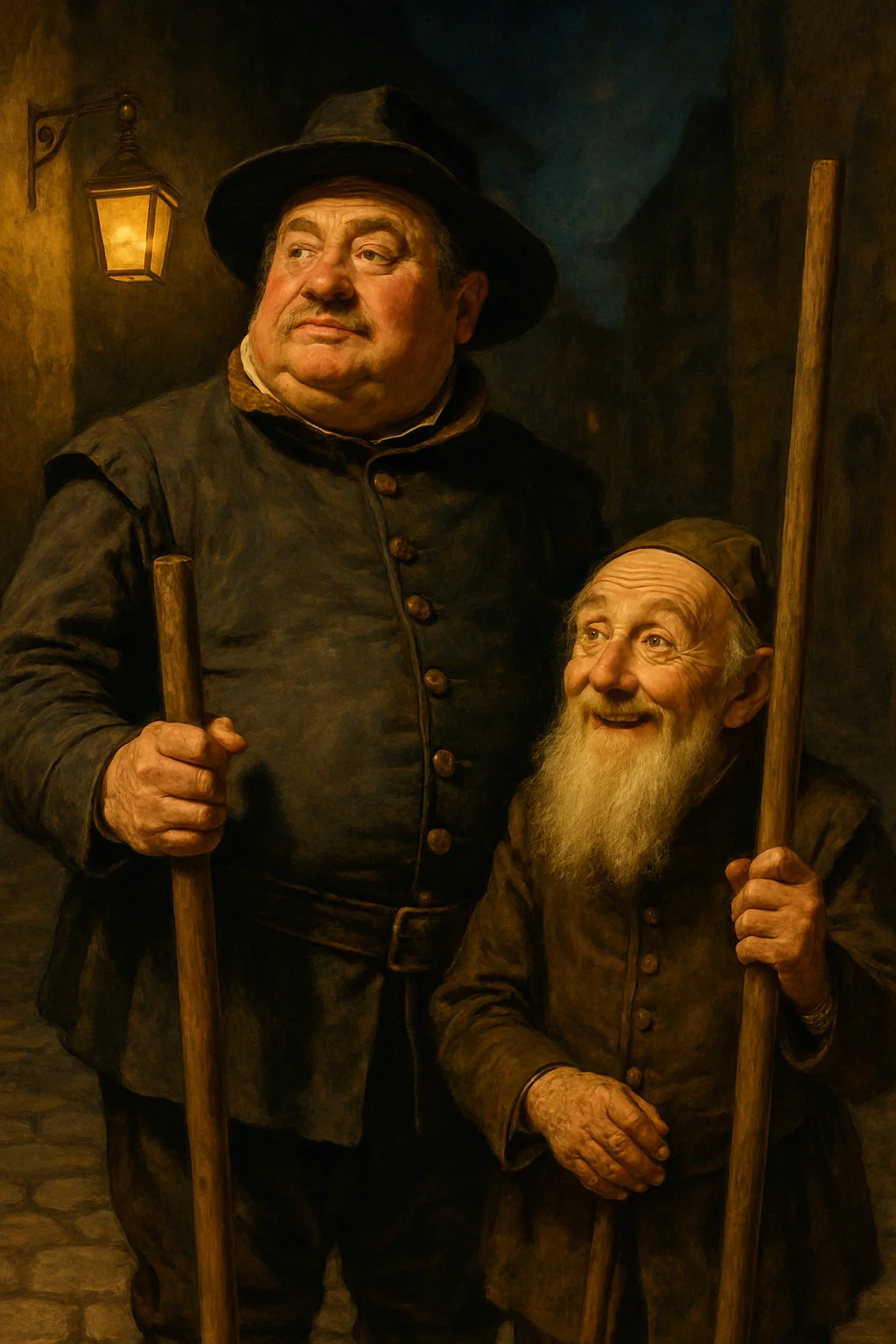
Dogberry & Verges
Dogberry and Verges lead the Watch whose accidental overhearing of Borachio's confession is the mechanism that finally exposes the plot against Hero - their comic incompetence is structurally essential, providing the play's unlikeliest instrument of justice.
Appears In
Who are Dogberry & Verges?
Dogberry, constable of the Watch, and Verges, his elderly deputy, are introduced instructing their men in the duties of night-watching with a solemnity wildly out of proportion to their competence - Dogberry's advice largely amounts to telling the Watch to avoid confronting anyone dangerous, since 'the most peaceable way for you, if you do take a thief, is to let him show himself what he is and steal out of your company.' His malapropisms - 'comparisons are odorous,' calling his men 'the most desartless man to be constable' - are delivered with a magistrate's total self-assurance, the gap between his confidence and his vocabulary being the engine of nearly every laugh he generates.
Verges functions as Dogberry's quieter foil, an old man whose occasional corrections and additions are treated by Dogberry with the same patronizing tolerance Dogberry expects from everyone else, creating a small comic hierarchy of incompetence within incompetence. Together they preside over the Watch that, entirely by accident, overhears Borachio boasting to Conrade about the deception of Claudio and Hero - the play's darkest plot is undone not by any of its clever aristocrats but by the men least equipped, on paper, to catch anyone.
Dogberry's examination of the prisoners in Act IV, Scene 2, is the comic high point of his role - he is so consumed by outrage at being called an ass that he nearly derails the interrogation that will save Hero's life, and it is only through his written account, however garbled, reaching Leonato that the truth finally surfaces. The gap between Dogberry's self-image as a keeper of law and order and his actual bumbling is precisely what allows the audience to trust that comedy, not catastrophe, will have the last word.
Motivation
Dogberry is motivated by an inflated sense of his own authority and importance as constable, eager to be recognized for wisdom and diligence he does not entirely possess; Verges, more modest, is motivated simply by loyal support of his old friend and superior.
Personality
Dogberry's confidence is entirely undimmed by his constant misuse of language, delivering each garbled instruction and malapropism with the gravity of a man certain of his own competence - the comedy depends on this sincerity being total rather than knowing. Verges, gentler and more retiring, provides a quieter comic counterpoint, occasionally correcting Dogberry only to be waved off with the same confidence Dogberry extends to everyone.