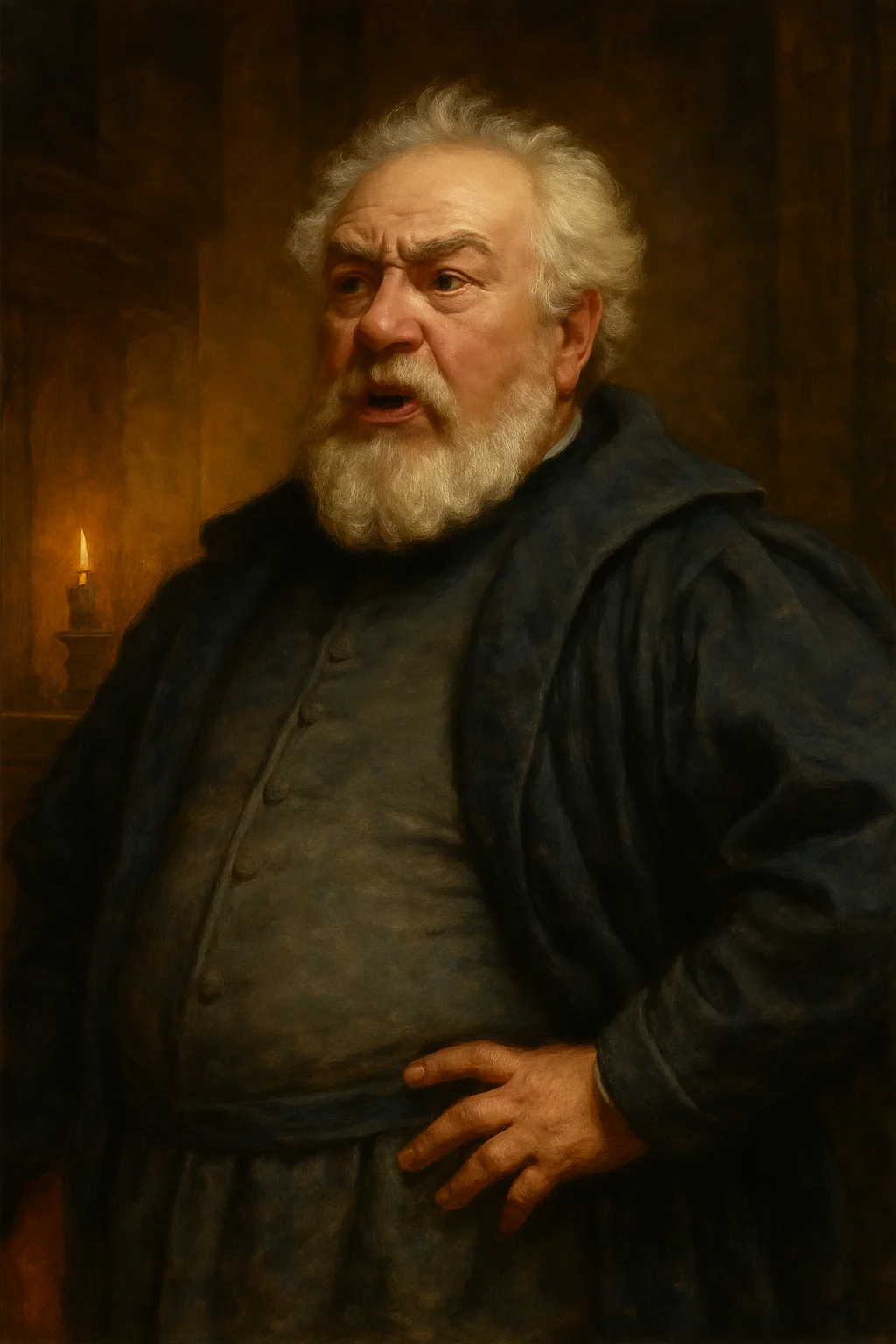
Antonio
Antonio functions as Leonato's loyal foil throughout the play - the source of a well-meant but mistaken report early on, a steady presence through the scandal of Act IV, and, in Act V, an unexpected eruption of fierce, protective anger that briefly outpaces even Leonato's own grief.
Appears In
Who is Antonio?
Antonio is Leonato's older brother, and his first contribution to the play is a piece of bad information delivered with entirely good intentions: on the eve of the masked ball, he tells Leonato that one of his servants overheard Don Pedro planning to woo Hero for himself, rather than for Claudio. The report is wrong in every particular - Don Pedro is wooing on Claudio's behalf, not his own - but Antonio's eagerness to bring it straight to his brother establishes the pattern the rest of his role will follow: a man whose loyalty outruns his certainty, and who acts on family feeling before he has fully verified the facts.
Through the scandal that follows, Antonio remains a steady, mostly silent presence at Leonato's side, the kind of support that does not need to announce itself in the play's darkest scenes to be understood as constant. It is only once Hero has been publicly shamed and the household's grief has curdled into fury that Antonio's quieter loyalty finds its voice, and when it does, it arrives with a force the play has not prepared the audience for.
In Act V, Scene 1, Antonio enters with Leonato to confront Don Pedro and Claudio, and it is Antonio, not his grieving brother, who supplies the scene's sharpest and strangest energy - brushing aside Leonato's attempts to restrain him, calling Claudio 'Boy' with real contempt, and insisting he is old enough and able enough to answer for Hero's honour himself: 'Win me and wear me, let him answer me.' The moment is played for both pathos and a faint, undeniable comedy - an old man working himself into a fighting rage his body may not entirely support - and it is precisely that mixture that makes Antonio, for one scene, the play's most unexpectedly moving figure. He appears once more at the final wedding, presenting the masked Hero to Claudio, his earlier fury folded quietly back into the family's restored happiness.
Motivation
Antonio is motivated entirely by loyalty to his family - to his brother Leonato and his niece Hero - a loyalty strong enough to make him relay unverified gossip in Act I and, once that same family is wronged, strong enough to send an old man to demand a duel he can barely still fight.
Personality
Antonio's defining quality is a family loyalty so complete it overrides his own good judgment and, in Act V, his own physical limits - he carries an unverified rumour to Leonato without pausing to question it, and later works himself into a genuine rage on Hero's behalf despite Leonato's attempts to calm him. The gap between his fierce intent and his aged body is the source of both the scene's pathos and its faint comedy.