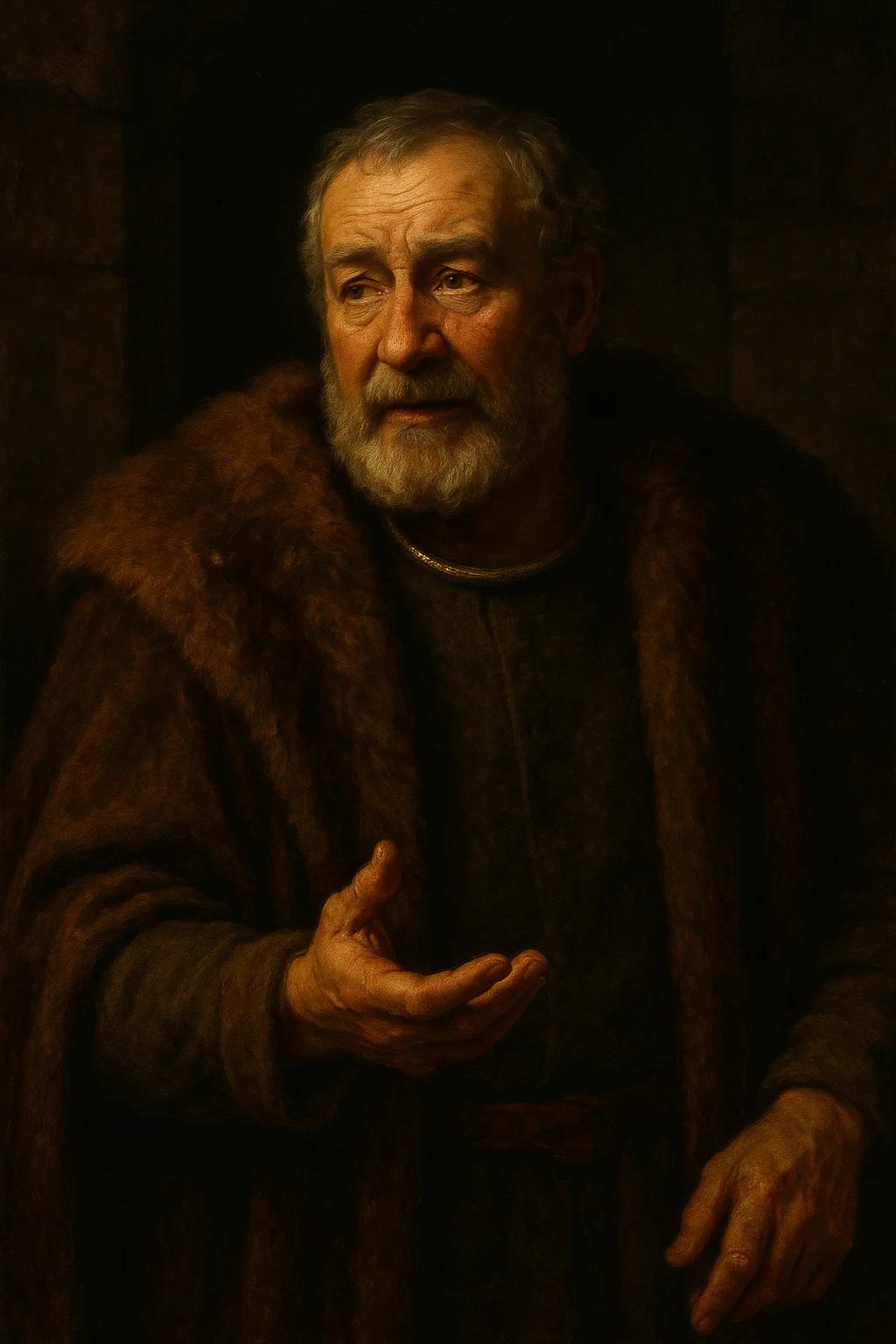
Gloucester
Gloucester's story runs as the play's deliberate second tragedy, parallel to Lear's - a father who mistakes a false son's performance for loyalty and a true son's honesty for treachery, and who pays for that misjudgment with his eyes, guided at the last by the very child he wronged.
Appears In
Who is Gloucester?
Gloucester's tragedy runs on a track that shadows Lear's throughout the play, and it begins with the same fundamental error: mistaking a child's performance for a child's truth. He is easily persuaded by Edmund's forged letter that his legitimate son Edgar plots against his life, and abandons Edgar to outlawry with barely a moment's hesitation, an error of judgment made all the more painful by the casual cruelty of his opening remarks about Edmund's illegitimate birth - jokes he makes in Edmund's presence without apparently considering what such jokes might cost a son who has spent his life absorbing them.
His decision to help the fugitive Lear, sheltering him and arranging his passage toward Dover despite Regan and Cornwall's explicit orders, is his one unambiguous act of moral courage in the play - and it is precisely this act of loyalty that Edmund uses to destroy him, betraying his father's secret to Cornwall in exchange for the earldom. Gloucester is bound to a chair and blinded onstage in one of the most harrowing scenes Shakespeare ever wrote, Cornwall gouging out one eye and then, at Regan's urging, the other, while a servant's horrified intervention costs Cornwall his own life in protest.
Blind and cast out to 'smell his way to Dover,' Gloucester is guided, unknowingly, by the very son he wronged - Edgar, disguised as the mad beggar Poor Tom, leads his father to what Gloucester believes is a cliff's edge so he may end his despair, and stages a fall that convinces Gloucester he has miraculously survived a leap the gods themselves must have intervened to soften. It is a strange, theatrical mercy performed by a son for a father who cannot see him, and when Edgar finally reveals his true identity near the play's end, the shock of joy and grief together is more than Gloucester's heart, in its worn and blinded state, can bear.
Motivation
Gloucester is motivated early on by an old soldier's credulous trust in whichever son seems to speak to him most directly, and later, once blinded and ruined, by a despair so total he seeks only an end to it - a despair Edgar's staged mercy gently redirects toward endurance instead.
Personality
Gloucester's early credulity - his readiness to believe Edmund's forged evidence against Edgar without demanding to see Edgar's own account - mirrors Lear's misjudgment of his daughters almost exactly, a man who reads children by their performance rather than their character. His blinding strips this credulity away by the cruellest possible means, and what remains afterward is a hard-won capacity for endurance: 'a man may rot even here,' Edgar tells him, and Gloucester, robbed of his eyes, learns to keep walking anyway.