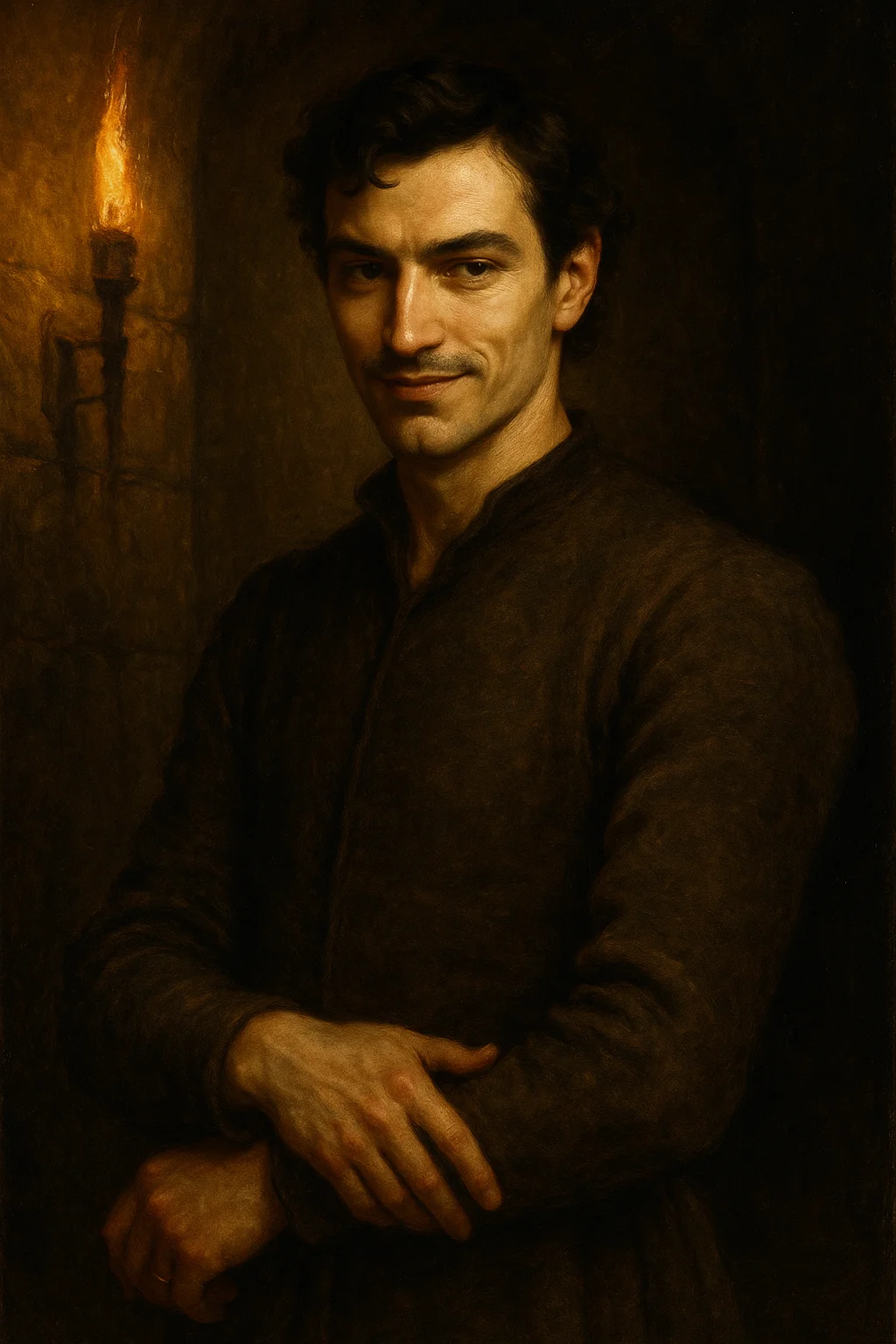
Edmund
Edmund is the play's most articulate and effective agent of chaos - his grievance against the accident of his birth is rendered with enough clarity to be almost persuasive, and his willingness to act on it without restraint drives nearly every catastrophe in the play's second half, from Gloucester's blinding to Cordelia's death.
Appears In
Who is Edmund?
Edmund opens his part of the play with a soliloquy of startling candour, addressing 'Nature' as his goddess and rejecting outright the 'plague of custom' that brands him bastard and denies him the inheritance his elder, legitimate brother receives simply by the good fortune of timing and a marriage bed. It is the clearest statement of grievance and ambition in the play, and it is impossible not to feel its force even while watching what Edmund is prepared to do about it: forge a letter in Edgar's hand suggesting a plot against their father's life, and deliver it to Gloucester with exactly the right note of reluctant, loyal concern.
Edmund's rise is a study in opportunism executed almost without friction. He exploits Gloucester's credulity to drive Edgar into outlawry, then betrays Gloucester's secret aid to Lear directly to Cornwall in exchange for the earldom his father's disgrace vacates, watching his own father blinded as the price of his advancement without visible hesitation. He extends the same cold calculation to his romantic entanglements, encouraging both Goneril and Regan's desire for him simultaneously, weighing which sister's favour is more useful to him with the same detachment he brought to forging the letter that started everything.
His final order - that Lear and Cordelia be executed in prison before the war's outcome can be reversed - is his single act of pure, unmitigated cruelty, and it very nearly succeeds. Wounded in trial by combat by the disguised Edgar, and hearing, dying, of Gloucester's death and of Goneril's and Regan's mutual destruction over him, Edmund experiences something the play has not shown him capable of until this moment: a wish to do good, despite his nature, and a countermanding order sent too late to save Cordelia. 'Some good I mean to do,' he says, and it changes nothing. The play does not grant him redemption, only the capacity, at the very end, to want it.
Motivation
Edmund is motivated by a resentment, entirely reasonable on its own terms, at a social order that denies him legitimacy and inheritance for no fault of his own - a resentment he converts, without much internal struggle, into a willingness to use anyone and betray anyone to claim by cunning what custom will not grant him by right.
Personality
Edmund's intelligence is the play's sharpest, and his opening soliloquy makes his resentment legible enough that his subsequent cruelty never feels like simple villainy - it feels like grievance given full, unrestrained expression. He moves through the play's second half with an ease that borders on charm, managing his father's trust, his brother's ruin, and two sisters' competing desire all at once, and it is only in the last minutes of his life, wounded and dying, that something in him turns toward regret - too late to undo anything, but not, the play insists, entirely feigned.