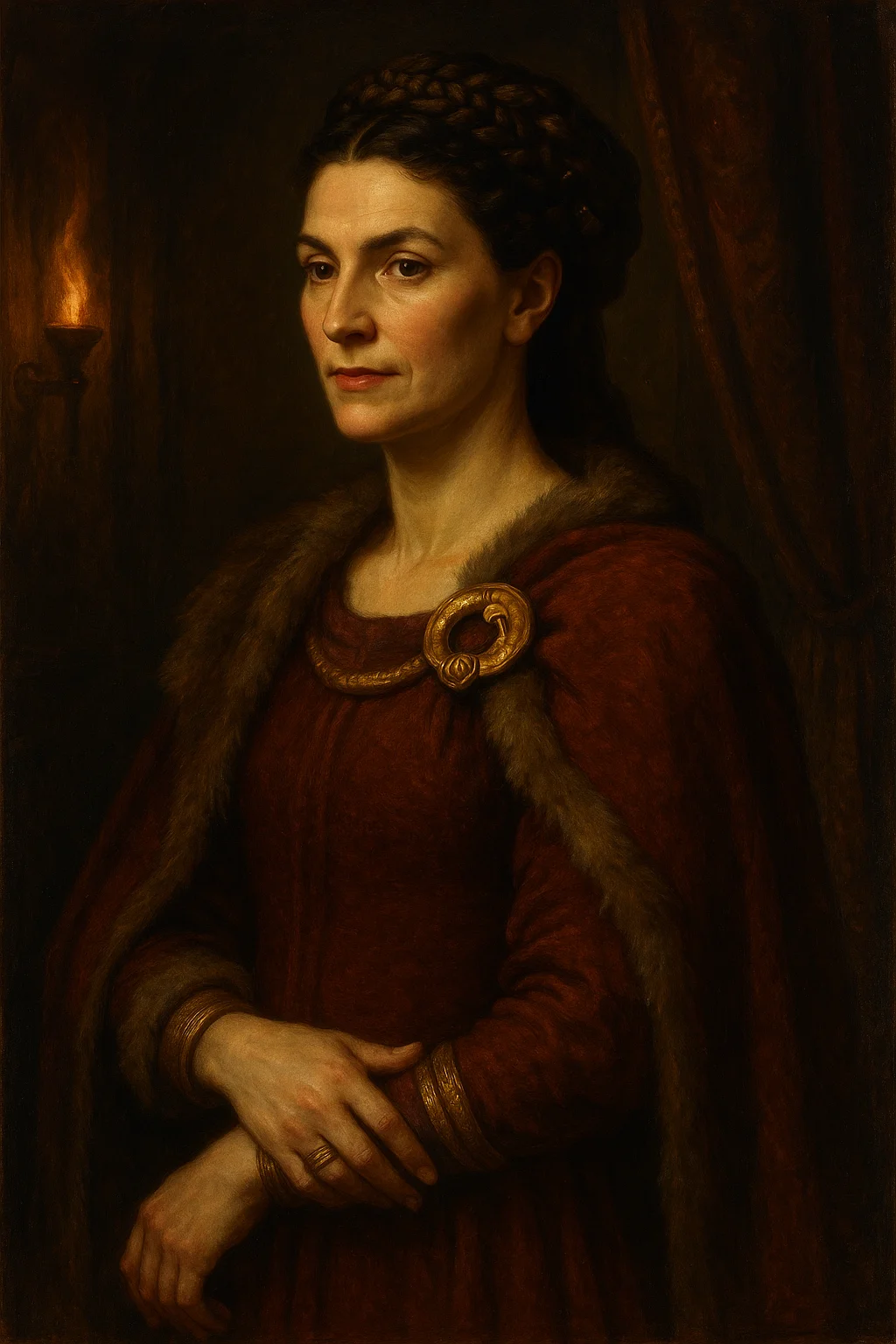
Goneril
Goneril is the play's first and most calculating engine of cruelty - the daughter whose performed love in Act I curdles almost immediately into a systematic dismantling of her father's dignity, and whose rivalry with Regan over Edmund provides the second half of the play with its most purely destructive energy.
Appears In
Who is Goneril?
Goneril opens the play with a speech of love so extravagant - she loves her father dearer than eyesight, space, or liberty - that its very excess should warn everyone in the hall it is currency rather than feeling. Having won her third of the kingdom on these terms, she wastes no time converting her new power into a campaign against the one condition Lear attached to his abdication: his hundred knights, his retinue, the last visible proof that he is still, in some diminished way, a king. Her complaint that his followers are riotous is plausible enough to sound reasonable and calculated enough to be believed as pretext - the play never lets us be entirely sure which.
Her marriage to the mild, hesitating Albany chafes against her from the start; she regards his scruples as a kind of cowardice and finds in Edmund, Gloucester's ambitious bastard son, an appetite that matches her own. The affair that develops between them is less romantic passion than a meeting of two people equally impatient with every obstacle - law, marriage, blood - that stands between them and what they want. She writes to Edmund urging him toward her husband's death with the same cold clarity she once used to calculate her father's love.
Her downfall arrives through the one force she cannot outmaneuver: her sister's matching appetite for the same man. Discovering that Regan, newly widowed, is also pursuing Edmund, Goneril poisons her at the first opportunity and, when her letter plotting against Albany is exposed, kills herself off-stage rather than face the consequence of everything she has done. She dies as she lived, taking control of the one thing - her own end - that no one else could yet claim from her.
Motivation
Goneril is driven by an appetite for total control - over her inheritance, her marriage, and eventually her lover - that treats every claim of loyalty, whether to a father or a husband, as an obstacle to be managed rather than an obligation to be honoured.
Personality
Goneril's intelligence is entirely instrumental - she reads situations for leverage rather than truth, and her early flattery of Lear establishes a pattern she never breaks: say whatever secures the advantage. Her contempt for Albany's hesitations and her rivalry with Regan reveal a woman who experiences other people's scruples, including her own husband's, as personal insults to her will. She meets her downfall not with remorse but with the same cold self-possession she has shown throughout, ending her own life on her own terms rather than someone else's.