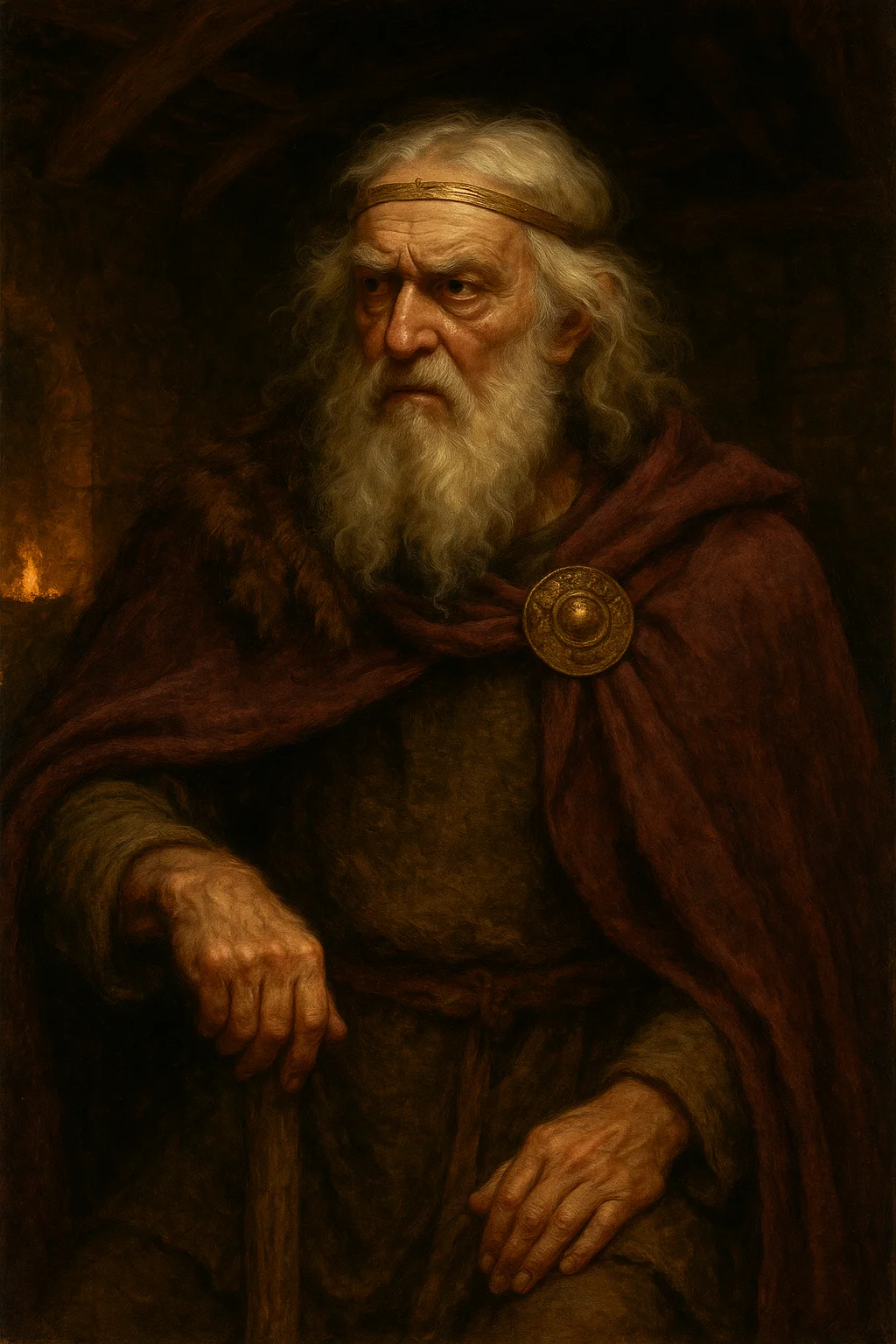
Lear
Lear is the storm at the center of his own play - a king whose demand to be loved in a quantifiable, public, immediate way sets in motion the ruin of everyone who touches him. His arc from absolute authority to a bare, forked animal on a heath and back to a broken father is the play's central structure, and the pagan world around him, its gods silent throughout, offers him no answer beyond what he can salvage from his own too-late understanding.
Appears In
Who is Lear?
Lear enters the play at the summit of his power and already, unknowingly, past the point at which he can safely wield it. He intends to divide his kingdom among his three daughters according to a public contest of love, a ceremony that should have been a formality - an old king rewarding devotion he already knows - and instead becomes the instrument of his own ruin. Cordelia's refusal to trade in the coin he demands, her flat 'Nothing, my lord,' is not defiance so much as an inability to perform what she genuinely feels, and Lear, who has spent a lifetime as the sun this small Britain orbits, cannot process a love that will not flatter the light back at him. He banishes her and Kent both in the same hour, disposing of the only two people in the hall who love him without calculation.
What follows is less a fall than a stripping. Goneril and Regan, having got what they wanted, set about removing what remains of his authority in installments - first his hundred knights, then his name, then his shelter on a night of storm so total it seems the old gods of thunder and sky have joined the daughters in the work of unmaking him. On the heath, mad and half-naked, accompanied only by a Fool, a disguised earl, and a beggar who is not what he seems, Lear discovers a fellow-feeling for 'poor naked wretches' he never once considered from the throne. It is the cruelest possible curriculum: he learns what a king owes his kingdom only after the kingdom has been taken from him.
The reconciliation with Cordelia in Act IV - Lear waking from madness into her forgiveness, kneeling to a daughter he wronged past any ordinary reckoning - is the play's single unclouded mercy, and Shakespeare revokes it within the hour. Lear carries her hanged body onto the stage in the final scene, asking the assembled court to look at her lips, certain past reason that she still breathes, and dies of the grief itself rather than any wound. There is no lesson extracted for him to carry forward, no moral clarity purchased with all that suffering - only an old man, undone, holding what is left of the one daughter who never lied to him.
Motivation
In the beginning, Lear is driven by the wish to lay down the burden of rule while keeping its pleasures - the retinue, the title, the deference - a wish that is not entirely foolish so much as entirely unexamined. After the storm, what remains of his motivation is simpler and more desperate: to be forgiven by the one daughter he wronged beyond any reasonable hope of forgiveness, and, having received it, to keep her.
Personality
Lear begins as a man so accustomed to absolute deference that he has lost the ability to distinguish it from love - a king whose rage, when Cordelia will not perform for him, is the rage of someone encountering an unfamiliar sensation rather than a familiar insult. The storm and the madness that follows strip this away by force rather than reflection: what emerges on the heath is not wisdom exactly, but a terrible new capacity for fellow-feeling, arriving decades too late to save the people it might have helped. By the end he is reduced to something almost childlike in its rawness - a man whose love for Cordelia is no longer complicated by anything at all, which is precisely what makes her death unbearable to him.