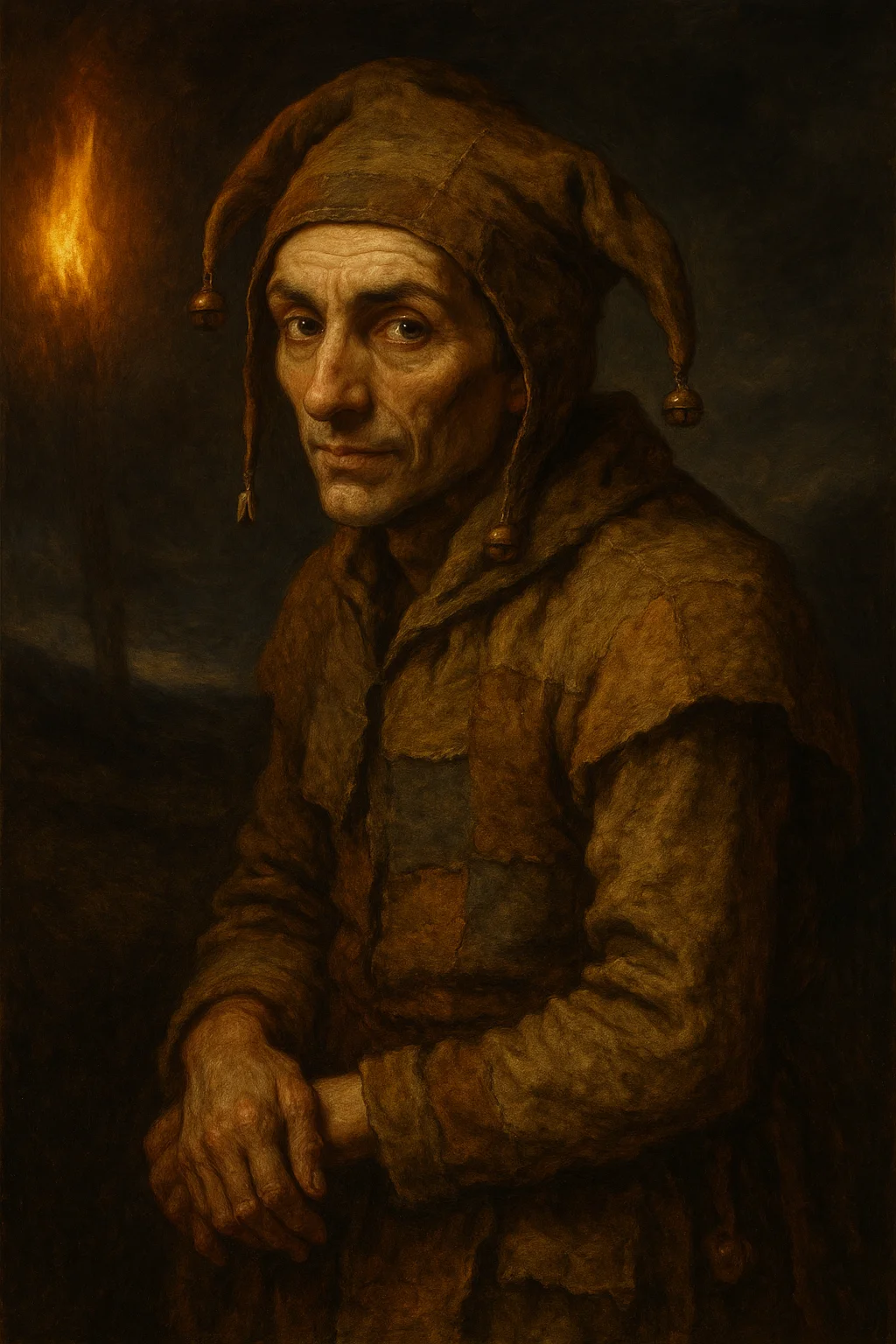
Fool
The Fool functions as Lear's licensed truth-teller - the single voice in the play permitted to tell the king plainly what his abdication has cost him, mockery serving as the vehicle for a devotion too clear-eyed to be spoken any other way. His disappearance partway through the storm, unexplained, is one of the play's most haunting loose threads.
Appears In
Who is Fool?
The Fool enters the play only after Cordelia and Kent have already been banished, as if licensed folly is the last register left in which anyone can safely tell Lear the truth. And tell him the truth is exactly what the Fool does, relentlessly, in riddle and song and pointed jest - reminding Lear, again and again, that he has given away his crown and kept none of the sense that should have gone with keeping it, that he has made his daughters his mothers, that the old fool is now less than the young fool who serves him. No one else in the play is permitted this directness; the Fool's madcap license is the only shield thick enough to let it through.
As the storm gathers and Lear's grip on reason begins to slip, the Fool's jokes darken and thin without ever quite disappearing - he stays at Lear's side on the heath, cold and frightened, still finding scraps of rhyme and mockery even as the king he serves drifts further from anything the jokes can reach. His loyalty is inseparable from his function: he mocks because he loves, and he stays because leaving would mean abandoning the one man who has always, however badly, needed exactly what the Fool has to offer.
He vanishes from the play without ceremony after the storm scenes, his last line a small, strange non sequitur - 'And I'll go to bed at noon' - and is never accounted for again except in one deeply ambiguous line from the dying Lear, cradling Cordelia's body: 'my poor fool is hanged.' Whether this refers to the Fool himself, to Cordelia, or collapses the two figures together in Lear's shattered mind, Shakespeare never says. The character exits the play as quietly and unexplainably as he entered it, leaving behind only the truths he was the only one allowed to speak.
Motivation
The Fool is motivated by a loyalty to Lear indistinguishable from his professional role - his jokes are barbed precisely because he cares what happens to the man he is mocking, and he stays through the storm not from duty alone but from something closer to love expressed in the only language his position allows him.
Personality
The Fool's wit is never merely comic - every joke lands as an accusation wrapped in enough absurdity that Lear can hear it without immediately raging against it, at least at first. Beneath the wordplay is a perceptiveness sharper than anyone else's at court: the Fool sees exactly what Lear has done to himself and says so, repeatedly, at real personal risk, and stays present through cold and storm with a fidelity that asks for nothing and vanishes, in the end, without any acknowledgment at all.