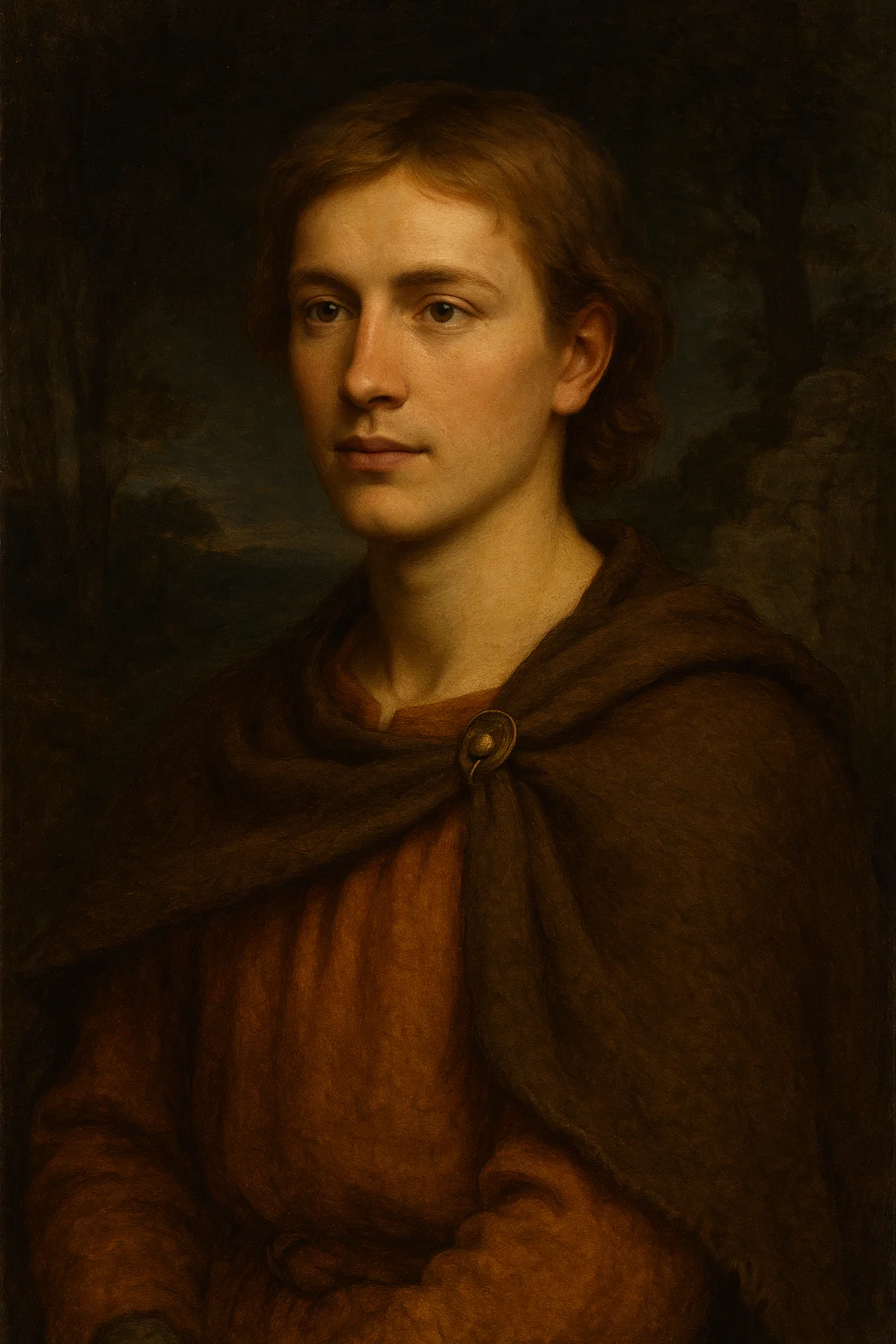
Edgar
Edgar's journey from trusting son to hunted outlaw to unrecognised guide and finally to his father's avenger is the play's clearest arc of transformation through suffering - his disguise as Poor Tom puts him at the exact center of Lear's descent into madness, and his eventual unmasking restores what little order the play allows.
Appears In
Who is Edgar?
Edgar begins the play as Gloucester's trusting legitimate son, entirely unprepared for the forged letter and whispered suspicion his half-brother Edmund uses to turn their father against him. He does not defend himself so much as vanish, fleeing into outlawry and adopting the disguise of Poor Tom, a Bedlam beggar - filthy, half-naked, speaking in a mad babble of devils and torment - a transformation so complete that it becomes, in effect, a kind of death and rebirth. As Poor Tom he encounters Lear on the heath and becomes, unexpectedly, a mirror for the king's own unraveling, 'unaccommodated man' reduced to 'a poor, bare, forked animal,' the precise image Lear needs and cannot look away from.
The disguise takes on a second and stranger purpose when Edgar discovers his own father, blinded and cast out, and guides him toward Dover without ever revealing who he is. His staged 'miracle' at the cliffs of Dover - allowing Gloucester to believe he has leapt to his death and survived by divine mercy - is one of the most peculiar acts of tenderness in the play, a lie told to save a father from despair, delivered by a son that father still does not recognise.
Edgar sheds his disguises only when the play's violence demands it: he kills Oswald in a chance roadside encounter to protect his father, and finally reveals himself to challenge Edmund to trial by combat, defeating and mortally wounding the brother who destroyed his family. His account of their father's death - of joy and grief together bursting the old man's heart - is delivered to the dying Edmund with a directness that costs Edgar nothing to give and Edmund everything to hear. He survives to the play's final lines, one of the few characters left standing, charged with the bleak duty of speaking what remains to be said.
Motivation
Edgar is motivated first by simple survival once his father turns against him, and increasingly, once he discovers Gloucester blinded and destitute, by a devotion to protecting his father that he cannot express directly and instead channels through disguise, guidance, and a merciful deception.
Personality
Edgar's core quality is an adaptability that never curdles into cynicism - he survives disguise, exile, and his father's unwitting cruelty by finding, in each new circumstance, a way to keep protecting the people he loves without breaking his own composure. His performance as Poor Tom is total enough to become genuinely instructive to Lear, and his patient, extended deception of his blind father is not cruelty but its opposite: a mercy so careful it must be sustained scene after scene before it can finally be safely set down.