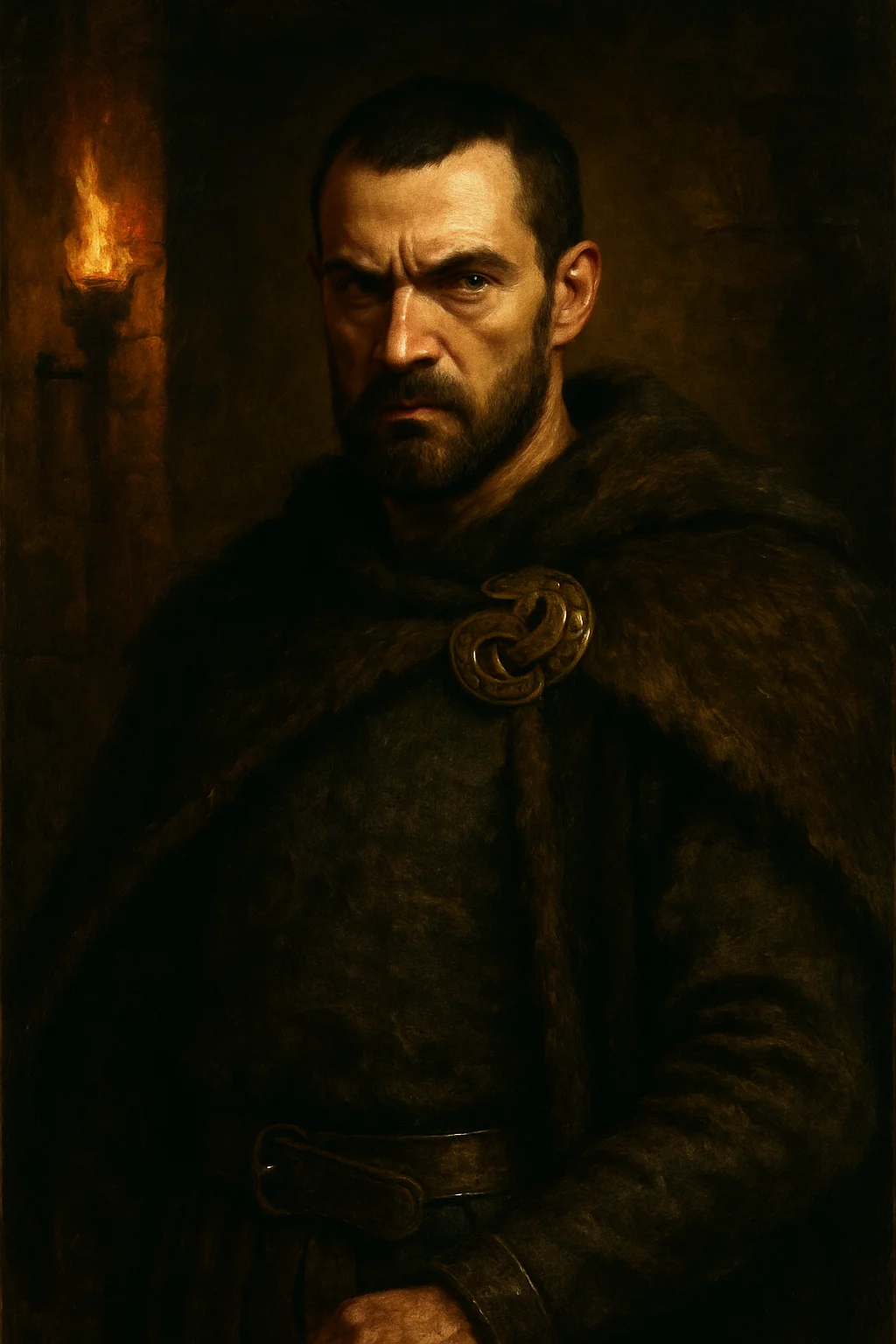
Cornwall
Cornwall functions as the play's most direct agent of physical cruelty - his blinding of Gloucester, encouraged rather than restrained by Regan, is the play's starkest depiction of violence, and his death at a nameless servant's hands is one of the only moments of spontaneous moral resistance the play allows.
Appears In
Who is Cornwall?
Cornwall enters the play as Regan's husband and, from his first scenes, a man notably quicker to violence than Albany - impatient with Kent's blunt disrespect toward Oswald, and entirely willing to have a nobleman set in the stocks over what amounts to a personal insult, an act so far outside the ordinary bounds of hospitality and rank that even Gloucester objects, weakly, without effect.
His alliance with Edmund is transactional and immediate: informed of Gloucester's secret aid to the fugitive Lear, Cornwall wastes no time rewarding the betrayal with Gloucester's own title, and no more time deciding what to do about Gloucester himself. The blinding that follows is Cornwall's personal act, carried out with his own hands, egged on by Regan rather than restrained by her - 'out, vile jelly' as he plucks the second eye, a line whose flat cruelty has made the scene one of the most disturbing in the entire Shakespearean canon.
His violence finds its own limit in the same scene: a servant, unable to watch any further, draws his sword against his master in protest and wounds Cornwall fatally, dying himself in the attempt. It is one of the play's few moments of unplanned, unpolitical resistance - an anonymous man's refusal to stand by - and it costs Cornwall his life within minutes of his cruelest act, before he can enjoy any of the power he has just seized.
Motivation
Cornwall is motivated by a straightforward hunger for power and control, exercised with a violence that requires no elaborate justification - he moves against Kent, against Gloucester, and finally against Gloucester's remaining eye with the same untroubled decisiveness.
Personality
Cornwall's cruelty is distinguished from Edmund's by its lack of any calculating patience - where Edmund plans, Cornwall simply acts, ordering Kent to the stocks and gouging out Gloucester's eyes with the same undelayed decisiveness. His marriage to Regan seems to amplify rather than restrain this instinct; whatever violence he is inclined toward, she is there to encourage further.