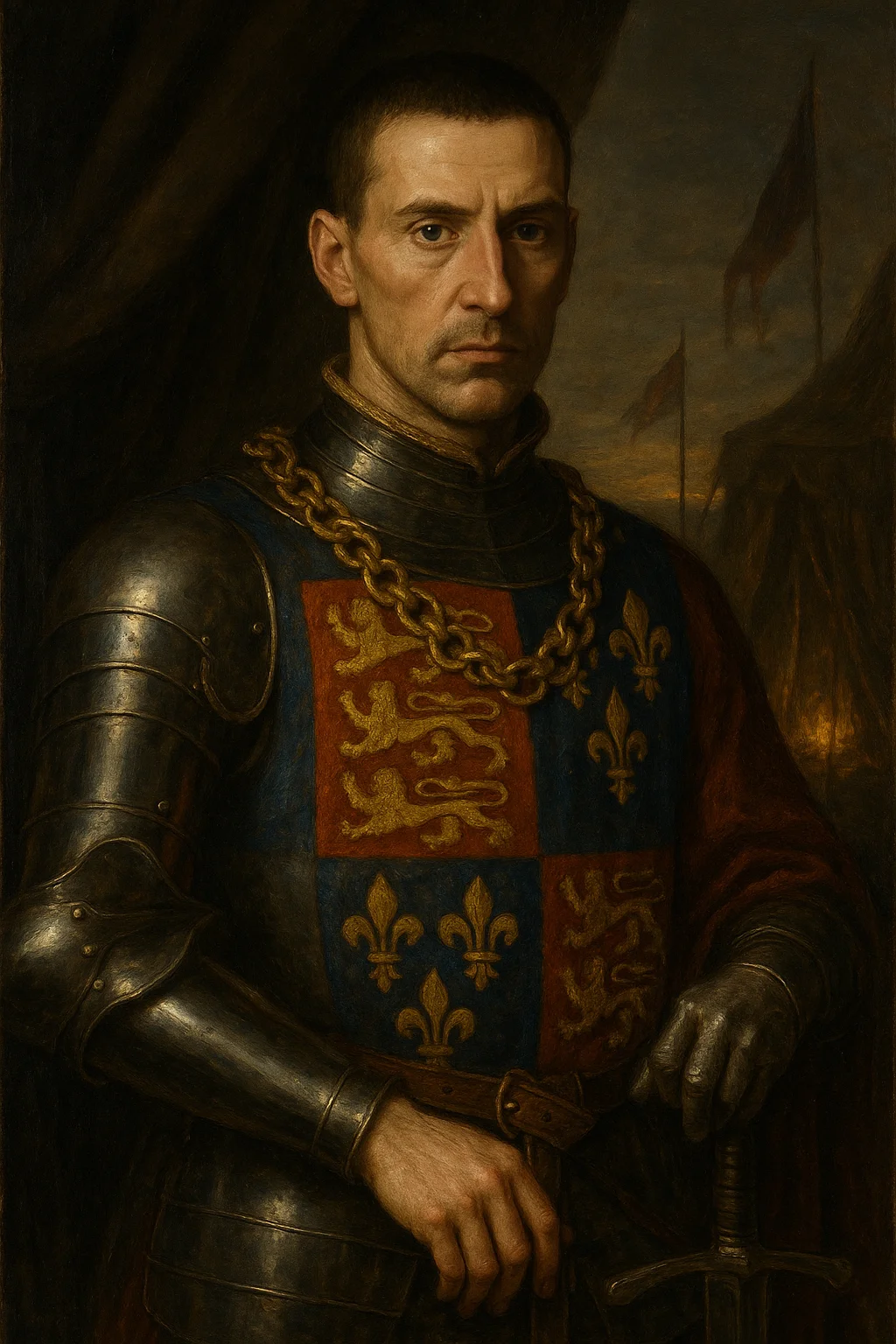
King Henry V
Henry is the play's title figure and its central argument made flesh - a king whose inspiring rhetoric and cold political pragmatism are shown side by side without the play ever quite resolving whether he is the ideal Christian king the Chorus insists he is, or a masterful performer of that role.
Appears In
Who is King Henry V?
Henry enters his own play already transformed from the wayward prince of the Eastcheap taverns - the Archbishop of Canterbury marvels at the change, 'never was such a sudden scholar made,' as if the riotous Prince Hal had been a chrysalis for the king now sitting in judgment on a Salic law dispute with the patience of a trained theologian. The Dauphin's mocking gift of tennis balls, a joke about the dissolute prince he once was, is the spark Henry needs: he answers with a promise that many a widow's husband will 'rouse him at' the memory of this jest, and the invasion of France begins.
The Henry who crosses the Channel is ruthless in a way the history plays have been building toward across two earlier instalments. He orders the execution of three noblemen who conspired against his life without a flicker of mercy, and later hangs his own former tavern companion Bardolph for looting a French church, a discipline that costs him nothing visibly but is meant to cost the audience something, watching an old friend of Falstaff's circle die for the new king's order. At Harfleur he threatens the town's governor with the rape and slaughter of its citizens in language of calculated horror, and the town surrenders before he need make good on a single threat.
It is at Agincourt, disguised and walking anonymously among his own soldiers the night before the battle, that Henry is made to answer for the burden he carries - a common soldier, Williams, argues that the king bears the guilt for every soul lost in an unjust cause, and Henry's long, troubled soliloquy on the loneliness of kingship that follows is the play's most searching moment. By morning he has converted that anxiety into the St Crispin's Day speech, transforming a heavily outnumbered army into 'we few, we happy few, we band of brothers' and winning a battle that should not have been winnable. His final scene, wooing the French princess Katharine in blunt, unpolished English despite the crown now nearly his, closes the play on something almost tender - though even this courtship is, in the end, a term of the peace treaty as much as a romance.
Motivation
Henry is driven by the need to prove, to his nobles, to France, and perhaps most of all to himself, that the crown has fully absorbed the wild prince who once wore it lightly - every act of severity and every act of inspiring leadership serves the same underlying project of legitimizing a kingship that began under a cloud of doubt.
Personality
Henry's genius is rhetorical - he can make an army of exhausted, outnumbered men believe themselves fortunate to be where they are, and make a besieged town surrender without a blow struck, using words alone. Beneath the eloquence is a steel that shows itself plainly when old loyalties are at stake: he mourns Bardolph's execution in principle while ordering it anyway, and the night-time soliloquy on 'ceremony' reveals a man who understands exactly what his crown costs him and pays it without flinching.