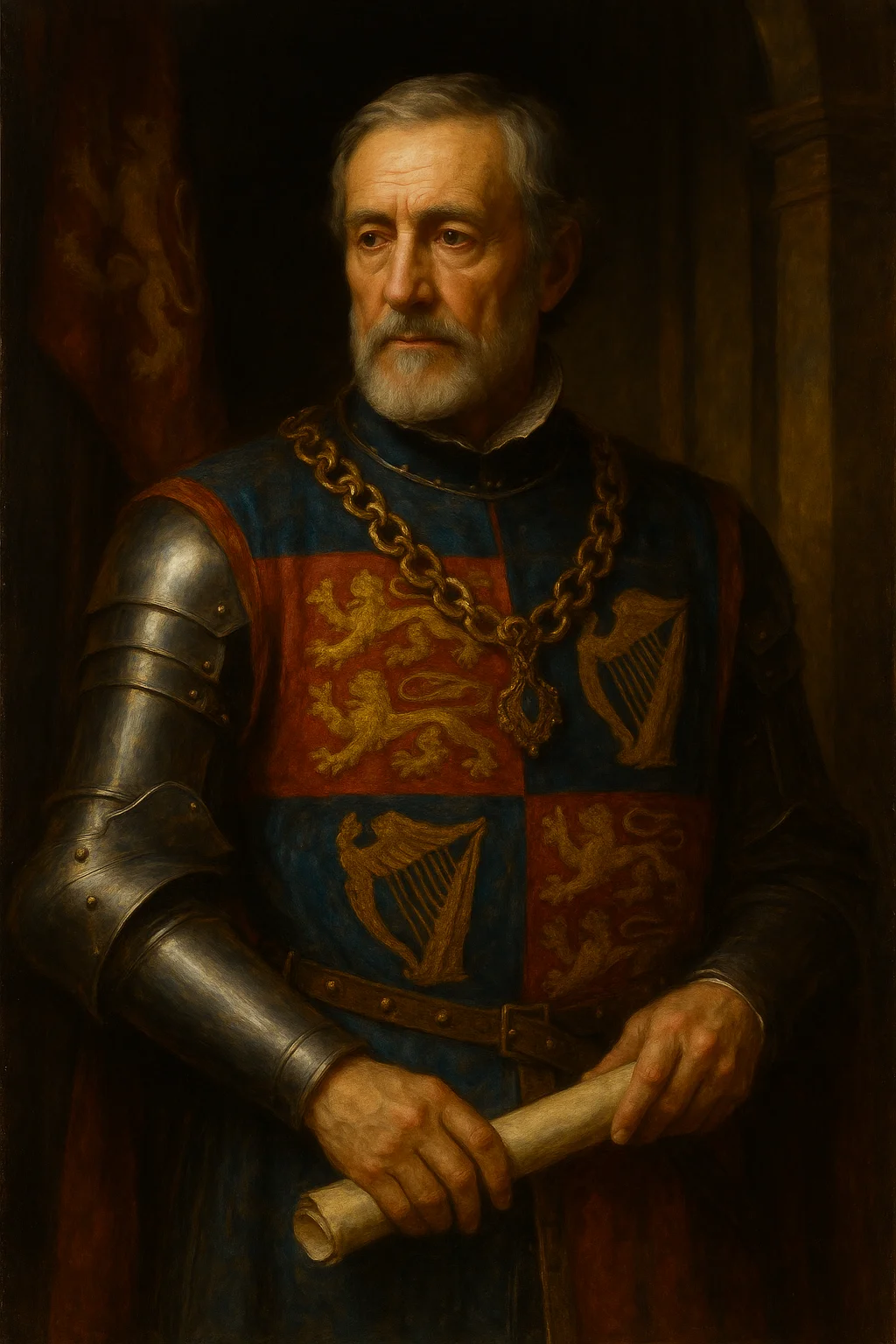
Exeter
Exeter functions as Henry's most senior and trusted lieutenant - the diplomat sent to deliver the war's opening ultimatum and the witness whose account of two noblemen's deaths at Agincourt gives the battle's aftermath its most genuinely felt moment of grief.
Appears In
Who is Exeter?
Exeter is Henry's uncle and the most consistently trusted figure in his inner circle, given the tasks that require both authority and tact: he is dispatched to the French court to deliver Henry's demand for the crown of France in terms formal enough to satisfy protocol and blunt enough to leave no doubt of the consequences of refusal. His bearing throughout is that of an elder statesman entirely comfortable wielding the threat of war as a diplomatic instrument, precise and unflustered even in a foreign court that has every reason to resent his message.
At Southampton, Exeter stands with Henry as the conspiracy of Cambridge, Scroop, and Grey is exposed, part of the inner council whose loyalty makes the plot's failure possible, and his presence through the Harfleur siege and the march to Agincourt establishes him as Henry's most senior and dependable military lieutenant, entrusted with tasks too important to risk on lesser men.
His most memorable moment arrives in the aftermath of Agincourt, when he reports to Henry the deaths of the Duke of York and the Earl of Suffolk in terms of genuine, moving tenderness - the two men dying in each other's arms on the field, York kissing the gashes on Suffolk's face and commending his soul to God. It is one of the few moments in the play where the human cost of the battle is allowed to register fully, delivered by the one character senior and trusted enough to make the grief land without undercutting the martial triumph surrounding it.
Motivation
Exeter is motivated by unwavering loyalty to the crown and to his nephew personally, a loyalty expressed through the precise, reliable execution of whatever task - diplomatic or martial - the king requires of him.
Personality
Exeter carries himself with the settled authority of a man who has served the crown across more than one reign, delivering even the harshest ultimatums with a formal composure that never tips into cruelty for its own sake. His report of York and Suffolk's deaths reveals a capacity for genuine feeling beneath the diplomatic polish - a soldier who has seen enough of war to be moved by it even while serving it faithfully.