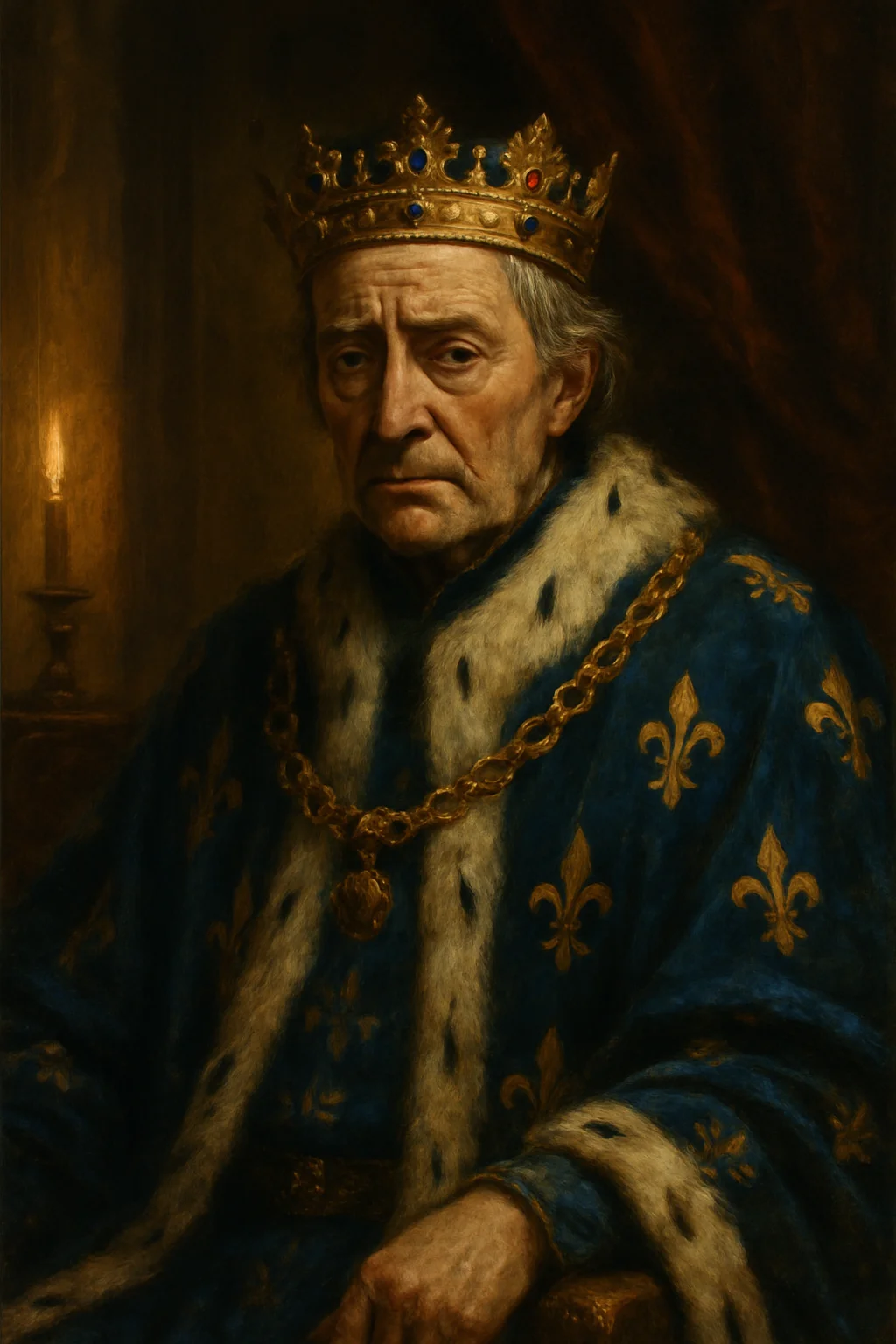
French King
The French King provides the play's clearest note of legitimate anxiety within the French court - a monarch who takes the English threat seriously from the outset, in contrast to his son's dismissive bravado, and who ultimately presides over the peace that formalizes France's total defeat.
Appears In
Who is French King?
Charles VI of France appears as a monarch notably more clear-eyed about the English threat than his son the Dauphin, receiving Exeter's ultimatum with an anxiety that reads as prudence rather than weakness - he has, unlike the Dauphin, taken the trouble to actually assess what an army led by this transformed young king might accomplish. His court's deliberations reveal a France aware, even before Harfleur falls, that the coming war may not go the way its aristocracy assumes.
As the English advance continues, the French King's alarm deepens, and his attempts to manage his son's overconfidence and rally an adequate defense reveal a ruler caught between the reality he perceives and a nobility still operating on assumptions Agincourt is about to demolish entirely. He is largely absent from the battle itself, the military catastrophe falling instead on the Constable, the Dauphin, and the French nobility more broadly.
By Act V, defeated and negotiating from a position of total weakness, the French King presides over the peace conference that cedes his daughter Katharine's hand to Henry and effectively signs away his throne's independent future, doing so with the resigned formality of a monarch who understood, from the very first ultimatum, roughly how this was going to end.
Motivation
The French King is motivated by a sober, largely accurate assessment of the danger Henry poses and a wish to protect his kingdom, undercut throughout by a court and a son more invested in aristocratic pride than in the clear-eyed defense he seems to recognize is needed.
Personality
The French King's anxiety, unlike his court's general overconfidence, proves to be the accurate reading of the situation - he senses the danger Henry represents well before Agincourt confirms it, and his eventual capitulation at the peace table carries the weariness of a ruler who saw the outcome coming and could not prevent his own nobility from hastening it.