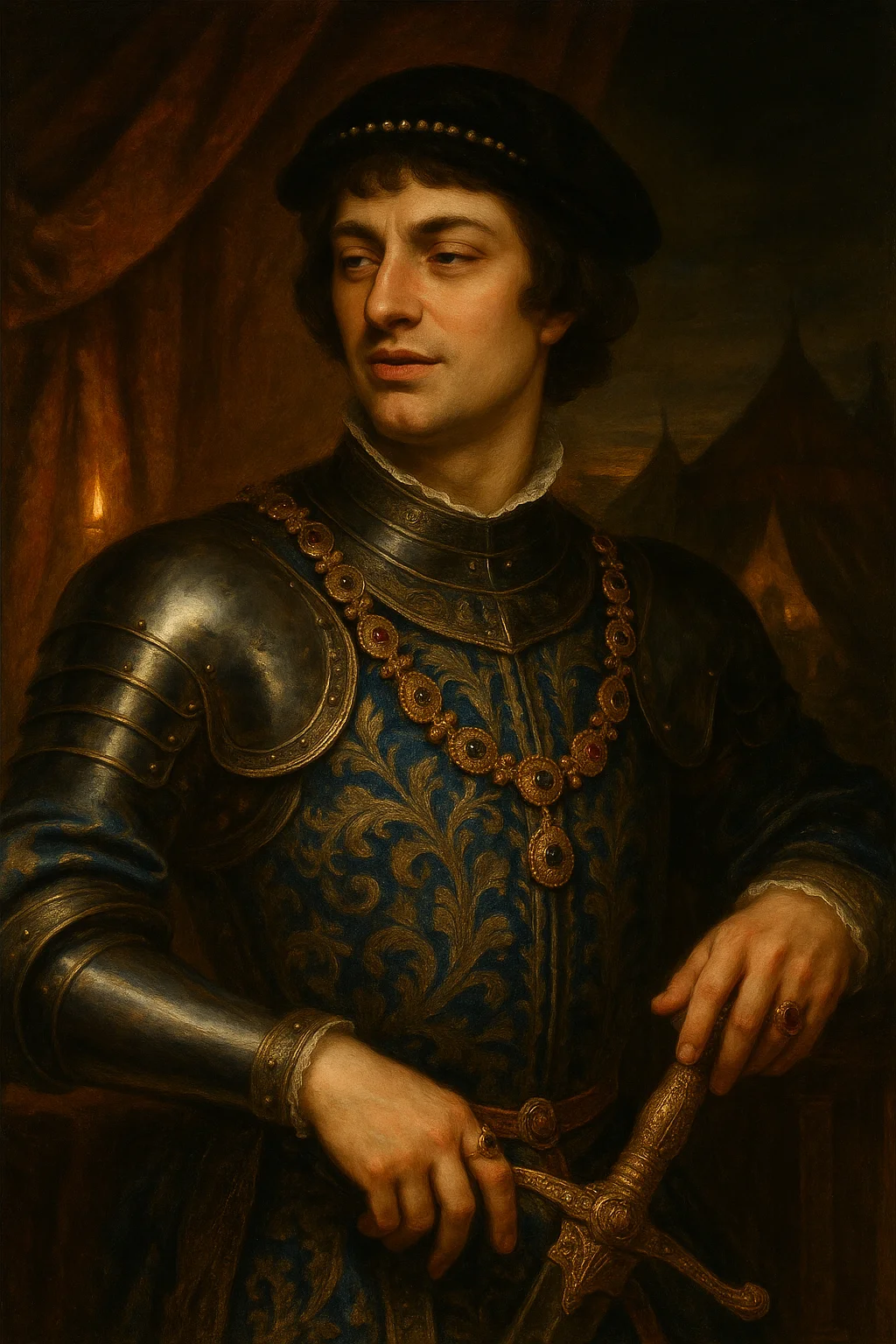
Dauphin
The Dauphin is the play's clearest figure of hollow chivalric pride - his mocking tennis-ball gift provokes the war outright, and his blustering overconfidence in the French camp provides the sharpest possible contrast to Henry's grounded, battle-tested leadership.
Appears In
Who is Dauphin?
The Dauphin's single most consequential act in the play arrives before he ever appears in a scene of his own: his mocking gift of tennis balls to Henry, a gibe at the memory of the wild, dissolute prince Henry once was, is delivered to the English court and answered by Henry with a promise that many a French widow's husband will pay for that jest. It is the direct spark for the invasion, and the Dauphin's contempt for Henry - treating him as an unserious boy unworthy of a serious king's notice - never fully dislodges even as the English army lands and advances.
In the French court and camp, the Dauphin is consistently the voice most eager for battle and least troubled by doubt, urging his father toward confrontation and boasting, in the company of the Constable, of the superiority of his horse and his own martial prowess in terms that read, with hindsight, as almost willfully blind to what is coming. His bravado is performed rather than tested - he talks of the coming fight with the ease of a man who has never seriously imagined losing it.
The play does not follow the Dauphin onto the field at Agincourt itself, leaving his fate to the same silence that swallows the rest of the French nobility in the battle's aftermath. His absence from the peace negotiations of Act V - his father and the ordinary business of the treaty proceeding without him needing to be present - is its own quiet verdict on a figure whose confidence the play spends its middle acts patiently, devastatingly deflating.
Motivation
The Dauphin is motivated by contempt for Henry as an unserious former wastrel and by an inherited assumption of French martial superiority - he wants to see the upstart English king humiliated and expects the coming battle to deliver exactly that outcome.
Personality
The Dauphin's arrogance is defined by a refusal to update his assessment of Henry even as the evidence mounts against it - the mocking gift of tennis balls sets the tone for a character who treats the coming war as an opportunity to humiliate a boy he still remembers rather than a genuine threat from the king that boy has become. His boasting with the Constable about horses and honour on the eve of Agincourt is the play's starkest picture of pride about to meet its reckoning.