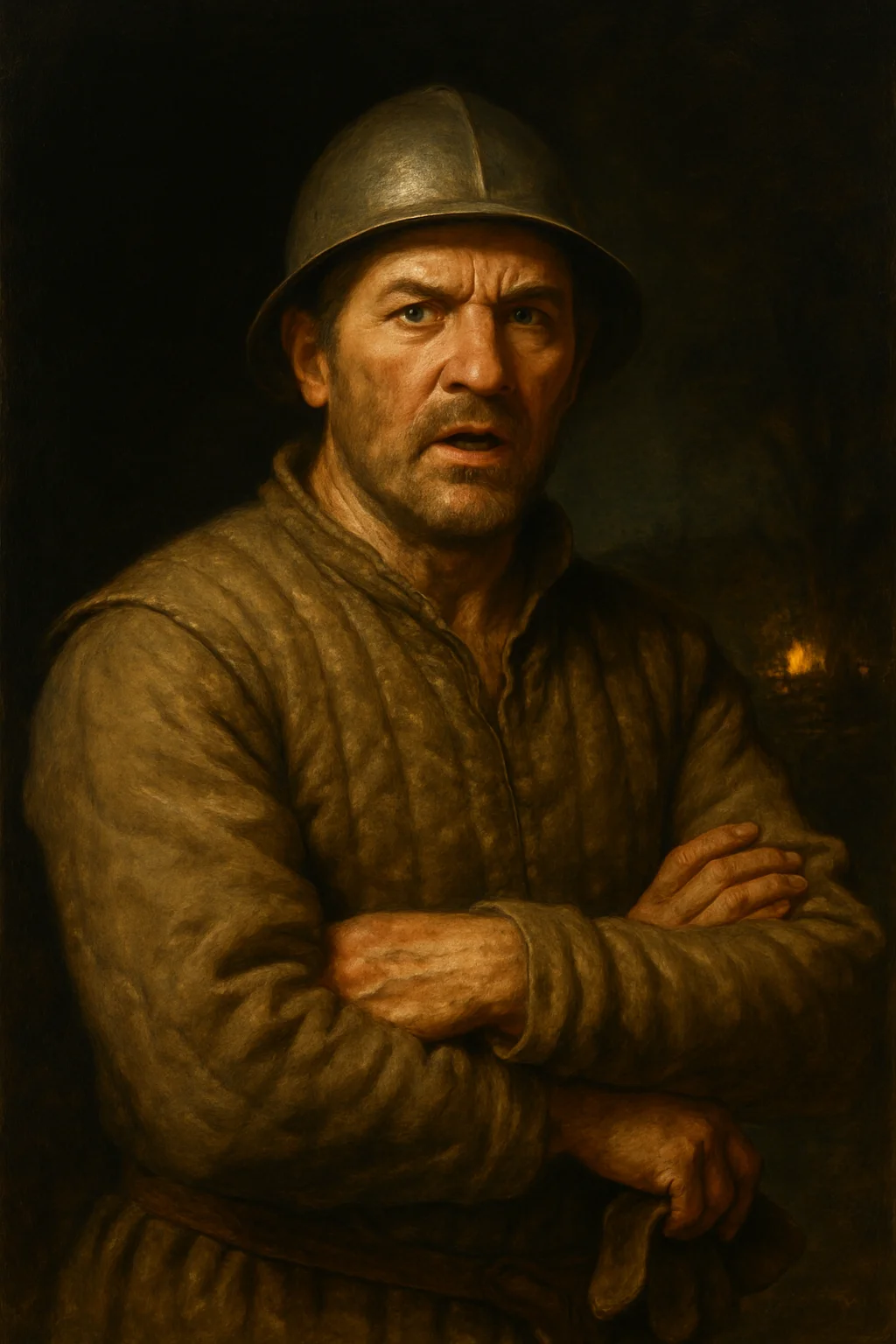
Williams
Williams provides the play's sharpest challenge to Henry's authority from below - his argument, delivered to a disguised king, that a soldier's death is on the conscience of the man who orders the war, is answered only by Henry's private soliloquy and later resolved through a good-humoured trick rather than any genuine rebuttal.
Appears In
Who is Williams?
Williams is an ordinary soldier in Henry's army, encountered on the eve of Agincourt when the king, disguised in a borrowed cloak and calling himself Harry le Roy, walks among his troops to gauge their spirits before the coming battle. Williams does not recognize his king and speaks to him with the plain, unguarded frankness of one soldier to another - arguing that if the king's cause is not just, the weight of every soul lost in the battle falls on the king's own conscience, not on the ordinary men who simply obey orders.
The exchange escalates into a genuine quarrel: Williams and the disguised Henry trade sharp words neither man can fully answer, and the two exchange gloves as a pledge to settle the matter by combat if they ever meet again and both survive the battle. Williams has no way of knowing he has just quarrelled with his own king, and the pledge is made in good faith between what he believes are two equals.
After the English victory, Henry engineers a good-natured trick using the exchanged gloves - giving Williams's glove to Fluellen to wear, so that Williams, seeing it, challenges Fluellen without either man understanding the setup, before Henry reveals the truth and rewards Williams's honest courage rather than punishing his earlier bluntness. It is one of the play's few moments of unambiguous warmth, a king secure enough in his victory to laugh at, and reward, a common soldier who spoke to him as an equal without knowing it.
Motivation
Williams is motivated by a plain soldier's sense of justice and a refusal to defer automatically to rank he does not recognize in the moment - he says what he believes to a man he takes for an equal, and stands by it even once the truth of who he was arguing with becomes known.
Personality
Williams speaks his mind without regard for who might be listening, which is precisely what makes his exchange with the disguised Henry so charged - he is arguing moral philosophy with his own king and does not know it, and does not back down even once he learns the truth, taking Henry's eventual reward with the same plain good humour he brought to the original quarrel.