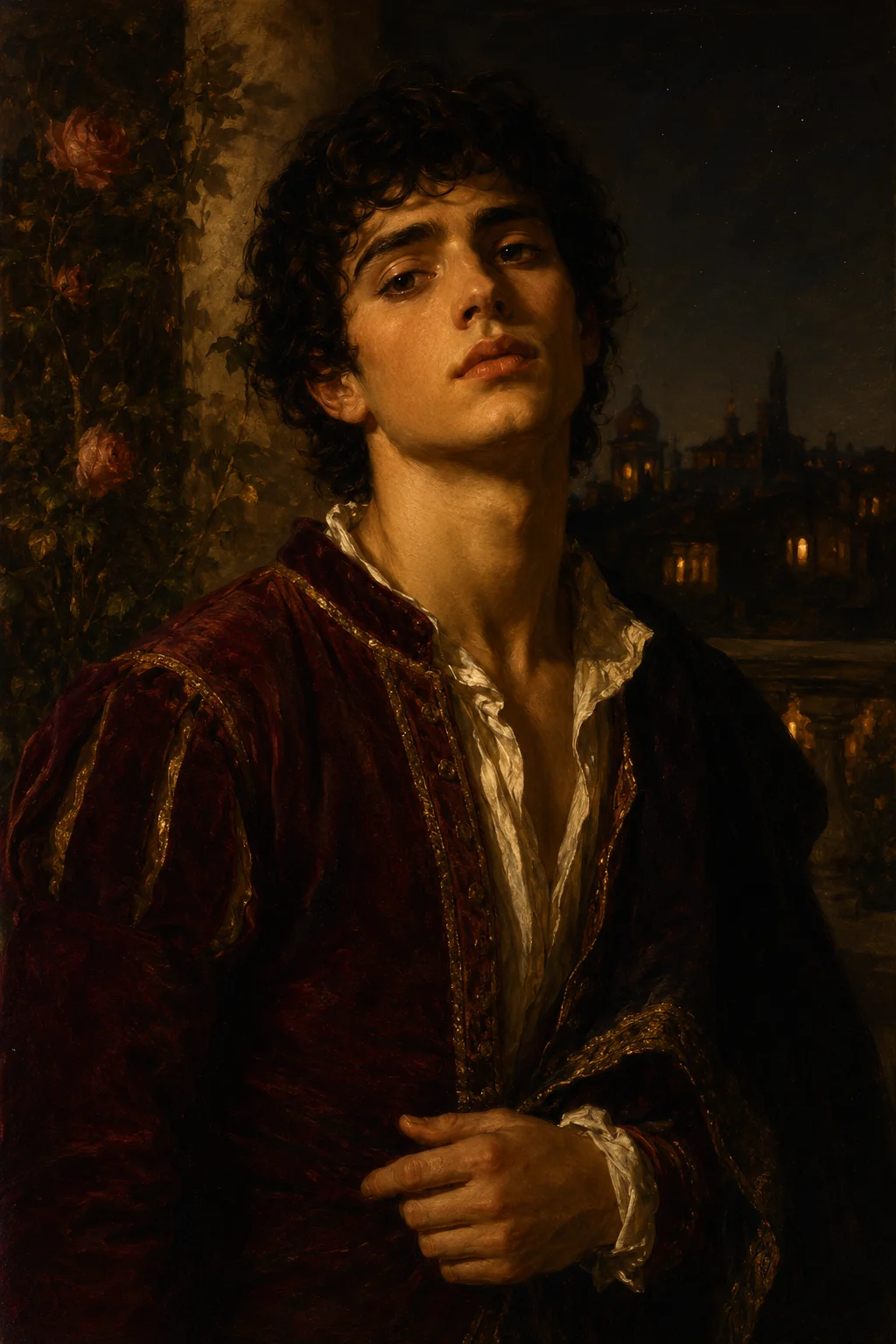
Romeo
Romeo is the play's co-protagonist and the engine of its forward motion: every major turn of plot follows from something he does, sees, or feels. He embodies the play's vision of love as a force that arrives suddenly, overwhelms judgement, and cannot be reconciled with the rational, feuding world of Verona's adults.
Appears In
Who is Romeo?
Romeo is the only son of Montague, a young Veronese nobleman first discovered in the grip of a lovesickness that has nothing to do with Juliet: he is mooning over Rosaline, a Capulet niece who has sworn off love entirely. His friends regard this infatuation as a pose, a young man's romantic self-dramatisation, and the play seems to agree - the moment Romeo sees Juliet across the Capulet feast, Rosaline is forgotten so completely that Friar Lawrence later chides him for the whiplash of his affections.
What follows is not the same performance repeated with a new object. Romeo's love for Juliet is written in a different register entirely - urgent, reckless, and absolute. He scales the orchard wall at the risk of death to speak with her, marries her within a day of meeting her, and treats every obstacle the feud throws between them as an offence against nature itself rather than a mere inconvenience.
His banishment after killing Tybalt is the play's hinge: a punishment lighter than death that Romeo nonetheless experiences as a form of it, since it separates him from Juliet. His final act - buying poison to die beside what he believes is Juliet's corpse - is the tragic completion of a nature that has always loved entirely or not at all, and that cannot survive in the space between.
Motivation
Romeo is driven by the conviction that feeling, once fully felt, must be fully acted upon. Love, once real, obliterates every other claim - family loyalty, personal safety, prudence - and he organises his entire remaining life, and finally his death, around that single, absolute logic.
Personality
Romeo is defined by the intensity and totality of his feeling. He does not love by degrees - he is either indifferent or consumed, and the play tracks the consequences of a temperament that cannot moderate itself. His idealism makes him a genuinely poetic figure, capable of the play's most lyrical language, but the same idealism blinds him to consequence: he acts on the emotional truth of a moment without weighing what the world will do with that action afterward.