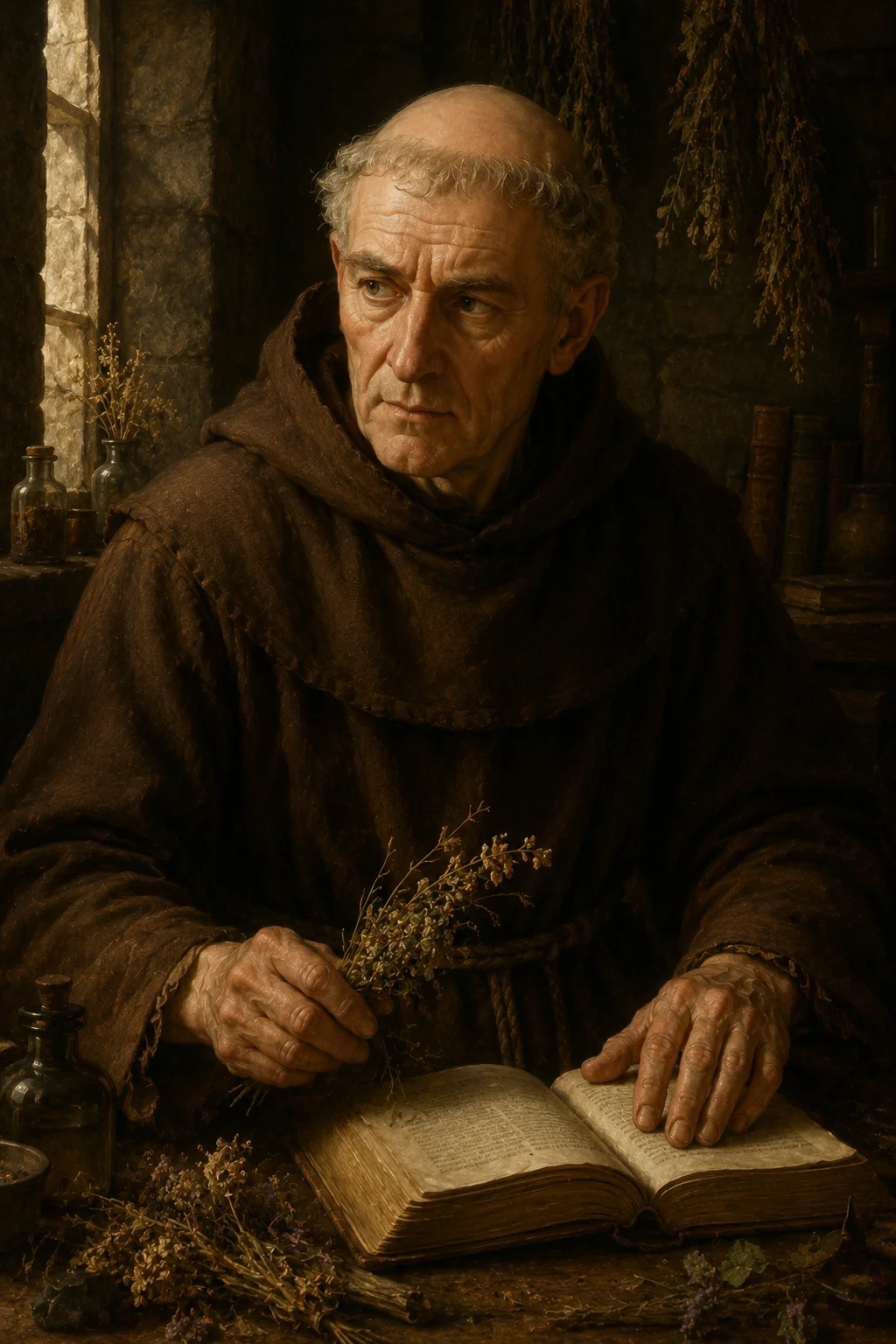
Friar Lawrence
Friar Lawrence functions as the play's well-meaning architect of reconciliation, whose plans - sound in intention, undone by circumstance and timing - ultimately produce the opposite of what he intended. His final testimony is what allows the feuding families to understand, and finally end, the tragedy they caused.
Appears In
Who is Friar Lawrence?
Friar Lawrence is a Franciscan friar of Verona, learned in the medicinal and sometimes dangerous properties of local herbs, and a quiet confidant to Romeo before the play even begins. He agrees to marry Romeo and Juliet in secret not out of simple sentiment but from a genuine hope that their union might finally reconcile the warring houses of Montague and Capulet.
That hope repeatedly collides with the speed of events he cannot control. He warns Romeo, in one of the play's most quoted lines, that 'violent delights have violent ends,' counsel that goes as unheeded as most of his careful plans. When Romeo is banished and Juliet is threatened with a second, bigamous marriage, the Friar improvises an increasingly desperate scheme: a potion to simulate death, a letter to explain the ruse to Romeo, and a plan to reunite the lovers once she wakes in the tomb.
The scheme fails through no fault of his devising - the letter never reaches Mantua - and the Friar arrives at the tomb only in time to find Romeo already dead and Juliet waking. His nerve fails him at the critical moment; he flees rather than face the watch, leaving Juliet to die alone. His final confession to the assembled families is honest and complete, and it is his account, more than anyone else's, that finally reconciles Montague and Capulet.
Motivation
Friar Lawrence is motivated by a genuine desire to end the destructive feud between the Montagues and Capulets, and by pastoral care for Romeo and Juliet individually. He believes their marriage can be a instrument of peace, and every subsequent scheme he devises is an attempt to protect that hope from collapsing.
Personality
Friar Lawrence combines genuine wisdom - his opening speech on the dual nature of plants, capable of poison or medicine depending on use, doubles as commentary on the play's own themes - with a pragmatism that sometimes tips into moral compromise, as when he agrees to marry Juliet in secret or engineers a deception involving a suspended-animation potion. His courage fails him exactly once, at the tomb, and that single lapse costs the play its chance at a less catastrophic ending.