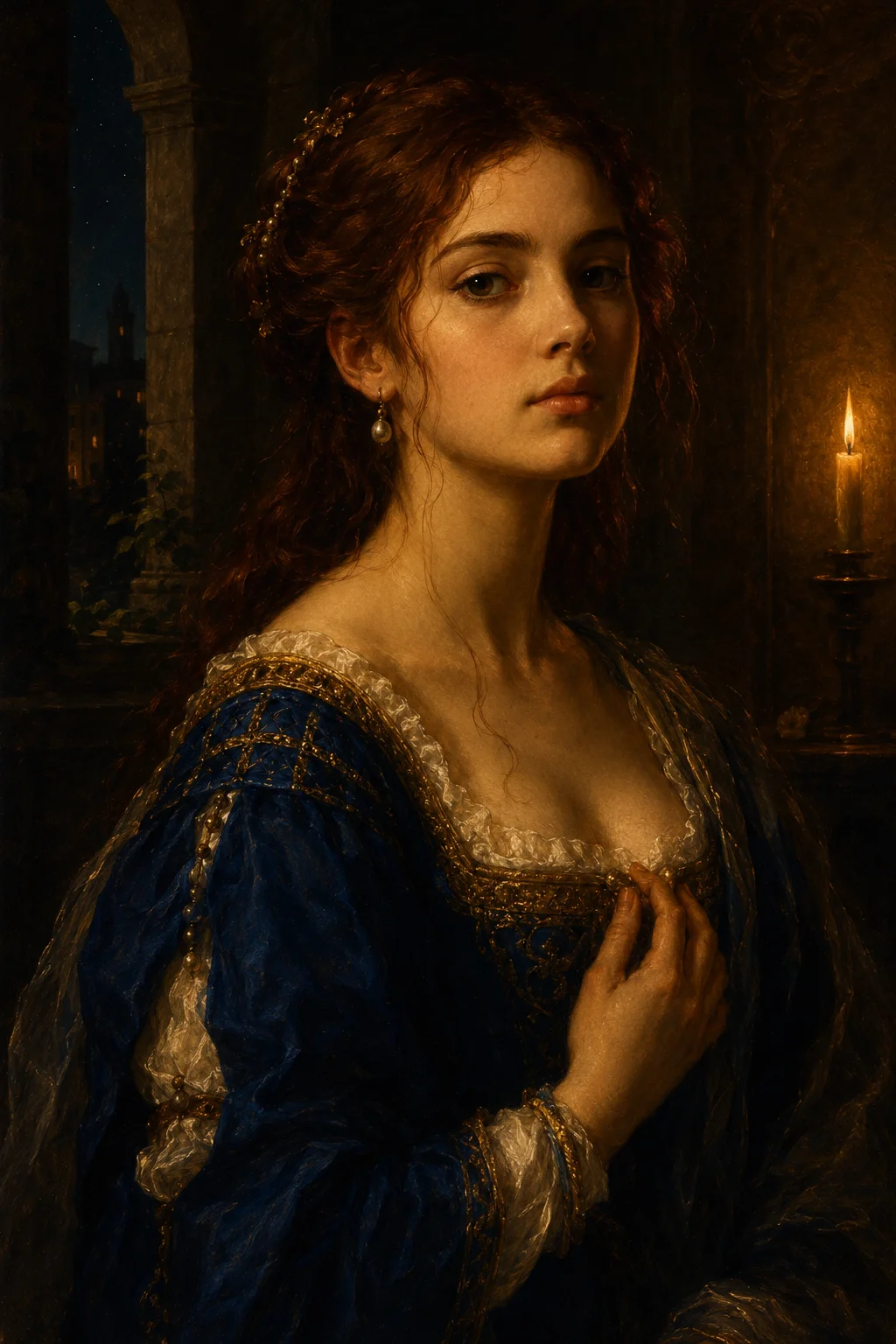
Juliet
Juliet is the play's co-protagonist and, in many respects, its moral centre - the character whose growth from obedient daughter to a young woman capable of extraordinary independent resolve gives the tragedy its full weight. Her isolation from every adult who might have protected her is the mechanism by which the plot's final catastrophe becomes unavoidable.
Appears In
Who is Juliet?
Juliet is the only daughter of Capulet, not yet fourteen, raised within a household that has already begun arranging her marriage to Paris before she has any say in the matter. When we first meet her, she is dutiful and untested - telling her mother she will look no further to like a match than her family's consent allows. The Capulet feast, and the sight of Romeo across it, changes the terms of her entire life within a single evening.
What distinguishes Juliet from the conventional lovesick heroine is the speed and clarity of her thinking. She is, if anything, more decisive than Romeo: it is she who proposes marriage on the balcony, she who arranges the practical details through the Nurse, and she who devises - with the Friar's help - the desperate plan to fake her own death rather than submit to a bigamous marriage to Paris.
Her isolation deepens across the play's second half as the people she has trusted fail her one by one: her father rages at her refusal to marry Paris, and the Nurse, her lifelong confidante, advises her to forget Romeo and marry again. Alone, she drinks the Friar's potion in a chamber full of imagined horrors, and when she wakes in the tomb to find Romeo dead beside her, she does not hesitate before following him.
Motivation
Juliet is motivated by a love that, once recognised as real, she refuses to subordinate to family duty, however much that duty has shaped her life until now. Her later actions are driven by a fierce determination to remain loyal to Romeo and to her own word, even when it costs her the support of everyone else she has ever depended on.
Personality
Juliet combines romantic intensity with a clear-eyed practicality that Romeo often lacks. She is the one who asks the necessary questions on the balcony - how did you get here, what if you're caught - even as she commits herself entirely to him. Her courage is not impulsive but deliberate: drinking the Friar's potion means confronting, in detail, every terror the vault might hold, and she does it anyway because the alternative - life without Romeo, or worse, bigamy - is unthinkable to her.