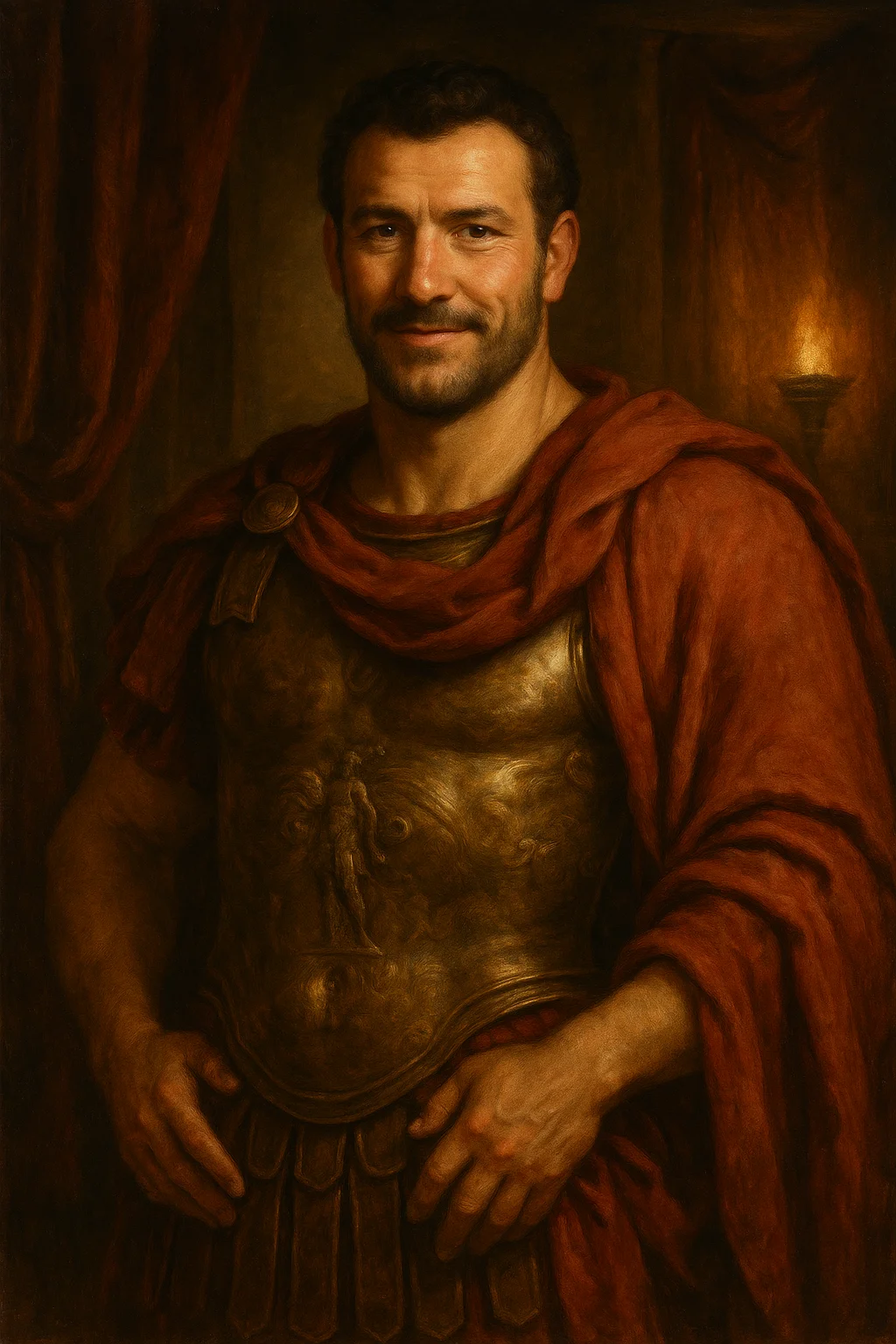
Mark Antony
Antony acts as the counter-force to Brutus - where Brutus is principled and ineffective, Antony is calculating and devastating. His transformation from apparent lightweight to Caesar's most dangerous avenger is the play's central reversal, demonstrating that political intelligence, not moral seriousness, is what shapes Rome's future.
Appears In
Who is Mark Antony?
Antony's first appearance - dismissed by Cassius as a mere 'reveller' and 'gamester' - establishes the expectation the rest of the play systematically dismantles. He is careful to appear harmless after the assassination, requesting only permission to speak at Caesar's funeral, and gives Brutus his word that he will say nothing to dishonour the conspirators. It is the promise of a man who has already decided exactly what he is going to say.
The funeral speech is the play's rhetorical centrepiece and perhaps the most technically sophisticated piece of manipulation in Shakespeare. Antony's repeated insistence that 'Brutus is an honourable man,' each repetition landing more ironically than the last, his physical display of Caesar's wounds, his fabricated reading of a will that gives Romans money and gardens - all are calibrated to produce exactly the riot that follows while Antony technically honours the letter of his agreement with Brutus. It is a performance of grief so precisely controlled that grief and calculation become indistinguishable.
After the civil war begins, Antony proves as ruthlessly practical in power as he was calculating in the Forum. His willingness to agree to the death of his own nephew Lepidus's brother while discussing Lepidus's future obsolescence in the same breath - 'a slight, unmeritable man' - reveals the coldness the funeral speech had entirely concealed. He ends the play as the most powerful of Rome's three rulers, at least for now, and closes the play with a tribute to Brutus that is both genuinely felt and the last move in a game Antony has been winning since Act III.
Motivation
Genuine grief for Caesar combined with a cold political instinct that transforms that grief into a weapon - Antony mourns Caesar, but he is also acutely aware of exactly what that mourning can be made to accomplish in front of a Roman crowd.
Personality
Antony's genius is his ability to appear exactly what the moment requires: a grieving friend, a reasonable man, a rousing orator, a cold political operator. The funeral speech works because his grief is real even as the speech is constructed - he does not need to fake the emotion, only to use it with precision. After Caesar's death, the sociable reveller the conspirators dismissed reveals himself as the most dangerous political intelligence in Rome.