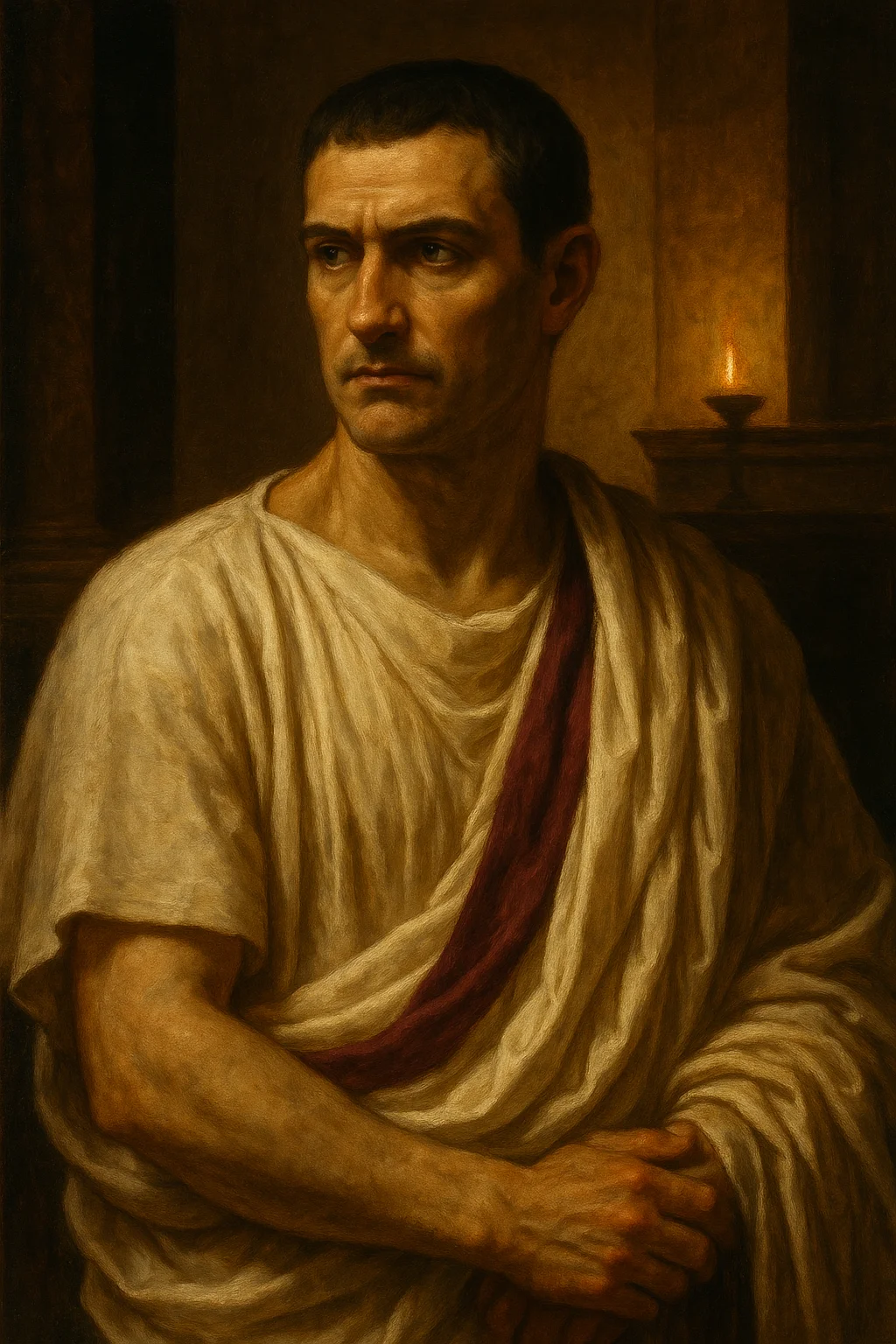
Brutus
Brutus is the play's true tragic protagonist - a man of genuine principle who is persuaded to act on that principle in a way that serves other people's purposes and destroys his own cause. His arc traces the fatal gap between good intentions and political effectiveness, between the private moral life and the public consequences of acting on it.
Appears In
Who is Brutus?
Brutus is descended from the legendary Lucius Junius Brutus who expelled the last king of Rome, and that lineage hangs over him throughout the play. Cassius appeals precisely to this heritage when he first recruits him to the conspiracy, knowing that Brutus's sense of honour - his need to believe himself acting for the good of Rome rather than personal advantage - is the lever that needs engaging. Once convinced, Brutus becomes the conspiracy's public face and moral legitimacy: without him, as Cassius says, the assassination will 'appear too bloody.'
Brutus's tragedy lies in the gap between his intentions and their consequences. He overrules Cassius's more pragmatic instincts at every decisive moment - refusing to kill Antony, allowing Antony to speak at Caesar's funeral, insisting on marching to Philippi rather than waiting - and each decision proves catastrophic. His commitment to acting honourably, to fighting as if the justice of the cause confers protection, makes him the least effective political operator in the play while remaining, perhaps, its most morally serious figure. He does not understand that the world the conspiracy has created is not one in which honour is a workable strategy.
He dies at Philippi after the battle has turned against him, running on his own sword rather than accept capture. Antony's final tribute - 'This was the noblest Roman of them all' - is both genuine and deeply ironic: the enemy's measure of a man whose nobility was precisely what destroyed him and everything he was trying to save.
Motivation
Brutus is driven by an absolute conviction that his actions serve Rome rather than personal interest - a conviction Cassius plants carefully and Brutus nurtures until it becomes indistinguishable from self-deception. He cannot act against Caesar for envy or grievance; he can only act if he is certain he acts for Rome, which is exactly what Cassius gives him.
Personality
Brutus has a mind of genuine quality - philosophical, serious, capable of examining his own motives with rigour - and this is precisely what makes him both admirable and catastrophically wrong. His Stoic self-discipline, his insistence on acting from principle, his refusal to let personal feeling contaminate his political reasoning, all lead him to the decisions that doom the republican cause. He is the play's measure of the limits of honour as a political tool.