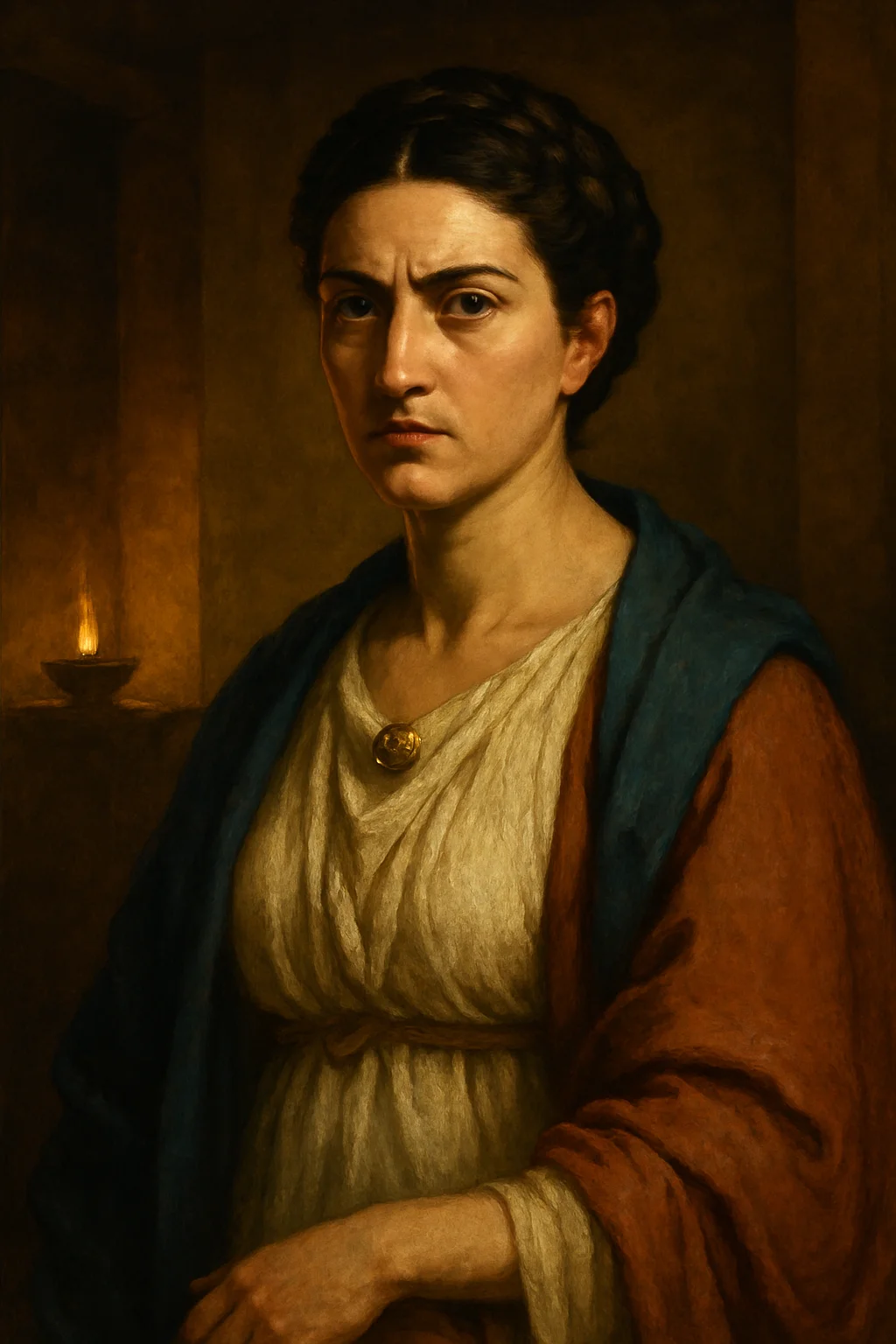
Portia
Portia functions as the domestic mirror to the play's public action - her demand to share Brutus's secret, and the manner of her death, measuring the private human cost of the political choices Brutus has made. She is the play's one character who grasps the full situation through love and instinct rather than information, and who is destroyed by what she correctly intuits is coming.
Appears In
Who is Portia?
Portia is Brutus's wife and the daughter of Cato, the renowned Stoic philosopher, and she invokes both relationships directly when she demands to know what is troubling her husband. She is aware before Brutus tells her anything that something is deeply wrong - she reads his distraction, his sleeplessness, his inability to eat - and she refuses to be deflected with the standard explanation that it is merely illness. Her challenge is precise: 'Am I yourself but, as it were, in sort or limitation, / To keep with you at meals, comfort your bed, / And talk to you sometimes? Dwell I but in the suburbs / Of your good pleasure?'
To prove her capacity to bear the weight of whatever Brutus is carrying, Portia has wounded herself in the thigh - a self-inflicted wound she shows him as evidence of her constancy. The gesture, startling in its combination of self-possession and self-harm, establishes a woman who argues through action as well as words, and who is entirely serious about her right to a full share in her husband's life rather than the sheltered, partial version she is being offered.
She dies offstage before Philippi, having swallowed hot coals in despair - Brutus reports her death during the quarrel with Cassius, in a moment of such compressed Stoic grief that it is hard to know whether to read it as self-command or its collapse. She is vindicated and absent simultaneously: the play confirms she was right to sense catastrophe, but she does not survive to see how right.
Motivation
Portia is motivated by love for Brutus and by a serious, principled conviction - rooted in both her character and her father's philosophy - that she has the right and the capacity to share fully in her husband's life, not merely the comfortable and protected portion she is being offered.
Personality
Portia combines a quality of clear-eyed emotional perception - she reads Brutus's distress long before he tells her anything - with the Stoic courage her father's lineage demands she demonstrate rather than merely assert. Her self-wounding is not hysteria but argument: she proves her constancy through action because she knows Brutus will respond to proof. Her death, by contrast, is the Stoic frame giving way - she cannot hold herself together under the weight of what she knows.