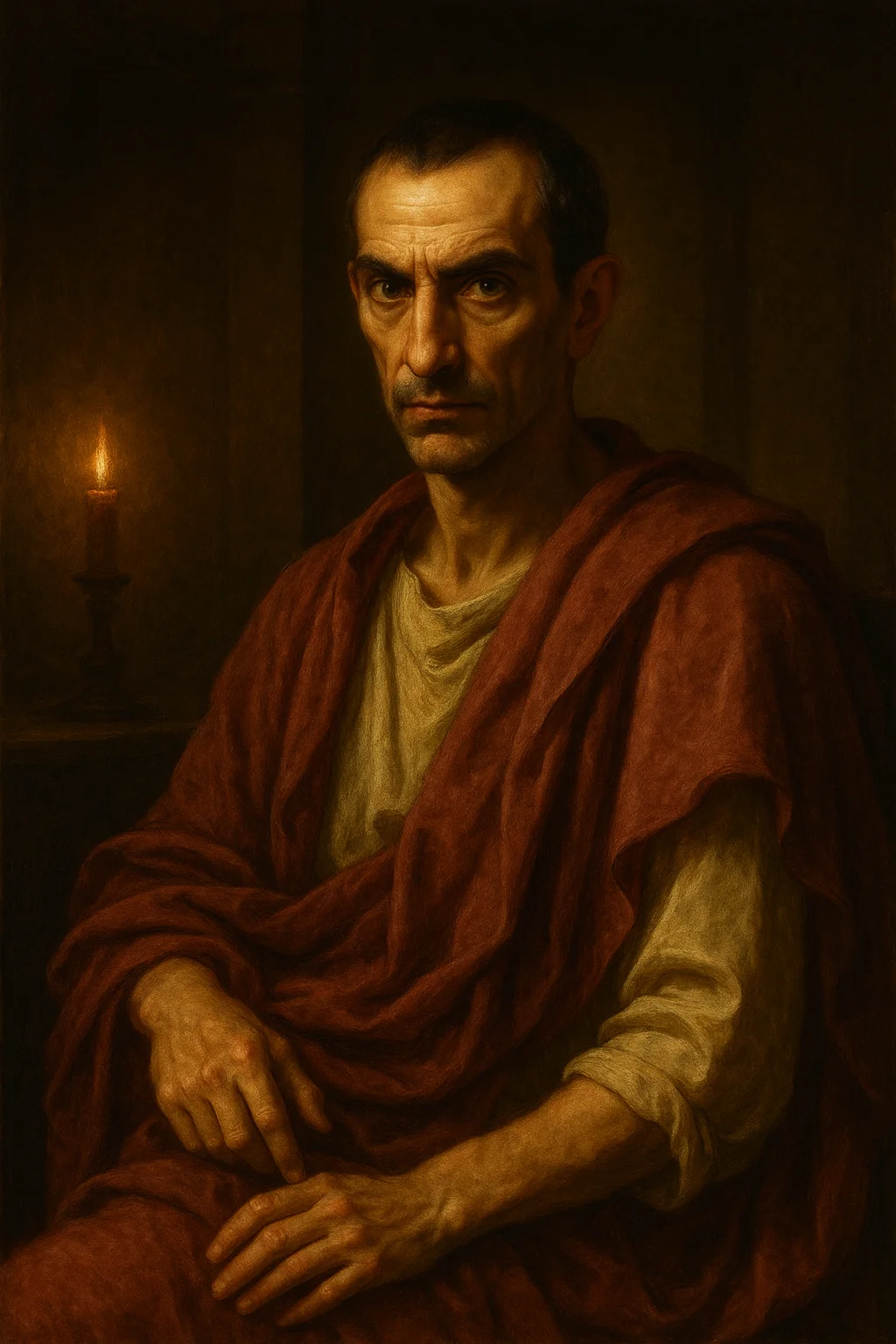
Cassius
Cassius is the conspiracy's architect, tactician, and recruiter - the man who makes the assassination happen by identifying and exploiting the one Roman whose participation will give it legitimacy. The play treats him with sympathy even as it shows the limits of his vision: he is right about everything tactical, and wrong about the one thing that matters - his faith that Brutus's judgement can substitute for his own.
Appears In
Who is Cassius?
Cassius is the conspiracy's instigator and recruiter, with the tactical intelligence to know that the plot needs Brutus's moral authority to succeed. His initial persuasion of Brutus is patient, clever, and not entirely honest: he tells stories of swimming the Tiber with Caesar, reads him anonymous letters supposedly from concerned Romans, appeals to his ancestor's legendary expulsion of the kings. His opposition to Caesar is personal as well as political, rooted in the resentment of a man who regards himself as Caesar's equal and has spent years watching the world treat him as less.
Cassius proves the sounder political and military mind at every point through the play: he wants Antony killed before he can become dangerous, he wants to wait at Sardis rather than march to Philippi, he is right each time. But Brutus overrides him each time, and Cassius, having staked everything on winning Brutus to the conspiracy, cannot bring himself to push back hard enough to overrule the man whose name legitimises what they have done. His deference to Brutus's judgement is the thing that undoes him.
He dies before the battle of Philippi is fully decided, having misread the military situation through failing eyesight and ordered his servant Pindarus to kill him. The irony is complete: he dies on his birthday, on the erroneous belief that the battle is already lost, killed not by the enemy but by his own despair. It is a death shaped by bad information - which is perhaps fitting for a man whose genius lay in controlling the information others received.
Motivation
A combination of genuine republican principle and personal resentment of Caesar that the play refuses to disentangle - Cassius's opposition is both ideological and envious, which makes his recruitment of the purely principled Brutus a kind of double dealing the play sees clearly even if Cassius does not.
Personality
Cassius reads people with extraordinary accuracy - Caesar himself identifies him as dangerous for this very quality, the lean and hungry look of a man who thinks too much. His persuasion of Brutus is a masterpiece of targeted appeal, finding exactly the right arguments for exactly the right mind. But he combines this perceptiveness with a temperamental volatility that Brutus's Stoic composure makes worse: in the quarrel of Act IV, Cassius rages and threatens while Brutus stands unmoved, and Cassius, characteristically, is the first to break.