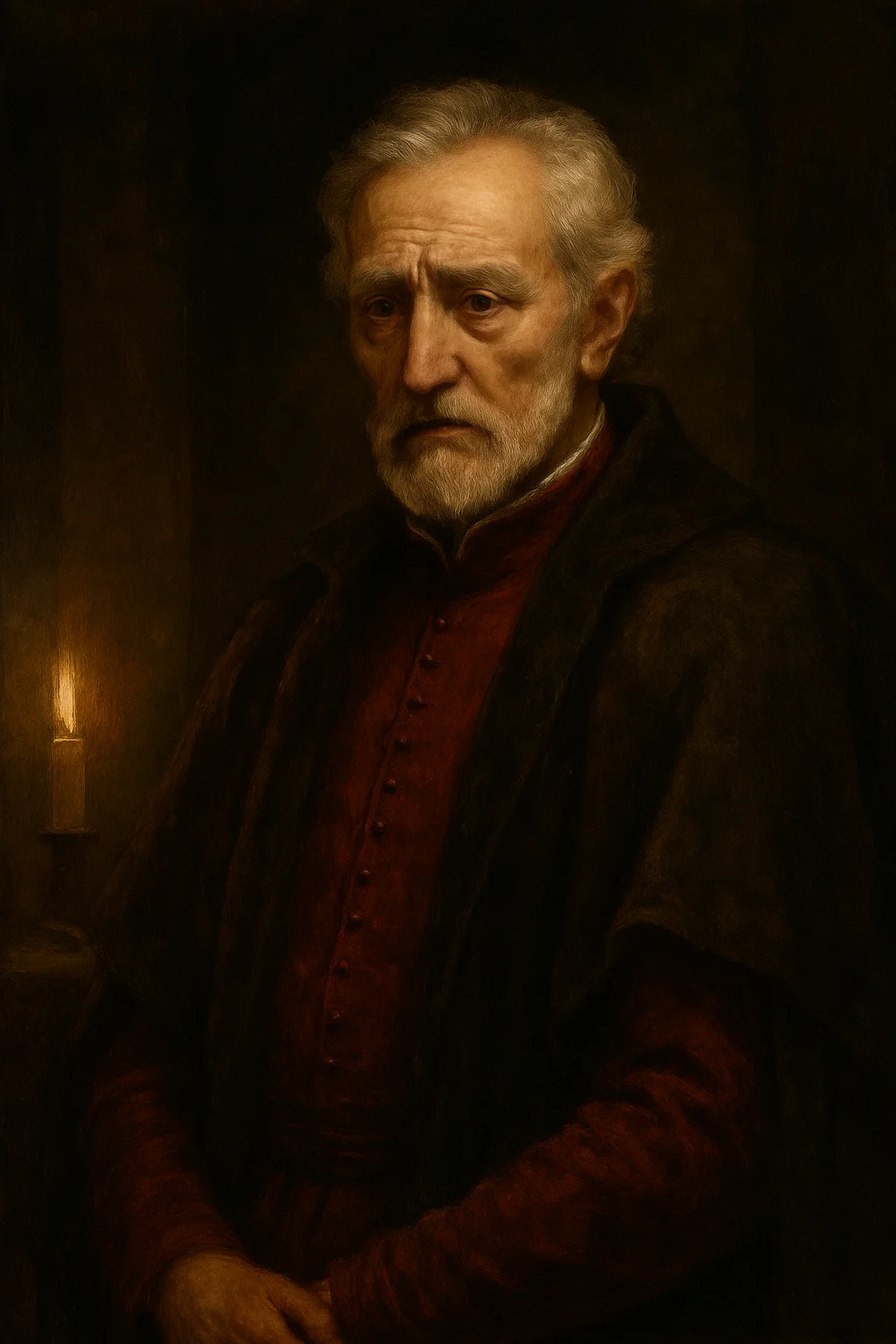
Gratiano
Gratiano is Venice's witness to the final catastrophe — a figure who connects the world of Brabantio and the play's Venetian opening to the events in Cyprus, and whose grief for Desdemona gives the closing scenes a note of external, uncomplicated sorrow that the play's other survivors cannot provide.
Appears In
Biography
Gratiano is a Venetian nobleman and kinsman to Brabantio, arriving in Cyprus with Lodovico as part of the Venetian embassy in Act IV. He is an older man — the play identifies him as Brabantio's brother — and he brings with him the news that Brabantio has died of grief over Desdemona's marriage. His arrival connects the play's Venetian opening to its Cypriot catastrophe: he carries the world from which Desdemona fled, and he arrives in time to witness the horror into which she has been delivered.
His most significant appearances are in the final act. He is outside Desdemona's chamber as the catastrophe unfolds, hearing Desdemona's cries but unable to break in — a figure of helpless proximity, aware something terrible is happening but unable to prevent it. His grief at the discovery of Desdemona's death is both formal and personal: she was his kinsman, and his response — that Brabantio's earlier death was a mercy, since this sight would have driven him to despair — is one of the play's most quietly devastating observations.
He is present at the play's conclusion when Iago's treachery is exposed, when Othello kills himself, and when Cassio inherits the governorship. His function in the final scenes is partly that of witness — the Venetian world's representative at the catastrophe — and partly that of measure: his grief for Desdemona gives the audience a clear-eyed external response to what Othello has done, unclouded by complicity or manipulation.
Motivation
Gratiano is motivated by kinship loyalty — to Brabantio's memory and to Desdemona — and by the instinct to understand what has happened. He carries no agenda beyond that of a decent man confronted with an atrocity committed against his family.
Personality
Gratiano is the play's most purely external grief — a man who loved Desdemona as family and arrives too late to save her, whose sorrow is uncomplicated by guilt or complicity. His quiet observation that Brabantio was lucky to die before seeing this is one of the most understated lines in the play's devastating final scene.