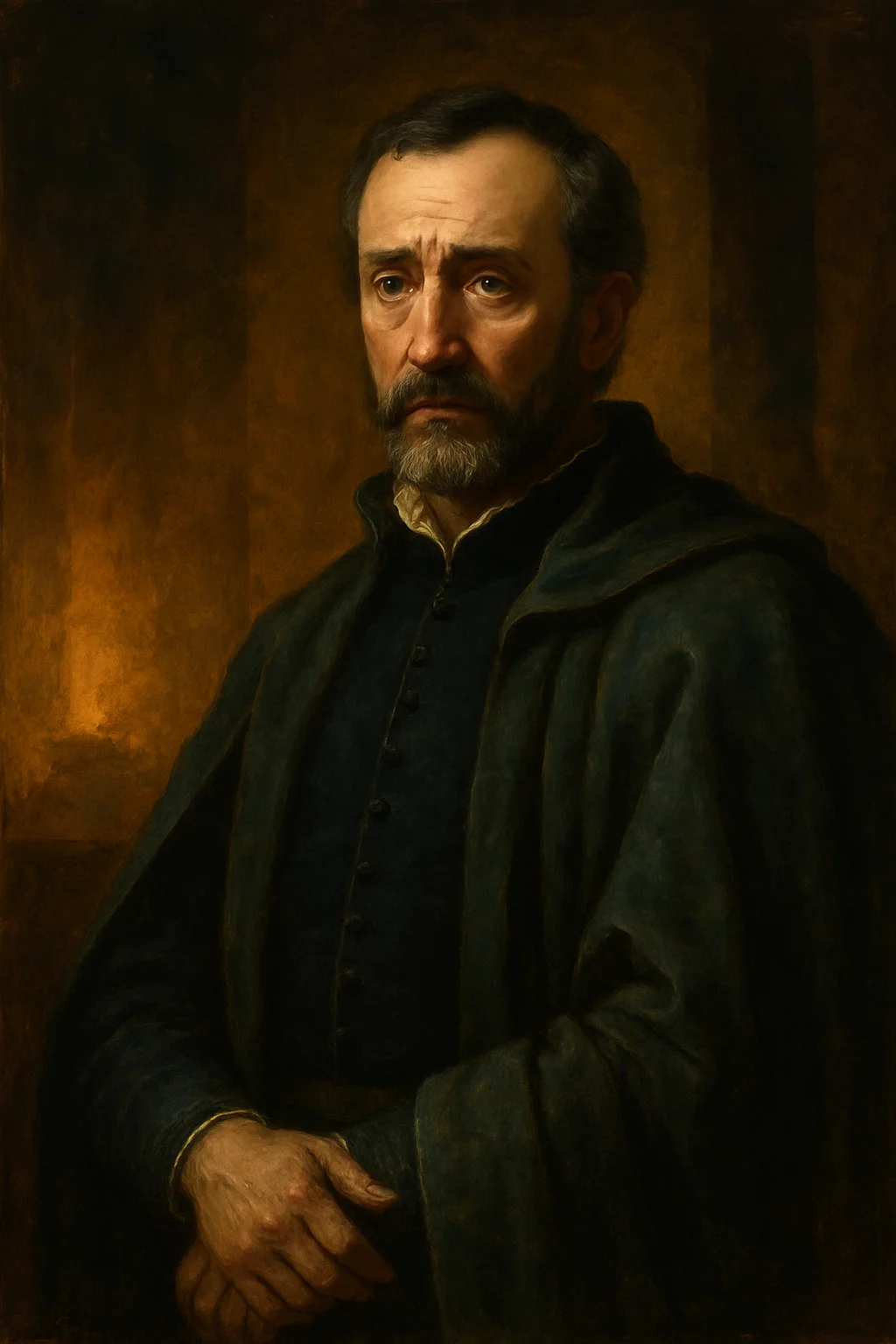
Lodovico
Lodovico functions as an external Venetian perspective on Othello's disintegration, his shock at Othello's violence toward Desdemona giving the audience an outside measure of just how far Othello has fallen. His authority in the final scene provides the civic mechanism by which the tragedy is formally closed and reported.
Appears In
Biography
Lodovico is a Venetian nobleman, kinsman to Brabantio, who arrives in Cyprus as an ambassador carrying the Senate's letters recalling Othello to Venice and installing Cassio as governor in his place. His arrival in Act IV coincides with one of the play's most shocking public moments: Othello, already unravelled by jealousy, strikes Desdemona in front of him, a breach of decorum and marital conduct that visibly appalls the visiting ambassador and signals to the audience how far Othello has fallen from the composed figure of Act I.
Lodovico's role through the middle of the play is largely that of an outside witness, someone whose presence measures the scale of Othello's transformation by his own genuine shock at what he sees — he cannot square the raging figure before him with the reputation of the noble general Venice sent to Cyprus.
He is present at the play's final catastrophe, arriving with Gratiano in time to help stop the attack on Cassio and, shortly after, to witness the discovery of Desdemona's murder and Iago's exposure. It falls to Lodovico, as the ranking Venetian authority on the scene, to take charge of the aftermath — arresting Iago, ordering Othello's confinement, and undertaking to carry the full, terrible report back to the Venetian state.
Motivation
Lodovico is motivated by his official duty as the Senate's representative, carrying out the business of recalling Othello and installing Cassio, and by a growing personal concern, as events unfold, over the deterioration he witnesses in a general Venice once trusted completely.
Personality
Lodovico carries himself with the composed formality of a Venetian statesman, which makes his visible shock at Othello's violence toward Desdemona all the more effective as a marker of how extreme that violence is. His clear-eyed handling of the play's final scene — restoring order, assigning blame accurately, and taking responsibility for reporting events to Venice — closes the play with the same civic authority that opened it in the council chamber.