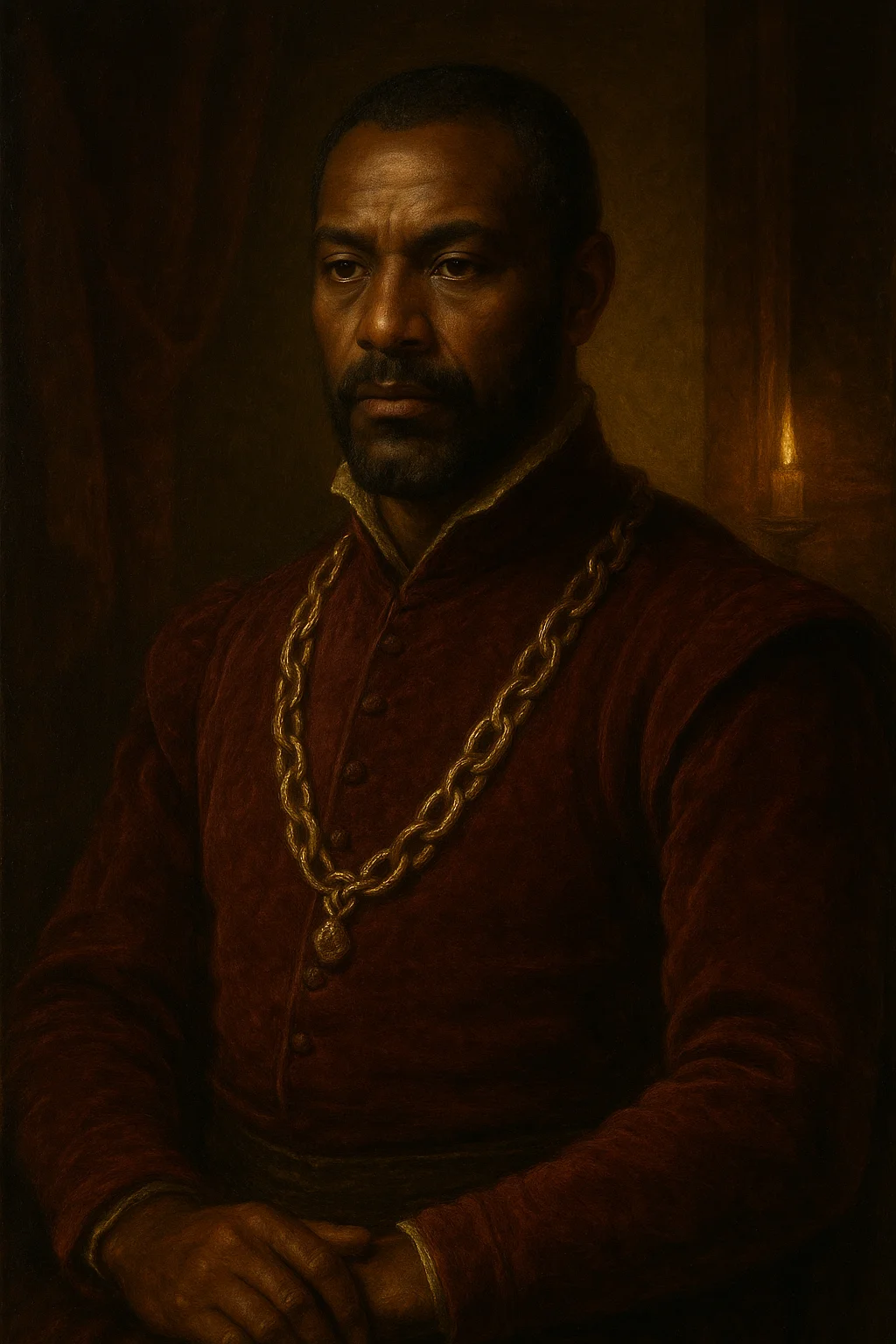
Othello
Othello is the play's tragic protagonist, and his fall traces the destruction of a singular, self-made authority by a force — Iago's manipulation — that attacks not his courage or competence but his capacity to trust. His outsider status in Venice, repeatedly invoked by other characters even as they depend on his generalship, gives his private catastrophe a social dimension the play never lets the audience forget.
Appears In
Biography
Othello is a Moor in the service of Venice, a general whose military brilliance has earned him a place at the top of a society that never fully accepts him as its own. He arrives in the play already secretly married to Desdemona, a senator's daughter, and his first extended appearance — defending that marriage before the Duke and an outraged Brabantio with nothing but the plain, dignified story of how he won her — shows a man of formidable self-possession, whose authority rests on deeds and speech rather than birth or wealth.
That self-possession is the very thing Iago spends the play dismantling. Othello's confidence in Desdemona's fidelity does not erode gradually so much as it is systematically demolished by a subordinate he trusts completely, using nothing more than suggestion, a lost handkerchief, and the sight of his own jealousy reflected back at him as reasonable suspicion. The speed of the collapse — from 'I do not think but Desdemona's honest' to plotting her murder within a single long scene — is the play's central, terrible study of how a mind can be turned against its own evidence.
By the time Othello smothers Desdemona in her bed, he believes himself to be executing justice rather than committing murder — 'an honourable murderer,' as he calls himself, acting to prevent future betrayal rather than avenging a present one. Emilia's revelation of Iago's plot arrives only after the act is irreversible, and Othello's suicide, delivered with a final speech that reasserts the eloquence and self-command of his opening scenes, is both a reckoning with what he has done and a last attempt to narrate himself back into the dignity Iago spent the play stripping away.
Motivation
Othello is driven, before Iago's poison takes hold, by love for Desdemona and pride in the honourable life he has built through service to Venice. Once that poison takes hold, his motivation curdles into a conviction that killing her is an act of justice and honour rather than jealousy — a belief he clings to with the same absolute certainty he once gave to his love.
Personality
Othello's public bearing is one of great composure and rhetorical command — he quells a street brawl with a single line and calms a hostile council with the story of his courtship. Beneath that composure, though, is a man acutely aware of his difference from the Venetians around him, and it is that unspoken insecurity, more than any inherent credulity, that Iago is able to locate and exploit. His tragedy is inseparable from his greatest strength: a mind that trusts absolutely, and therefore, once turned, doubts absolutely.