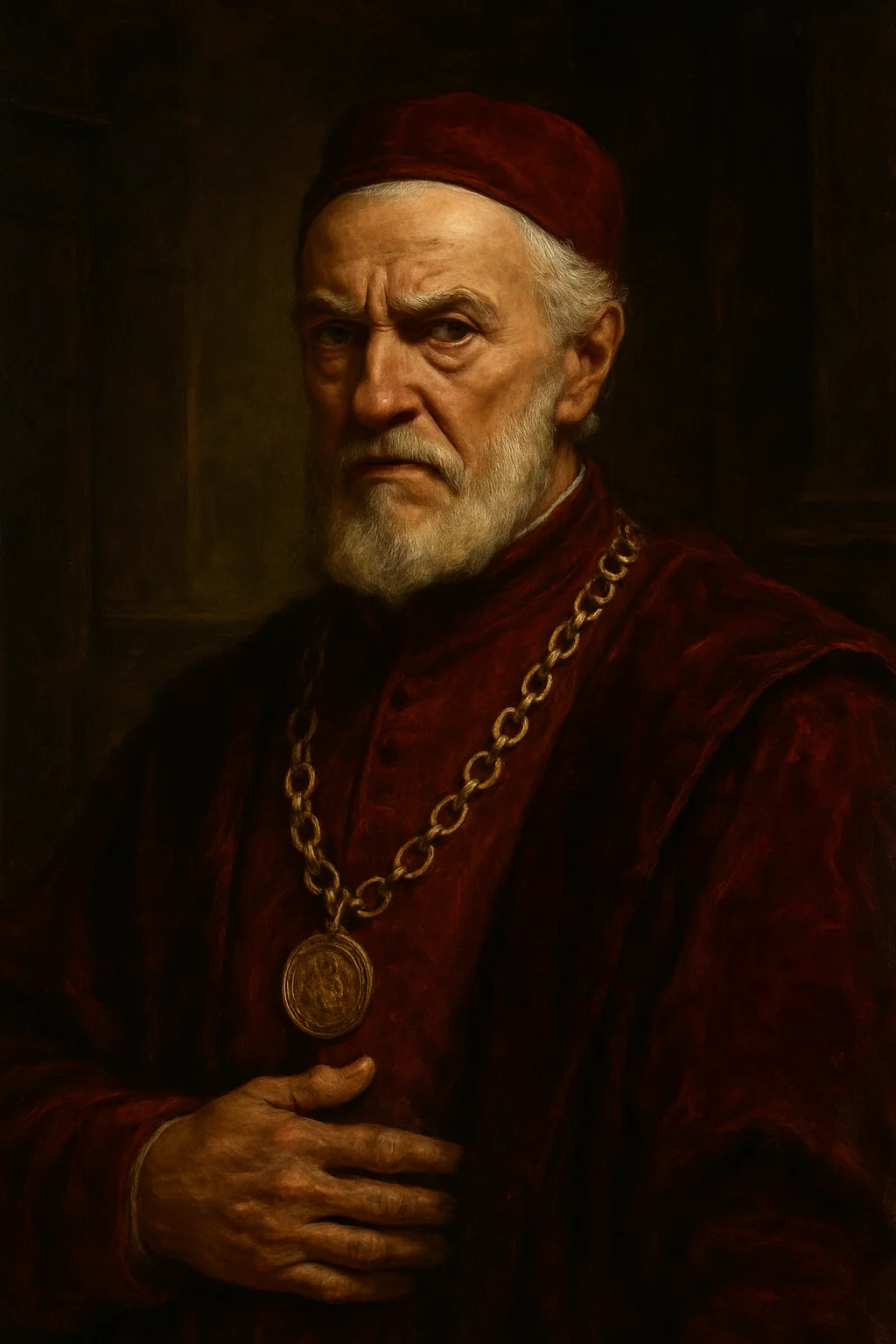
Brabantio
Brabantio embodies Venetian prejudice against Othello made explicit and public, and his parting warning to Othello about Desdemona's capacity for deception becomes, in Iago's hands, one of the seeds of the jealousy that eventually destroys her. His offstage death from grief adds a quiet but pointed toll to the tragedy's final reckoning.
Appears In
Biography
Brabantio is a Venetian senator and Desdemona's father, introduced in the middle of the night by Iago and Roderigo's crude, deliberately inflammatory news that his daughter has eloped with Othello. His fury is immediate and total — he refuses to believe Desdemona could have chosen a Moor freely and insists instead that Othello must have used witchcraft or drugs to seduce her, a suspicion that reveals as much about Venetian prejudice as it does about paternal outrage.
Brought before the Duke to press formal charges, Brabantio is overruled by Desdemona's own calm, public testimony that her love for Othello was freely and knowingly given. His defeat in that scene is total and public, and his parting words to Othello — a warning that a daughter who deceived her father may yet deceive her husband — plant a seed of doubt that lies dormant until Iago revives it with devastating effect much later in the play.
Brabantio does not appear again after the council scene; his death is reported near the play's end, and Gratiano suggests it was grief over Desdemona's marriage that killed him. He is, in this sense, another quiet casualty of the play's opening injustice, a father who never reconciles with the daughter he loses twice — first to Othello, and then, offstage, to death.
Motivation
Brabantio is motivated by wounded paternal authority and by genuine, if prejudiced, disbelief that his daughter would choose Othello without some form of coercion. His warning to Othello after losing his case is driven by a bitterness he cannot fully relinquish even in defeat.
Personality
Brabantio's fury in the play's opening scenes is that of a man whose sense of order — social, racial, and paternal — has been upended in a single night, and his instinct is to explain that upheaval through witchcraft rather than accept his daughter's free will. His defeat before the Duke exposes the limits of his authority, and the bitterness of his final warning to Othello shows a man who cannot let go of his grievance even when the law has ruled against him.