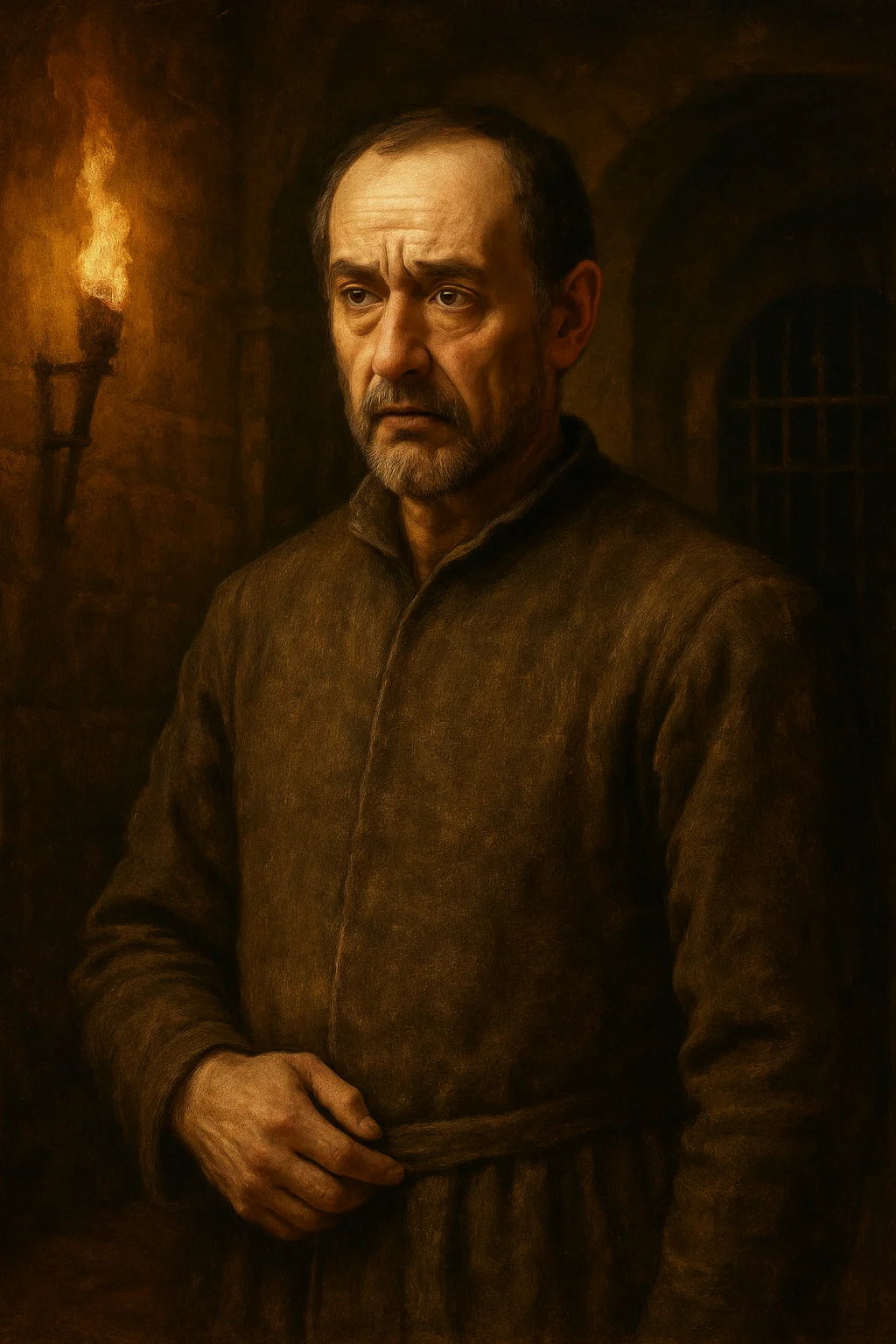
Provost
Who is Provost?
The Provost oversees Vienna's prison and is charged with carrying out Angelo's sentences, a duty he performs with visible reluctance once Claudio's case reaches him - he delays the execution slightly on his own initiative and seeks Angelo's confirmation of the order rather than proceeding automatically, a small act of resistance within the limits of his office.
The keeper of Vienna's prison, whose growing willingness to defy Angelo's sentence in favor of the disguised Duke's counter-scheme helps spare Claudio's life.
Appears In
Biography
His deepening involvement in the Duke's counter-scheme marks him as one of the play's few characters to act on conscience against direct authority: he agrees to hide Claudio and present Angelo with a substitute head, first considering the condemned murderer Barnardine and then, once Barnardine refuses to cooperate, the conveniently deceased pirate Ragozine, a solution that spares both Claudio's life and the Provost's own conscience.
His trust in the disguised Duke is established gradually and rewarded at the play's end - Vincentio commends him for his conduct once the deception is revealed, and the Provost's willingness to bend the letter of his orders in service of a more humane outcome positions him as a quiet moral center among the play's officials.
Motivation
The Provost is motivated by a conscience uneasy with the severity of the sentences he is ordered to carry out, which leads him to cooperate cautiously, and then fully, with the disguised Duke's plan to save Claudio.
Personality
The Provost occupies an uncomfortable position between obedience and conscience, and the play traces his gradual shift from reluctant compliance with Angelo's orders to active, careful participation in undermining them once he trusts the disguised Duke's judgment.