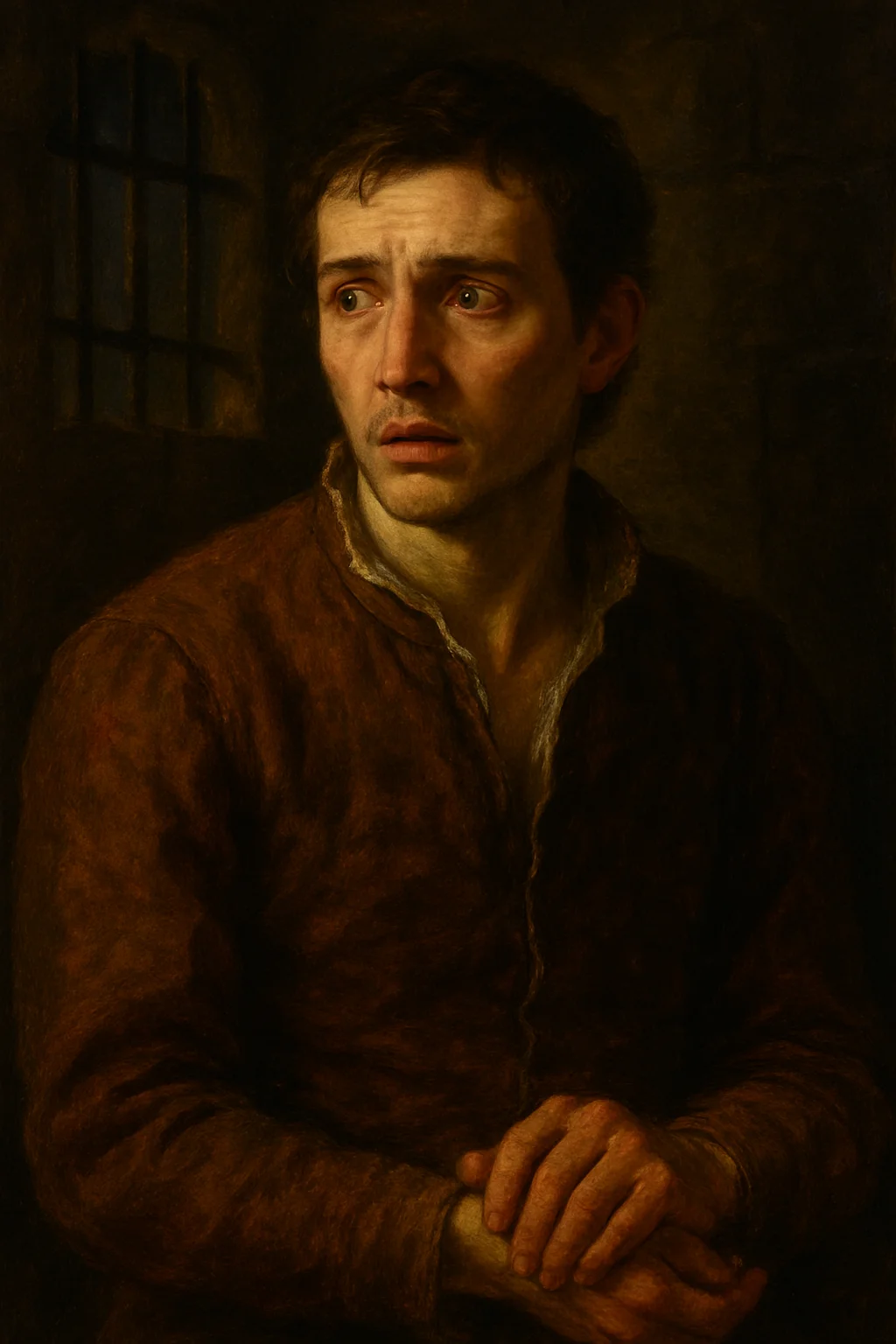
Claudio
Who is Claudio?
Claudio is arrested at the play's outset for conceiving a child with Juliet, his betrothed, before the formal completion of their marriage contract - a technical lapse he freely admits to Lucio while being led to prison, distinguishing it clearly from casual vice even as he faces the harshest possible penalty for it. His sentence, under a law long unenforced until Angelo's sudden severity, strikes him and everyone around him as wildly disproportionate to the offense.
A young gentleman sentenced to death under Angelo's revived law against fornication, whose case sets the play's central plot of justice and mercy in motion.
Appears In
Biography
His response to the sentence is not defiance but a kind of philosophical resignation, articulated most fully in his prison conversation with the disguised Duke, where he accepts death as a release from a life of accumulated small compromises. That resolve collapses once Isabella reveals Angelo's proposition: Claudio's plea - 'Ay, but to die, and go we know not where' - is one of Shakespeare's most vivid expressions of the terror of death, and it leads him to beg his sister to accept Angelo's bargain, provoking her fury.
Claudio's fate is resolved entirely through others' actions rather than his own - the Duke's substitution scheme spares his life without his active participation, and he remains imprisoned, believing himself moments from execution, until the play's final scene reveals him alive to Isabella, Escalus, and the assembled court, restoring him to Juliet and to his sister's forgiveness.
Motivation
Claudio is motivated first by love for Juliet and remorse for the technical lapse that endangers them both, and then, as execution nears, by a very human terror of death that briefly overrides his earlier acceptance of it.
Personality
Claudio's character turns on the gap between his composed acceptance of death in the abstract and his desperate terror of it once the possibility of escape is dangled before him - a shift the play treats sympathetically rather than as simple cowardice, since few characters are asked to face death as concretely as he is.