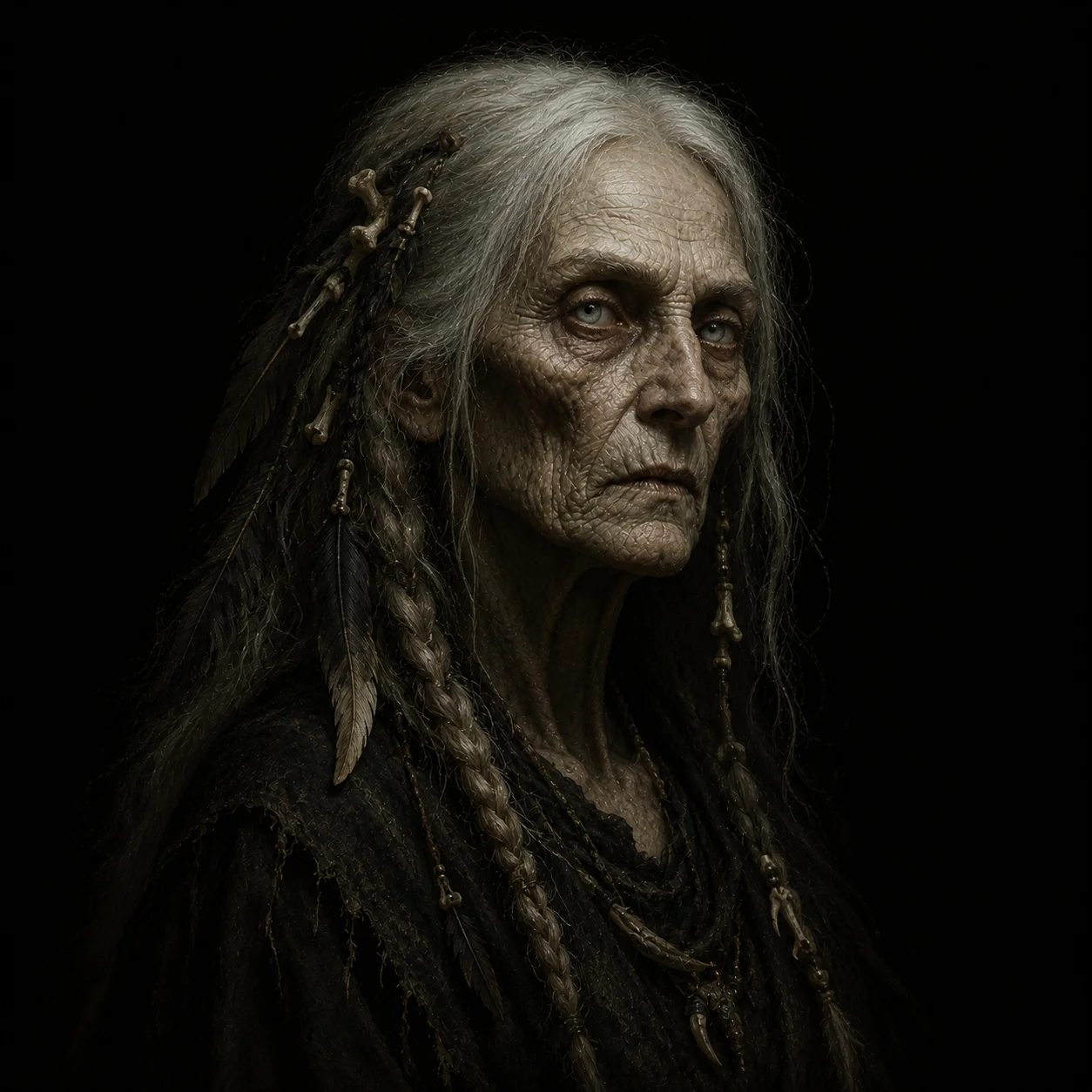
Third Witch
The Third Witch's role is structural: she completes the trio. Three is the number of the supernatural, and her presence is necessary to the witches' power even when she is silent.
Appears In
Who is Third Witch?
The Third Witch completes the trio of Weird Sisters that provides the play with its supernatural engine. She is as ancient and indefinite as her companions - beyond gender in the usual sense, beyond ordinary time, present in storms and at the edges of human understanding.
In the cauldron scene she contributes to the creation of the prophetic apparitions. The three together call up an armed head, a bloody child, and a crowned child holding a tree - images that Macbeth reads as reassurance but which are precisely calibrated to mislead.
She vanishes with the others after their final encounter with Macbeth. Where they go between appearances is not explained - they belong to a layer of the play's world that exists outside ordinary geography and causality.
Motivation
As with her sisters, the Third Witch's motivation is unspecified and the more powerful for it. She serves a function that the play is careful not to fully explain.
Personality
The Third Witch's character is subsumed into the collective identity of the Weird Sisters. She is the completing note in a chord whose resonance the play depends upon.