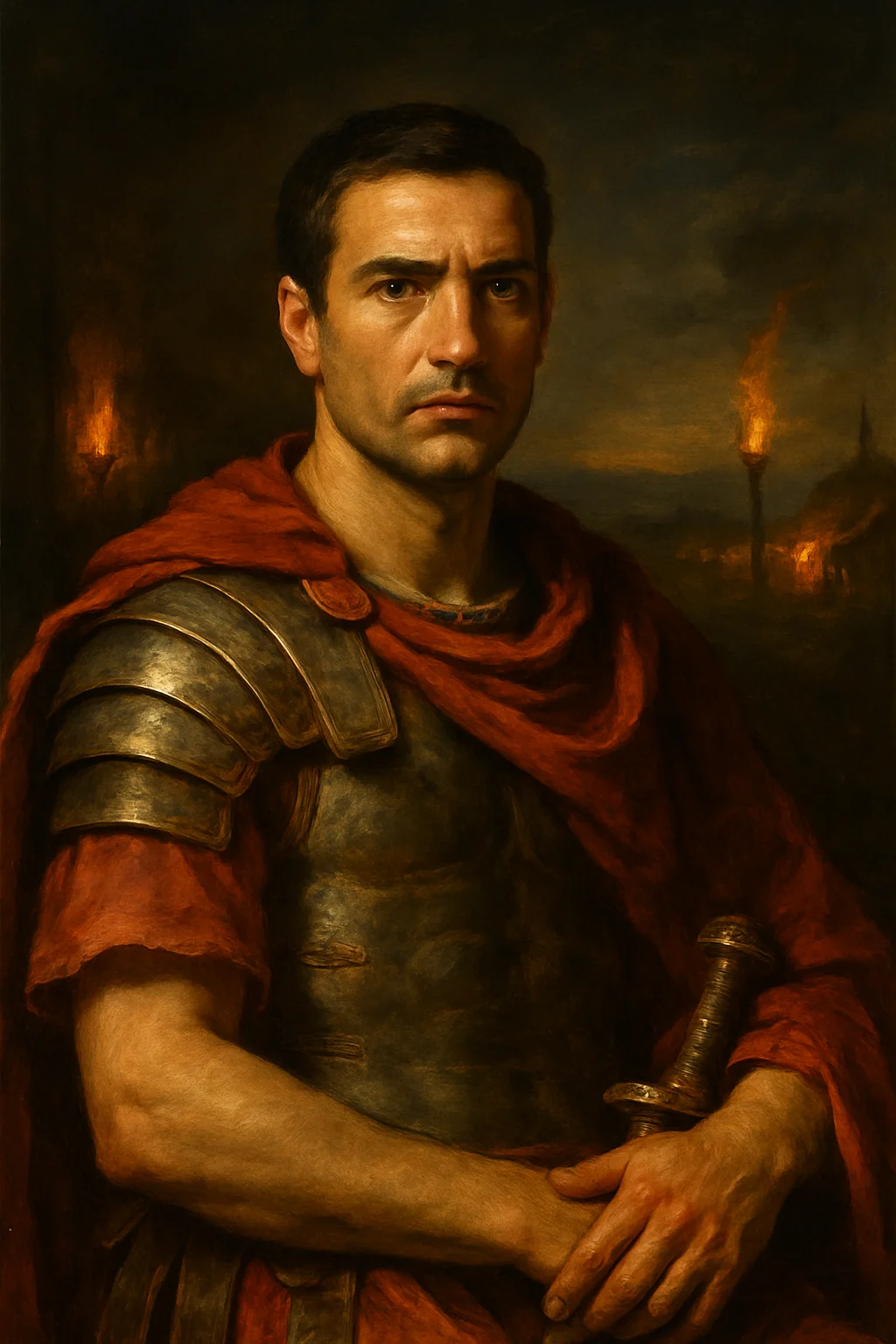
Lucilius
Lucilius is the play's emblem of unconditional military loyalty - a man who impersonates his commander to protect him and survives because the enemy commander is magnanimous enough to recognise the act for what it is. His brief scene in Act V is one of the play's most humane exchanges.
Appears In
Who is Lucilius?
Lucilius is an officer in Brutus's army and one of the play's most striking minor figures - a man whose single great action is to impersonate his general in battle. When Antony's forces capture him in Act V, he announces himself as Brutus, hoping to draw attention away from the real Brutus and allow him to escape. It is a deliberate, lucid act of sacrificial loyalty: he offers himself as a decoy, knowing the deception will be discovered.
Antony's response to the discovery is one of the play's most generous moments: he tells his soldiers to treat Lucilius well, because such men - men who will sacrifice themselves for their general - are worth more as friends than as prisoners. 'I had rather have / Such men my friends than enemies,' he says. The scene is a pause in the battle's violence, a moment in which Antony, the play's most politically calculating figure, acts from something simpler.
Lucilius survives the play. His loyalty, which the play presents without irony as an admirable thing, is rewarded - not by saving Brutus, who dies on his own terms, but by Antony's recognition and his own continued life. He is the play's clearest example of a virtue - fidelity - that the larger political drama has no mechanism for defeating.
Motivation
Lucilius is motivated by absolute loyalty to Brutus - not to the republican cause in the abstract, but to the man. His impersonation is a personal act of devotion, not a political calculation.
Personality
Lucilius acts without hesitation and without apparent fear - he announces himself as Brutus to armed enemies with the composure of a man who has already decided what loyalty requires of him. His survival is the play's quiet reward for a virtue that the political world usually has no room for.