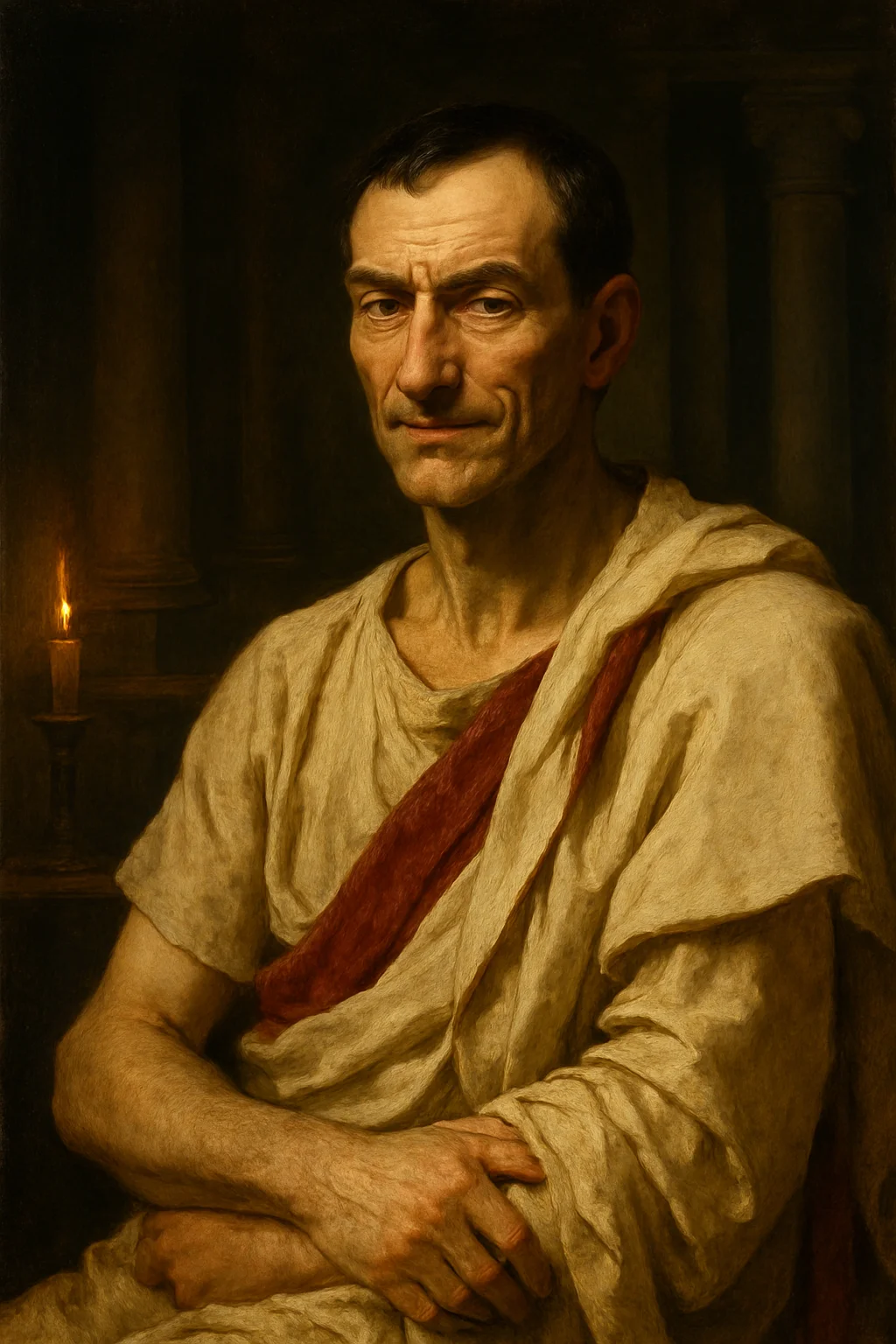
Casca
Casca functions as both the play's political satirist - his account of the crown episode is Julius Caesar's nearest approach to comedy - and as the conspiracy's first instrument, the sardonic bystander who, recruited to action, acts with a decisiveness his detached manner never predicted.
Appears In
Who is Casca?
Casca is introduced as the conspiracy's most sardonic observer - his account of Caesar's three refusals of Antony's crown is the play's sharpest piece of political satire, delivered with a dry contempt for all parties: Caesar performing reluctance for a crowd that cheers each refusal and would cheer the acceptance equally, Antony the good-natured instrument of the spectacle, the Roman mob sweating and cheering and stinking. Casca sees through the performance with an acid clarity that suggests a man who has long since decided that all public life is theatre.
By Act I Scene 3, amid the supernatural portents of a violent storm, this sardonic poise has entirely deserted him. Casca is frightened - rattled by lions in the Capitol, fire dropping from the sky, an owl screaming at noon. Cassius exploits this very effectively, reinterpreting the omens as signs directed at Caesar's unnatural power rather than general chaos, and recruits Casca to the conspiracy in a single focused conversation. The transformation from cool observer to superstitious recruit is swift enough to suggest that Casca's cynicism was always a surface.
In the assassination itself, Casca strikes first: 'Speak, hands, for me.' He has been the last man in Rome you would expect to be first to act, which may be why he is. Thereafter he is a background figure - present at the Capitol, implicitly in the chaos that follows, but his character completes itself in that one committed moment.
Motivation
Casca's opposition to Caesar seems driven by temperamental contempt for political performance rather than republican principle or personal resentment, and his recruitment to the conspiracy happens quickly enough to suggest he was ready to be persuaded long before Cassius spoke to him.
Personality
Casca's defining quality in his early scenes is a biting, dry wit - he describes the crown episode with the relish of a man who has found political theatre genuinely funny for the first time in years. This detachment collapses entirely at the first sign of supernatural disruption, revealing a superstition beneath the scepticism that Cassius knows how to convert into action. He is the play's emblem of how political cynicism and principled commitment can look indistinguishable from outside.