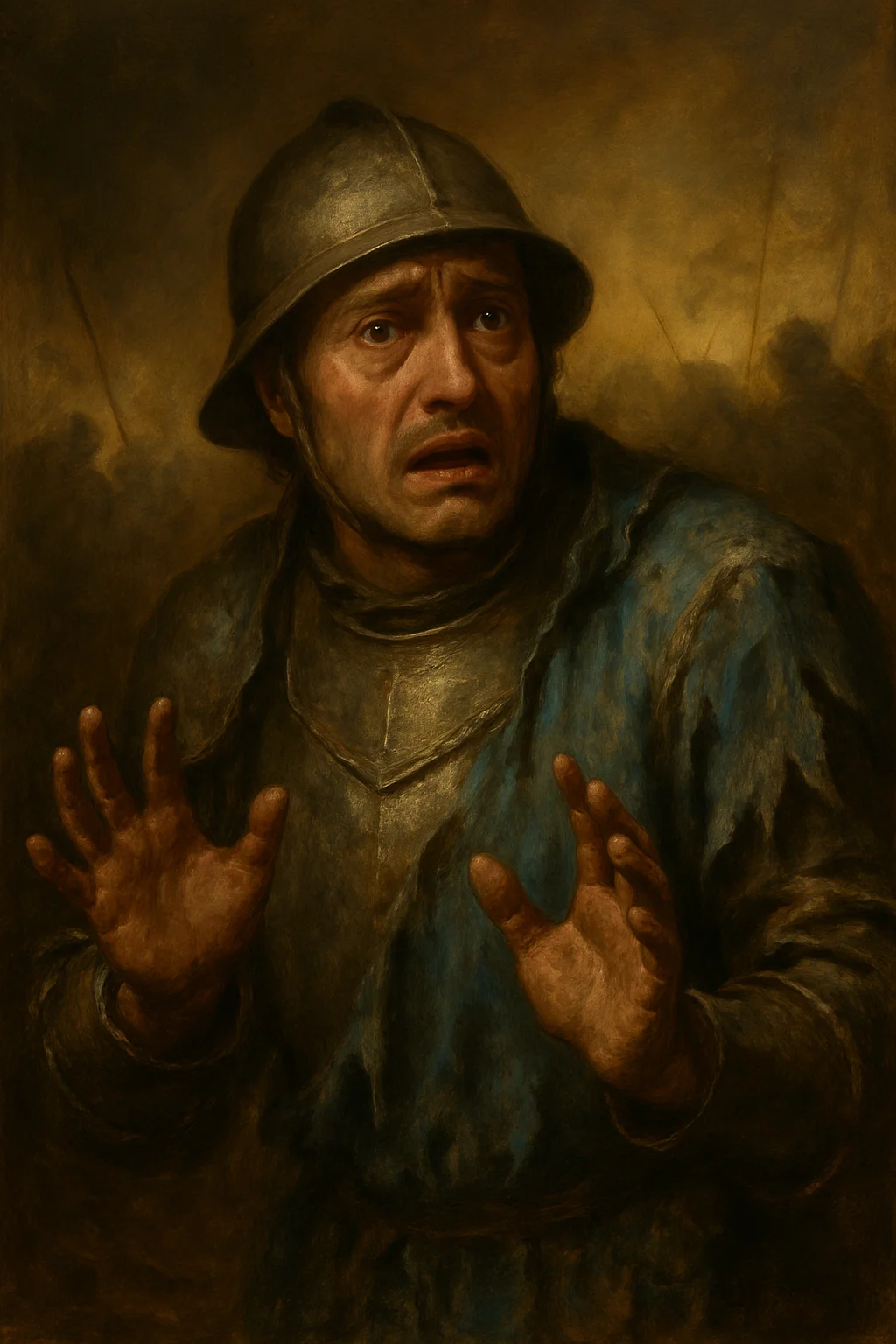
Le Fer
Le Fer's capture by Pistol provides the play's clearest comic deflation of martial bravado in the midst of real battle - an ordinary, terrified soldier caught between a captor who cannot understand him and a translator too young to be doing any of this.
Appears In
Who is Le Fer?
Le Fer is a French soldier who has the misfortune, amid the chaos of the battlefield, to be captured by Pistol - a soldier whose reputation for bombast has, until this moment, never actually been tested against a real armed opponent. Le Fer, speaking only French and thoroughly terrified for his life, begs for mercy in a stream of words Pistol cannot understand a syllable of, producing one of the play's most purely comic sequences at the very center of a battle otherwise full of genuine death.
The Boy is pressed into service as translator, and the comedy sharpens further as it becomes clear that Pistol's threatening, garbled English and Le Fer's desperate French are both, in their own ways, performances - Le Fer offering flattery and promises of ransom money he hopes will save his life, Pistol accepting the arrangement with a grandiosity entirely unearned by anything he has actually done in the fighting.
Le Fer disappears from the play once the ransom is agreed, his brief scene having served its purpose: a moment of very human, ordinary terror amid the battle's larger drama, and a final deflating joke at the expense of Pistol's entirely undeserved reputation for martial prowess.
Motivation
Le Fer is motivated entirely by the wish to survive the encounter, offering money and flattery in whatever combination might persuade his captor to spare him.
Personality
Le Fer's single scene reveals an entirely ordinary soldier with none of the play's grander chivalric pretensions, reduced to pure, honest terror and doing whatever the moment requires to stay alive - a small human reality that the surrounding comedy does not entirely erase.