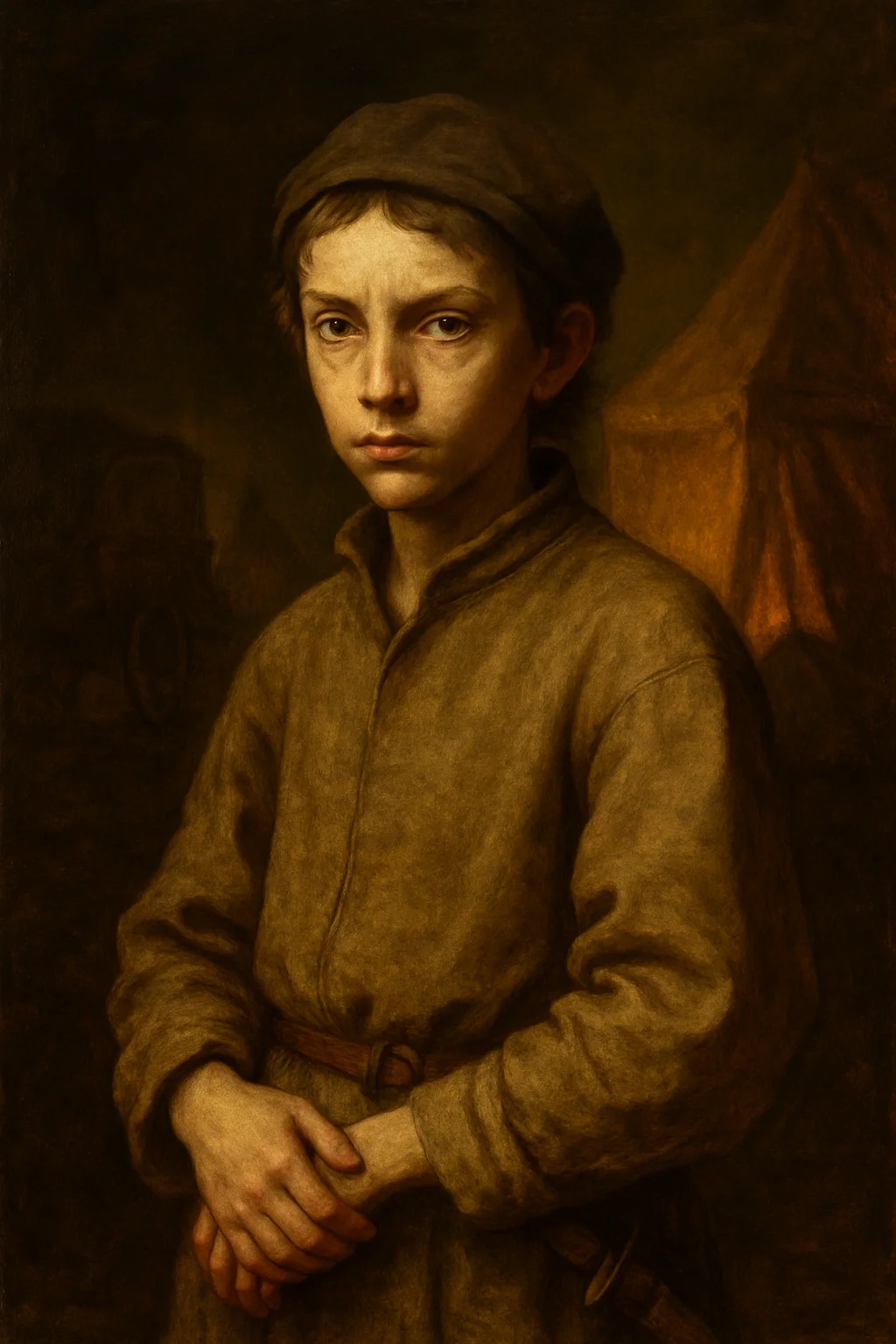
Boy
The Boy provides the play's clearest unsentimental moral witness among the common soldiery - his private assessment of Pistol, Bardolph, and Nym punctures their bravado entirely, and his offstage murder during the French raid on the English baggage train is one of the war's starkest and least glorified casualties.
Appears In
Who is Boy?
The Boy serves Pistol, Bardolph, and Nym as a page, and his clear-eyed narration of their characters - delivered in a soliloquy that assesses all three men as thieves and cowards dressed up in soldiers' bravado - is some of the sharpest, least sentimental commentary in the entire play, delivered by the youngest and least powerful person in it. He sees through Pistol's borrowed rhetoric and Bardolph and Nym's petty larceny with a clarity none of the adults around him seem to possess about themselves.
His usefulness to Pistol becomes explicit at Agincourt, where he is pressed into service translating between Pistol and a terrified French soldier during the play's comic ransom scene - a boy doing the actual linguistic work that makes the scene function, while the adult soldier gets the credit and the coin. It is a small, telling detail about who does the real labor in Pistol's schemes.
The Boy's death, reported rather than shown, is one of the play's genuine atrocities: French raiders slaughter the boys guarding the English luggage train, an act of battlefield savagery that helps provoke Henry's furious order to kill the French prisoners. The play does not linger on the Boy's death for sentiment, but its placement - a child's murder used to explain a king's cruelty - is one of Henry V's starkest reminders that the war's costs fall hardest on those with the least power to affect it.
Motivation
The Boy is motivated by simple survival within a company of men he neither respects nor can escape - he serves competently and observes accurately, understanding his masters' cowardice and thievery long before the play confirms his judgment.
Personality
The Boy's precocious clarity about the adults around him - delivered in soliloquy, unfiltered by any need to flatter his masters - makes him one of the most reliable narrators in the play, for all his youth and powerlessness. His usefulness as a translator during Pistol's ransom scheme shows a resourcefulness his masters lack, and his death at the hands of French raiders underscores how little that competence protects him.