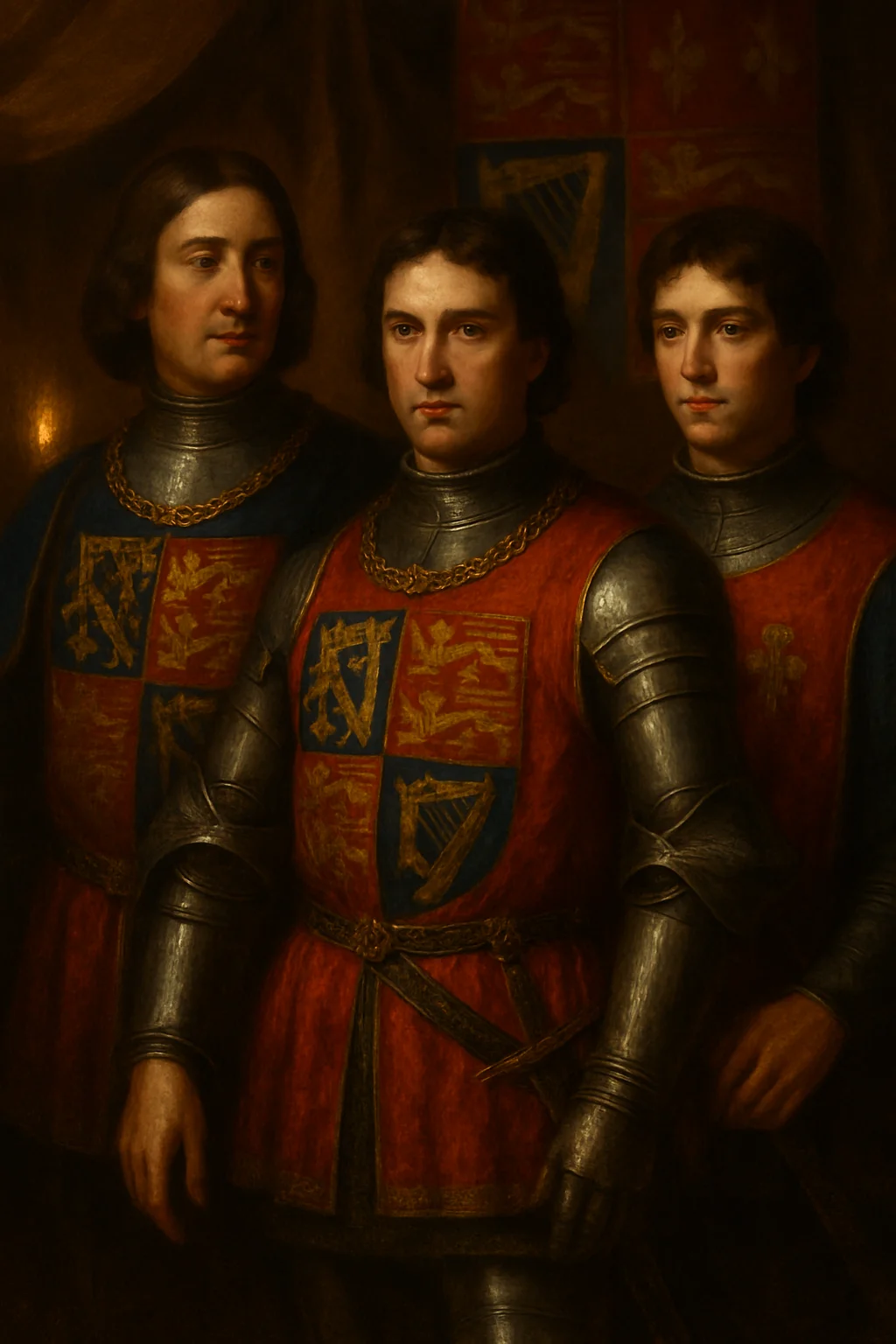
Henry's Brothers
Henry's three brothers represent the steady family loyalty that underlies his kingship - a visible royal solidarity present at council and in camp that reinforces his authority without requiring any individual dramatic moment to demonstrate it.
Appears In
Who are Henry's Brothers?
Humphrey, Duke of Gloucester, John, Duke of Bedford, and Thomas, Duke of Clarence - Henry's three younger brothers - appear through the play as the steady family core of the king's inner circle, present at council, at Southampton as the conspiracy against Henry's life is uncovered, and in the English camp at Agincourt as the army prepares for battle. None of them is given a major solo scene, but their collective presence registers as something the play clearly values: the reassurance that the crown is held by a man whose own family stands beside him.
Bedford is the most visible of the three, appearing at the king's council and settling in alongside the troops the night before Agincourt. Gloucester and Clarence appear alongside him, all three named in Henry's St Crispin's Day speech among the 'band of brothers' whose shared memory of this day will bind them long after it is over.
Their steady loyalty is the quiet foundation of a kingship that depends, beyond Henry's own transformed character, on the visible solidarity of his own house - the simple fact that the men nearest to him by blood are also the men he most consistently relies upon.
Motivation
The brothers are motivated by family loyalty and a shared investment in the success of the crown they stand to protect - their presence at every significant moment of the campaign is the quiet evidence that Henry's cause is a family undertaking.
Personality
Bedford, Gloucester, and Clarence are defined collectively by consistency rather than any single memorable scene - reliably present at their brother's side through council and camp, the quiet reinforcement of family loyalty beneath the play's more dramatic set-pieces.