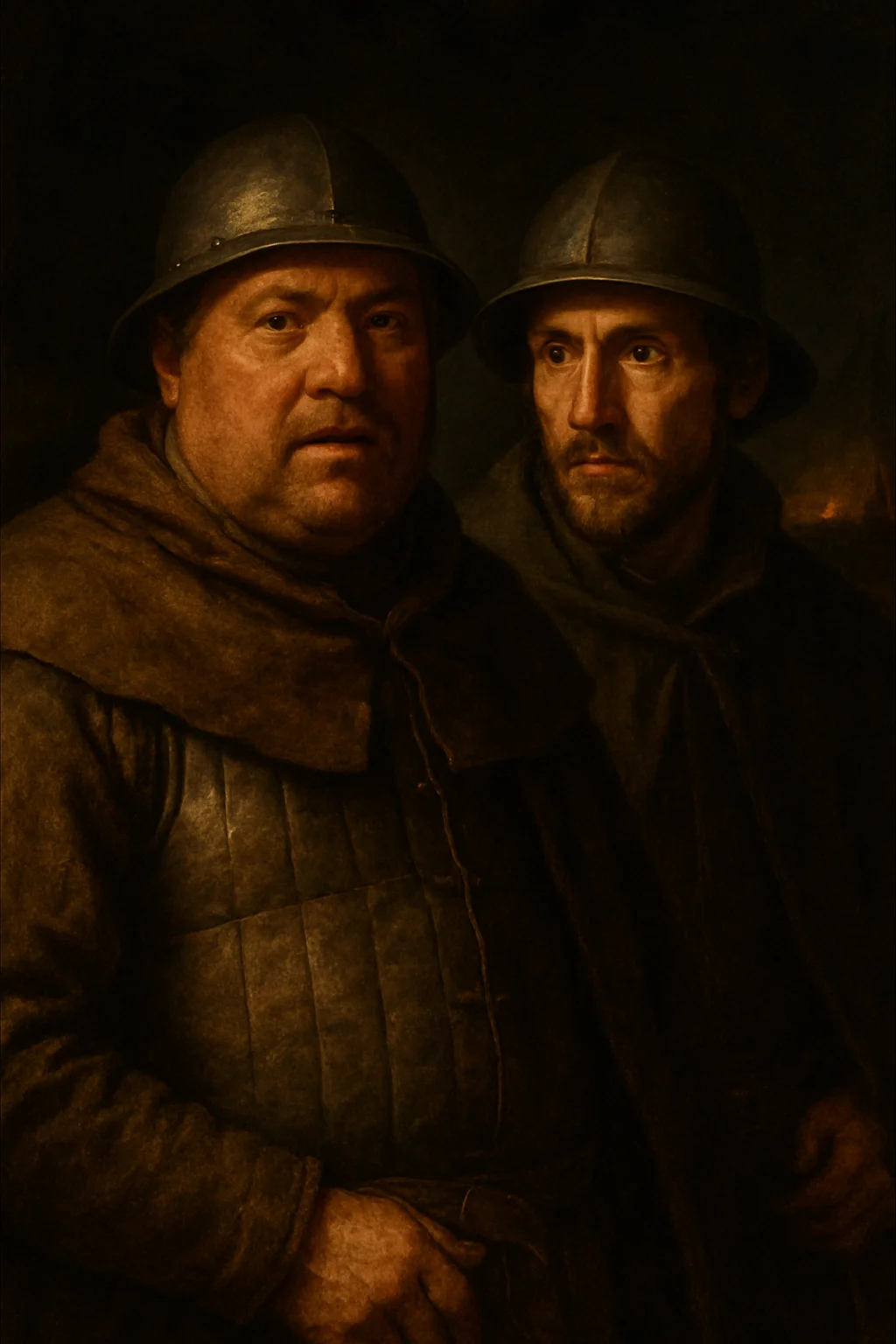
Bates & Court
Bates and Court provide the first voices of ordinary soldierly anxiety in the night-before-Agincourt scene, their plain unguarded speech setting the terms for the more charged exchange between Williams and the disguised king that follows.
Appears In
Who are Bates & Court?
John Bates and Alexander Court are common soldiers encountered by Henry, disguised in Erpingham's borrowed cloak, on the night before Agincourt. Court is the first to engage the stranger who has joined their watch, asking which captain he serves under - an ordinary soldier's question that sets the scene's tone of frank, unglamorous soldiering in the dark and cold before a battle that will kill many of them.
Bates is the more vocal of the two, arguing alongside Williams that the ordinary soldier's duty is simply to obey the king's command, and that the weight of justice for the cause belongs to the king alone. Where Williams presses the argument to a personal pledge and an exchange of gloves with the disguised Henry, Bates and Court remain in the background of the quarrel - ordinary men who have said what they think and leave it at that.
Neither man reappears in the play's subsequent scenes. Their brief, plainspoken presence serves its purpose: a glimpse of the unglamorous reality of soldiering on the night before a battle that will, by morning, be transformed into something legendary - from the inside, it is cold, frightening, and uncertain.
Motivation
Bates and Court are motivated by simple survival and a practical soldier's philosophy that obedience to orders is enough - the questions of justice and royal responsibility that Williams pursues more hotly are not theirs to press.
Personality
Bates and Court are soldiers without pretension or philosophy - they speak plainly about the night's cold and the morning's danger, hold their modest opinion that the king's cause is the king's business, and make no attempt to press the argument further than the moment requires.