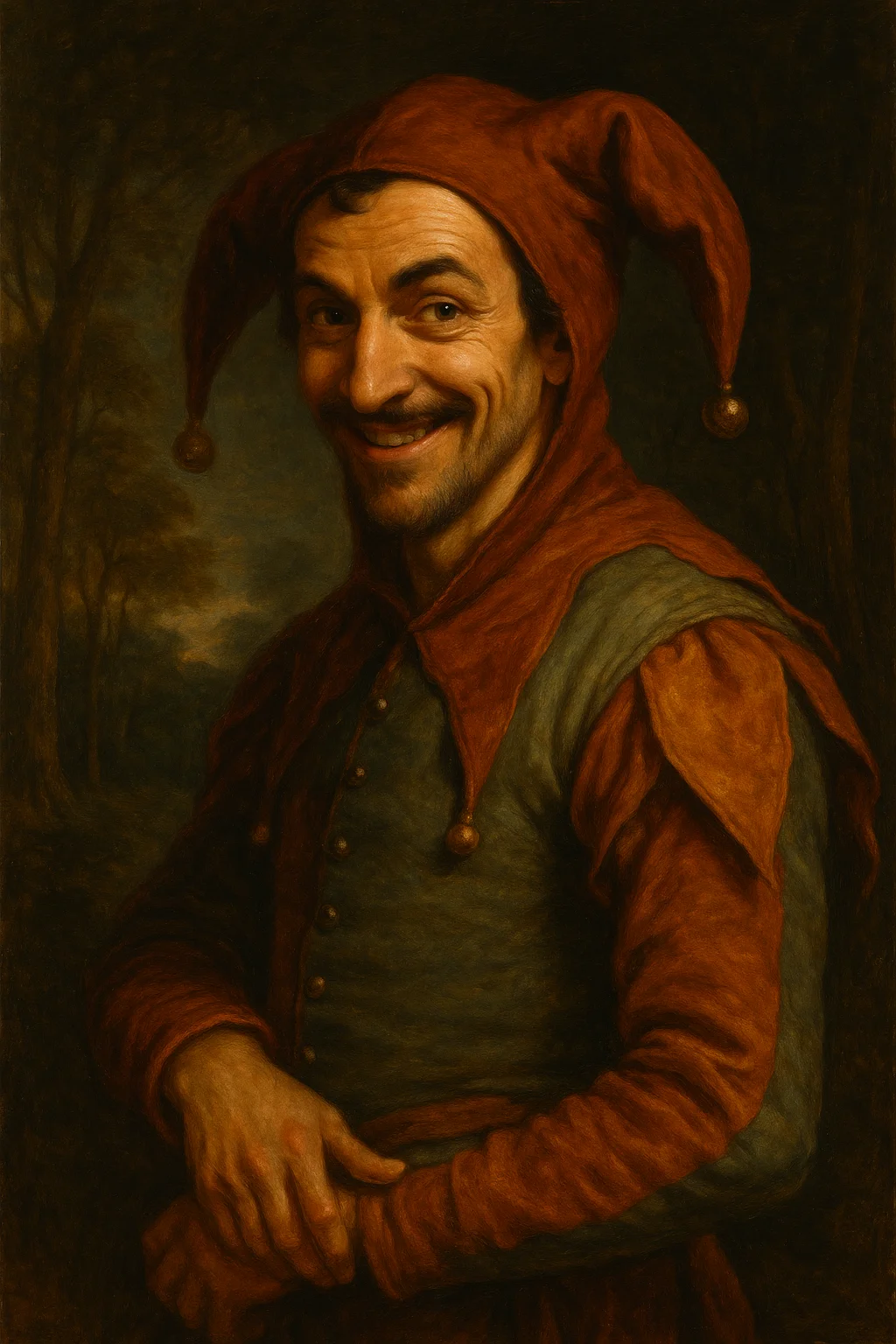
Touchstone
Touchstone is the play's professional wit and parodic counterweight to its romantic plots - his insistence on following Rosalind into exile brings the court's licensed foolery into the forest, and his unromantic courtship of Audrey comments on the earnestness surrounding it without undermining it.
Appears In
Who is Touchstone?
Touchstone is the court fool who insists on accompanying Rosalind and Celia into their exile, and his presence turns the flight to Arden into something closer to a licensed expedition than a desperate escape - he complains about the journey constantly and never once suggests turning back. His wit at court has a professional polish that immediately marks him as an outsider once the party reaches the forest, where his sophisticated wordplay lands, more often than not, on people too plain to appreciate it.
His courtship of the goatherd Audrey is the play's clearest parody of the romantic plots surrounding it - Touchstone pursues her with a cynicism about marriage and fidelity that he states outright, at one point seeking out a hedge-priest of dubious qualification specifically because a proper wedding might prove too binding. It is a deliberately unromantic mirror held up against Orlando's earnest poetry and Rosalind's careful testing, and the play seems to enjoy the contrast without fully endorsing either extreme.
Touchstone's set-piece in Act V, Scene 4 - a taxonomy of the 'seven causes' of a quarrel, delivered with mock-legal precision - is the fool's most sustained comic performance and a final demonstration of exactly what his wit is for: taking the forms of courtly and legal seriousness and showing how easily they collapse into nonsense. He marries Audrey in the play's final scene alongside the other three couples, a fool's-eye version of the same happy ending everyone else receives.
Motivation
Touchstone is motivated by loyalty to Rosalind and Celia, whom he follows into exile without being asked twice, and by a professional wit's pleasure in finding fresh material - the forest's shepherds and lovers give him plenty to work with.
Personality
Touchstone's wit is more knowing and more cynical than Rosalind's, deployed against the pretensions of court and country alike, and his own courtship of Audrey - pursued with an openly stated lack of romantic illusion - gives him a clear-eyed vantage point on every other love story in the play. He is never taken in by anything, including his own performance of foolishness.