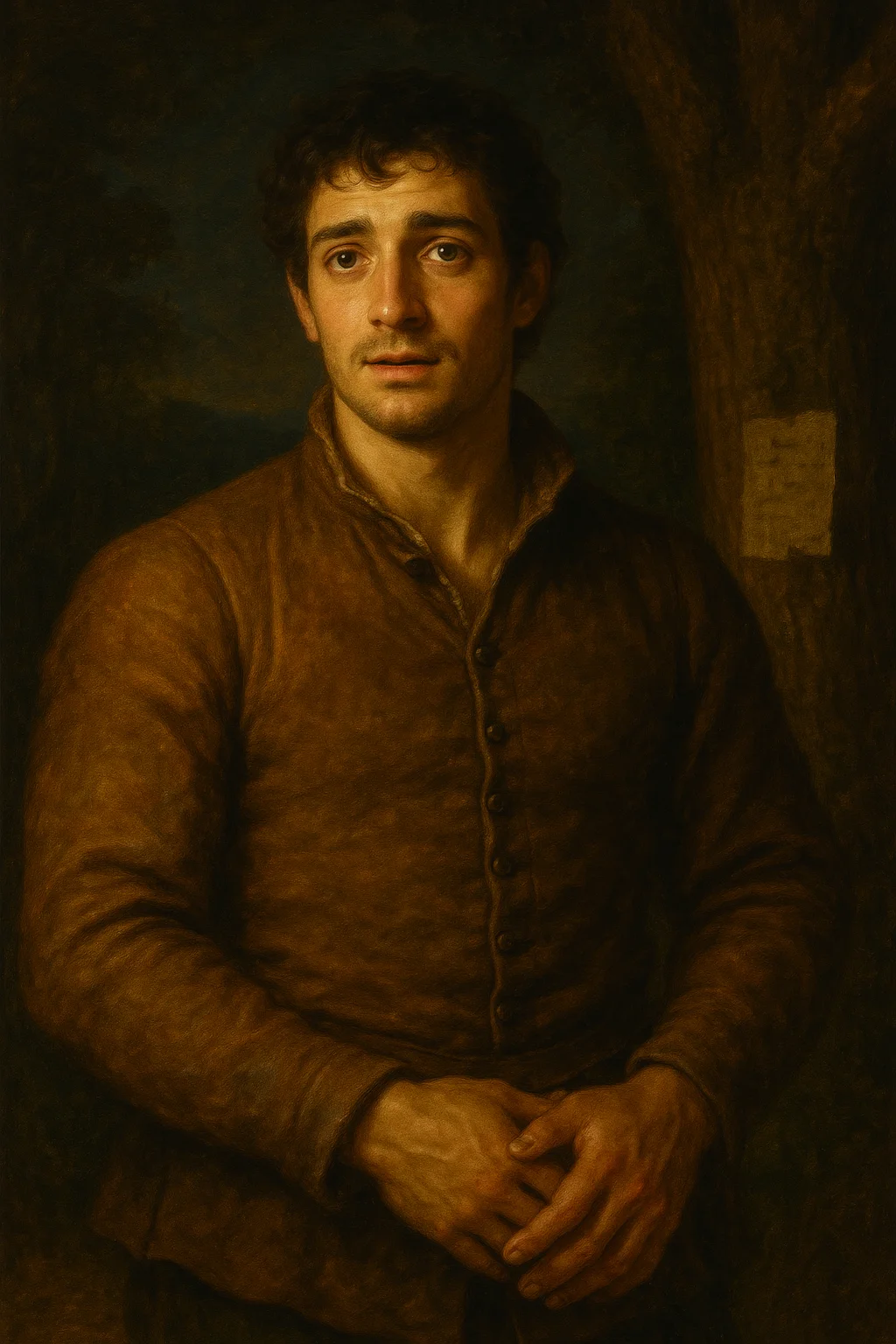
Orlando
Orlando is the play's romantic hero - his wrestling victory sets the love plot in motion, his flight from Oliver brings him to Arden, and his sincere, unguarded love for Rosalind - even conducted with a boy he doesn't know is her - gives the forest plot its emotional center.
Appears In
Who is Orlando?
Orlando opens the play with a grievance stated plainly to Adam: his brother Oliver has kept him 'rustically at home,' denied him the education their father intended, and treats him worse than a hired hand. His decision to challenge the court wrestler Charles is partly desperation and partly a bid to be seen as something other than what Oliver has made of him, and it works spectacularly - he throws Charles, wins Rosalind's admiration on the spot, and finds himself, for the first time in the play, genuinely looked at.
Warned by Adam that Oliver now means to kill him, Orlando flees to the Forest of Arden with the old man, and there his devotion turns practical and fierce - he draws his sword on Duke Senior's company to demand food for the starving Adam, only to be met with a courtesy that undoes his desperation instantly. His love for Rosalind, meanwhile, expresses itself in the artless love poems he nails to every tree in Arden, verses the play is happy to let Rosalind and Touchstone mock even as it takes his feeling seriously.
Orlando's failure to recognise Rosalind beneath the Ganymede disguise is not treated as foolishness so much as an index of how completely he has given himself over to loving her - he practises his courtship on 'Ganymede' with total sincerity, and his rescue of Oliver from the lioness, at the cost of his own blood, resolves the brother-plot the same way his devotion resolves everything else: through action rather than cleverness.
Motivation
Orlando is motivated first by a desire to be treated with the dignity his birth and his father's memory entitle him to, and then by a love for Rosalind he pursues with complete sincerity, undiminished by having to declare it to a disguise.
Personality
Orlando lacks Rosalind's wit and does not pretend to it - his love poems are bad and the play knows it - but his sincerity is never in doubt, and his physical courage (the wrestling match, the demand for food, the rescue from the lioness) is matched by an emotional directness rare among Shakespeare's romantic leads. He forgives Oliver as readily and completely as he loves Rosalind.