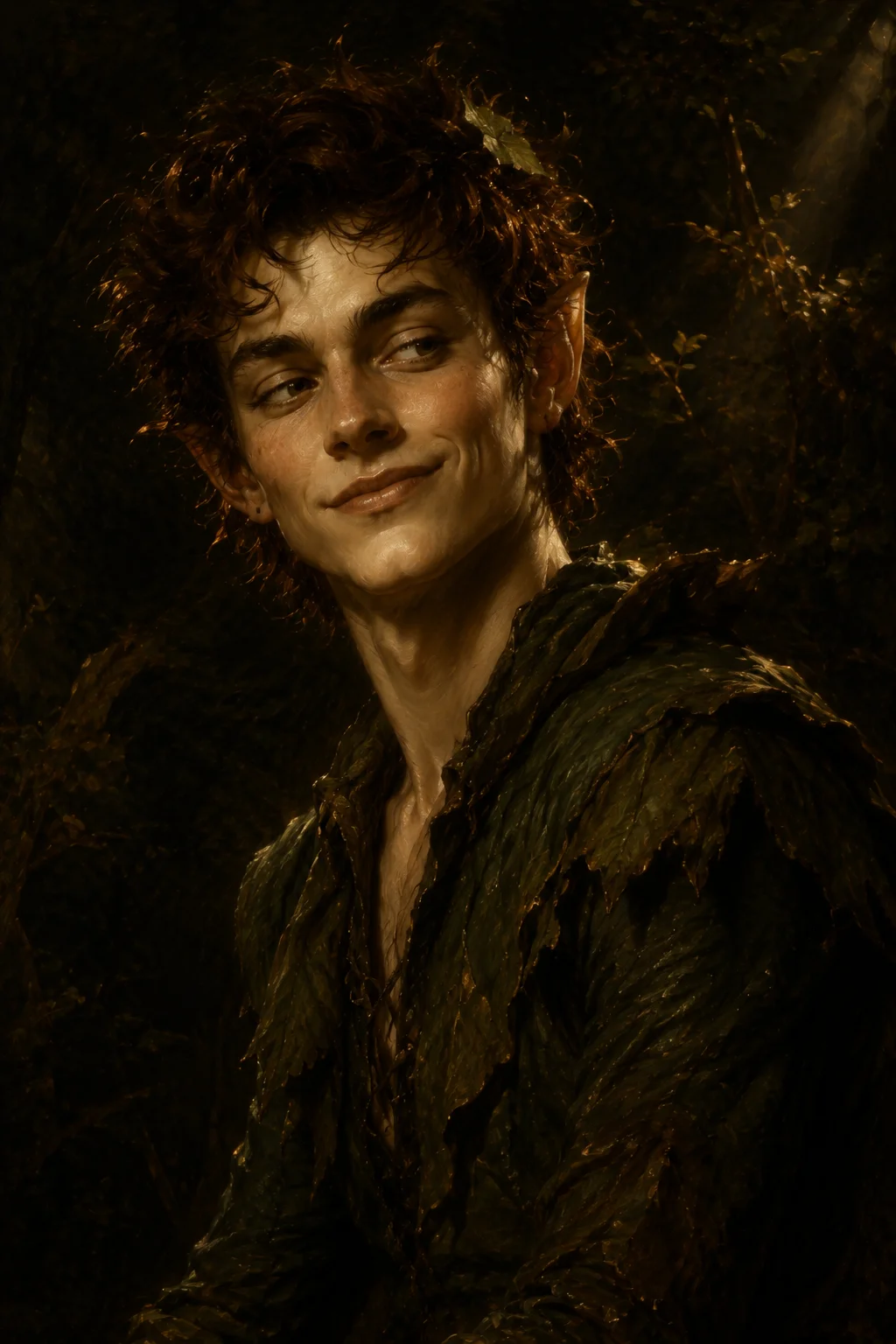
Puck
Puck is the play's chief agent of mischief and its most theatrically self-conscious character - the figure who controls the pace of the comedy through his errors and their corrections, and who frames the entire play as dream-logic rather than event. He is not the protagonist but he is the play's animating spirit.
Appears In
Who is Puck?
Puck - Robin Goodfellow - is Oberon's jester and sprite, a creature of pure mischievous energy whose reputation precedes him: before he appears, a fairy describes him as the one who frightens village maidens, skims the cream from milk, and misleads night-wanderers through the dark. He is introduced as a figure of comic folklore, a household spirit gone feral, and he never entirely ceases to be one.
His error - mistaking Lysander for Demetrius when applying the love-juice - is the mechanical cause of most of the play's comic chaos, but Puck's response to his mistake matters as much as the mistake itself: he finds it funny. When Oberon reproaches him, Puck acknowledges the error cheerfully and then relishes the spectacle of the enchanted lovers turning on each other. The chaos amuses him far more than getting it right would have done.
His closing soliloquy - 'If we shadows have offended' - steps outside the play entirely to address the audience directly, reframing the whole performance as a dream, a shadow, a 'weak and idle theme.' It is the most formally self-aware speech in the play, and Puck delivers it with the ease of someone for whom the boundary between the play and the world has always been slightly negotiable.
Motivation
Puck is motivated above all by delight - in disruption, in confusion, in the spectacle of human beings behaving foolishly under magical influence. He serves Oberon loyally but his real investment is in the entertainment value of what results, not in any particular outcome.
Personality
Puck is the play's most morally uncomplicated character precisely because he has no morality to speak of - only appetite for mischief and delight in spectacle. He is not malicious but entirely indifferent to the harm his pranks cause, and the play treats this as a natural property of his nature rather than a flaw. His cheerful acknowledgment of his own errors and his evident pleasure in their consequences make him one of Shakespeare's most genuinely funny creations.