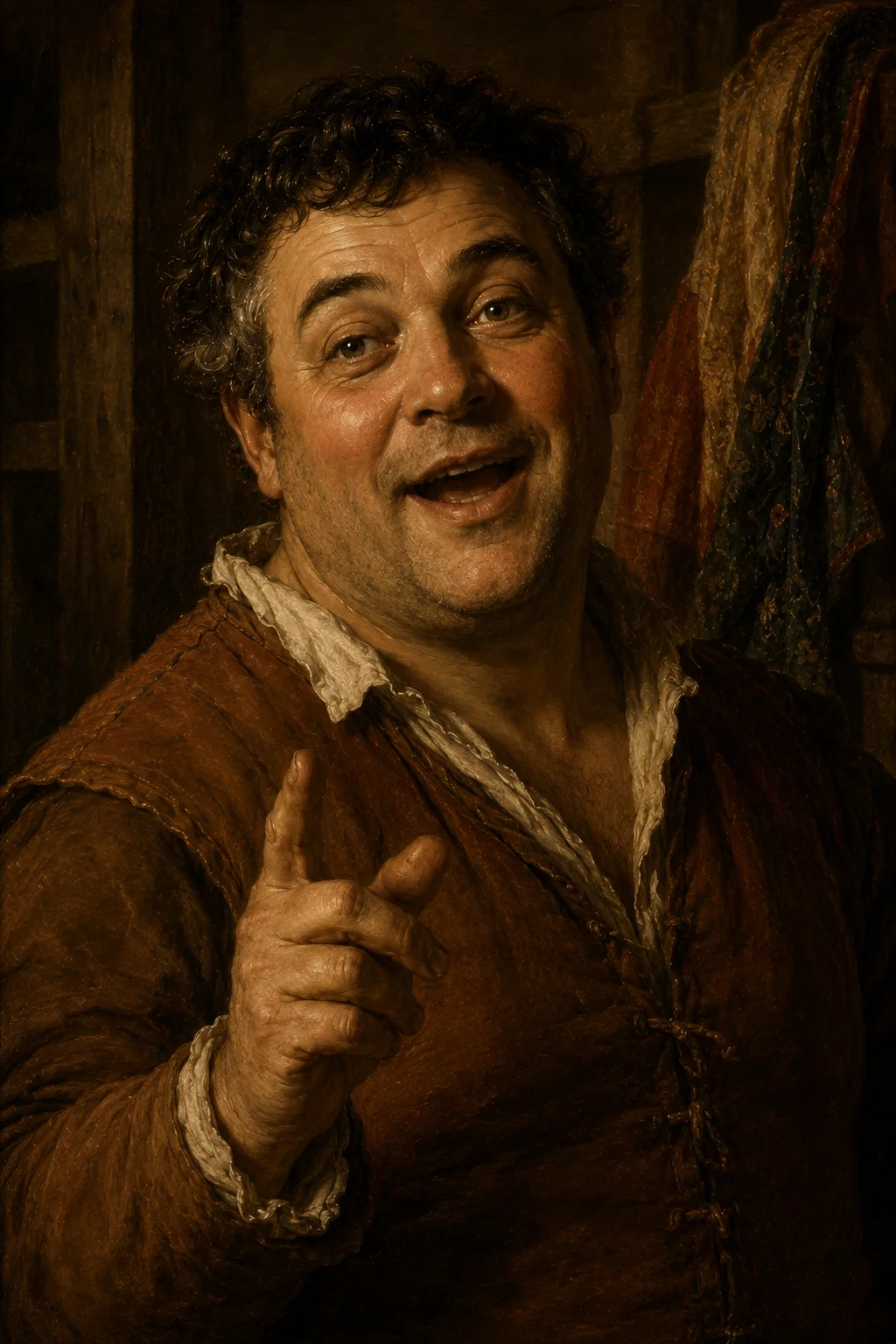
Bottom
Bottom is the play's great comic hero and its most unexpected moral figure: a man of no pretension who moves through the fairy world with more ease and dignity than the lovers who belong to the same social order as the play's official protagonists. His scenes with Titania are the play's most tonally complex - simultaneously the funniest and, viewed from a certain angle, the most tender.
Appears In
Who is Bottom?
Nick Bottom is a weaver of Athens and the most fully realised human character in the play - which is to say, he is both the funniest and, in his way, the most sympathetically drawn. He arrives at the mechanicals' first meeting with opinions on everything, an eagerness to play every part in the Pyramus and Thisbe play, and a total absence of self-doubt that is at once comic and, in its way, rather magnificent. He is not stupid - he is simply operating at a frequency that bears no relation to what is conventionally considered refinement.
When Puck gives him an ass's head and his companions flee in terror, Bottom's response is instructive: he sings. He is, he announces, not afraid. When Titania wakes and declares her love, he receives it with a combination of courtesy and pragmatism - 'Methinks, mistress, you should have little reason for that' - that is more genuinely dignified than the enchanted lovers' frantic declarations. He is the only character in the play who meets the fairy world entirely on his own terms.
His account of his experience afterwards - 'I have had a most rare vision; I have had a dream past the wit of man to say what dream it was' - is one of Shakespeare's most affecting comic speeches, a man trying to describe something genuinely extraordinary in the only language he has, which is entirely inadequate and entirely sincere. He plans to have it set to music. The play does not patronise him for this.
Motivation
Bottom is motivated by enthusiasm - for theatre, for performance, for the experience of being alive and engaged with whatever is in front of him. He wants to play all the parts because he loves all the parts, and he accepts Titania's love with the same generous openness with which he accepts everything else. He is not ambitious in any competitive sense: he simply wants to be fully involved.
Personality
Bottom's comic greatness lies in his complete self-possession: where the lovers lose themselves entirely to enchantment and the other mechanicals flee from anything they do not understand, Bottom simply incorporates the inexplicable into his existing worldview and continues. His confidence is not arrogance - it lacks the meanness that arrogance requires - but a kind of constitutional good cheer that functions as its own form of resilience. He is the play's most lovable character because he is the most fully himself.