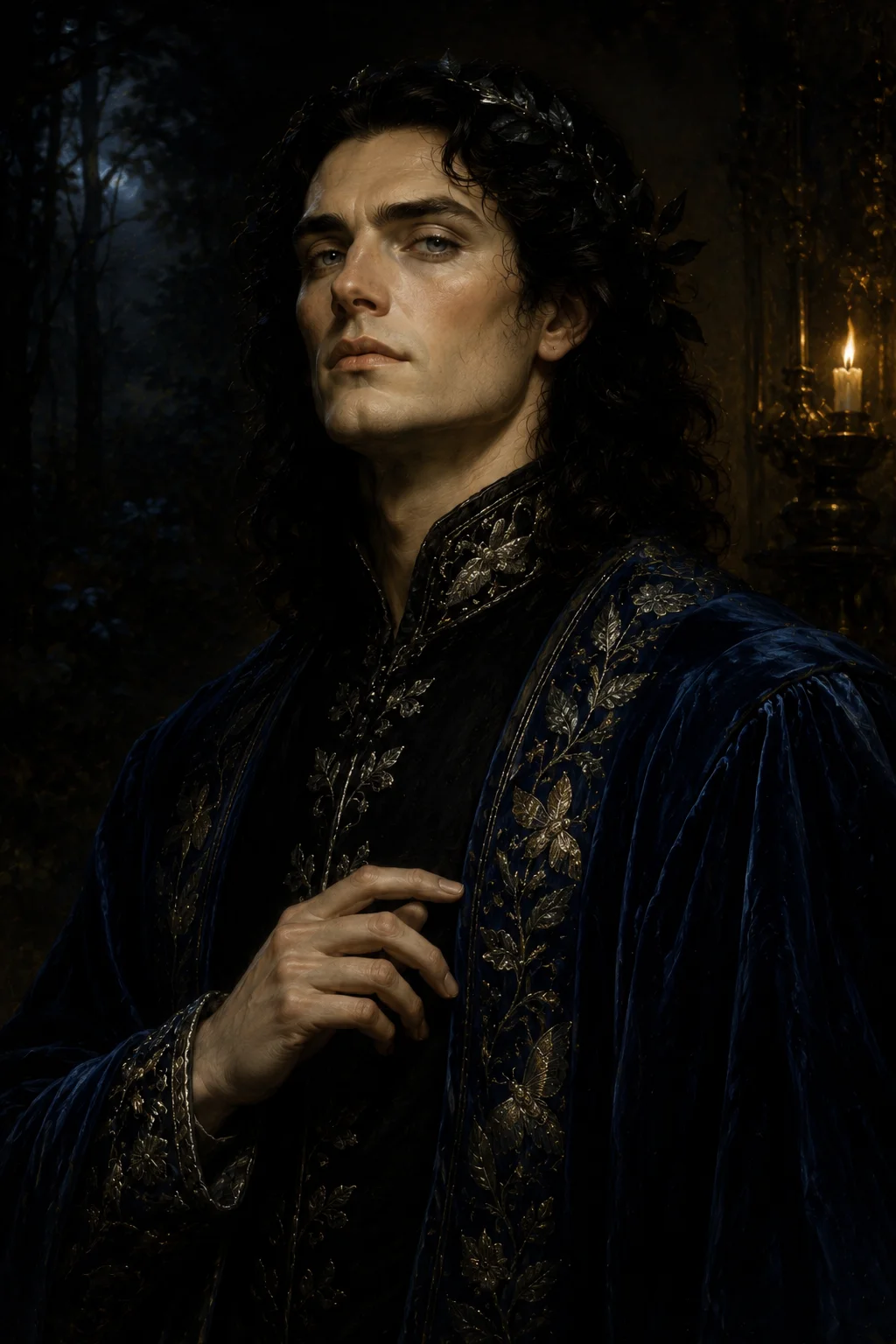
Oberon
Oberon is the play's primary supernatural authority and its chief architect of both confusion and resolution. Every major magical intervention flows from his decisions, and it is his change of mood - from vengeful to magnanimous - that allows the play to end in reconciliation rather than ruin.
Appears In
Who is Oberon?
Oberon is the King of the Fairies, a figure of enormous and capricious power whose quarrel with his queen Titania over a changeling boy is the engine that sets the play's entire chaos in motion. That quarrel is not trivial: the changeling's mother was Titania's devoted votaress, now dead in childbirth, and Titania's refusal to surrender the boy is an act of loyalty as much as possessiveness. Oberon's insistence on claiming him is the play's first reminder that even magical authority can be petty.
To get the boy, Oberon enlists Puck and the juice of a flower called love-in-idleness - a nectar that causes its victim to fall in love with the first creature seen on waking. He uses it first on Titania to humiliate her into compliance, and then, observing the four Athenian lovers' tangle in the forest, attempts to set Demetrius right - with the result, thanks to Puck's error, that both men are suddenly devoted to Helena while Hermia is abandoned.
What prevents Oberon from being simply a bully is the ease with which he relents once he has what he wants: he lifts Titania's enchantment with evident tenderness, restores the lovers to the correct pairings, and presides over the play's final blessing of the Athenian houses. His capacity for both vindictiveness and grace defines the fairy world's fundamental difference from the human one - consequence here is reversible, if the king wills it.
Motivation
Oberon is driven initially by pride and the desire to prevail over Titania in their domestic quarrel, and secondarily by a genuine, if paternalistic, impulse to set the human lovers' affairs in order. Both motivations are expressions of the same thing: an absolute confidence in his right to arrange the world as he sees fit.
Personality
Oberon combines the arbitrary authority of a king with the mercurial temperament of a creature who has never needed to moderate himself. His vindictiveness is real but not deep - he turns it off as easily as he turns it on, once it has served its purpose. He is not cruel so much as accustomed to getting his way, and the play treats this as the natural condition of supernatural royalty rather than a moral failing.