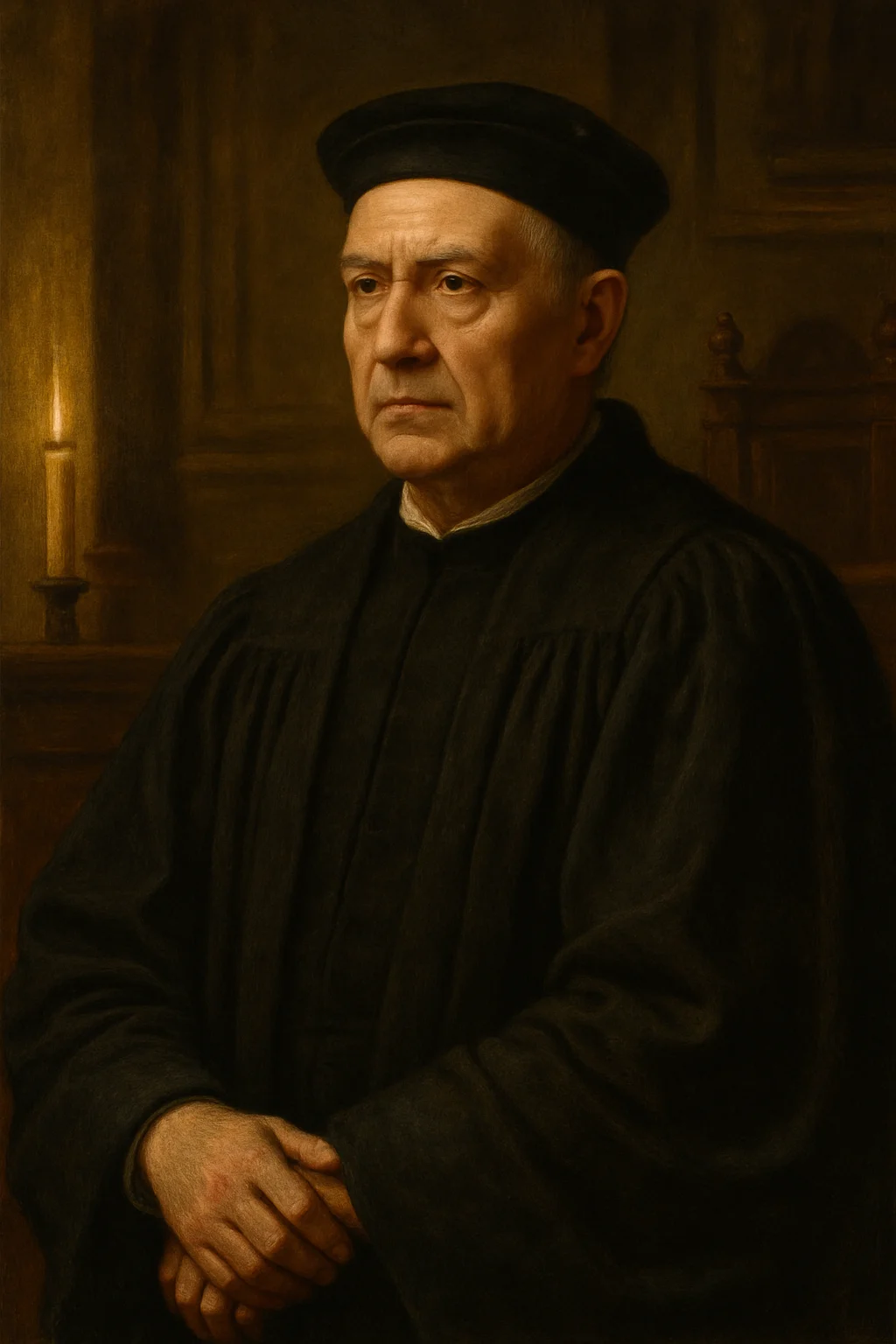
Justice
Who is Justice?
The Justice appears briefly alongside Escalus following the confused prosecution of Pompey and Froth, offering a single pointed observation: that Claudio's death sentence for fornication seems remarkably severe set against Angelo's evident tolerance for the more persistent, lower-level vice Elbow has just failed to prosecute. Escalus's response - that Angelo intends the severity as an example - is prompted directly by the Justice's remark.
A magistrate who briefly appears with Escalus to remark on the disproportion between Claudio's death sentence and the city's tolerated, lower-level vice.
Appears In
Biography
The character does not appear again, functioning entirely as a vehicle for making the play's central irony explicit: that the deputy pursuing Claudio's execution seems considerably less troubled by Vienna's ongoing, unglamorous vice trade than by one young man's private lapse.
Motivation
The Justice is motivated by a straightforward, professional interest in the consistency of Vienna's legal enforcement, prompting the observation that draws Escalus's telling explanation of Angelo's motives.
Personality
The Justice's single pointed remark exists mainly to draw out Escalus's explanation of Angelo's motives, functioning as a brief but efficient vehicle for the play's central irony about disproportionate justice.