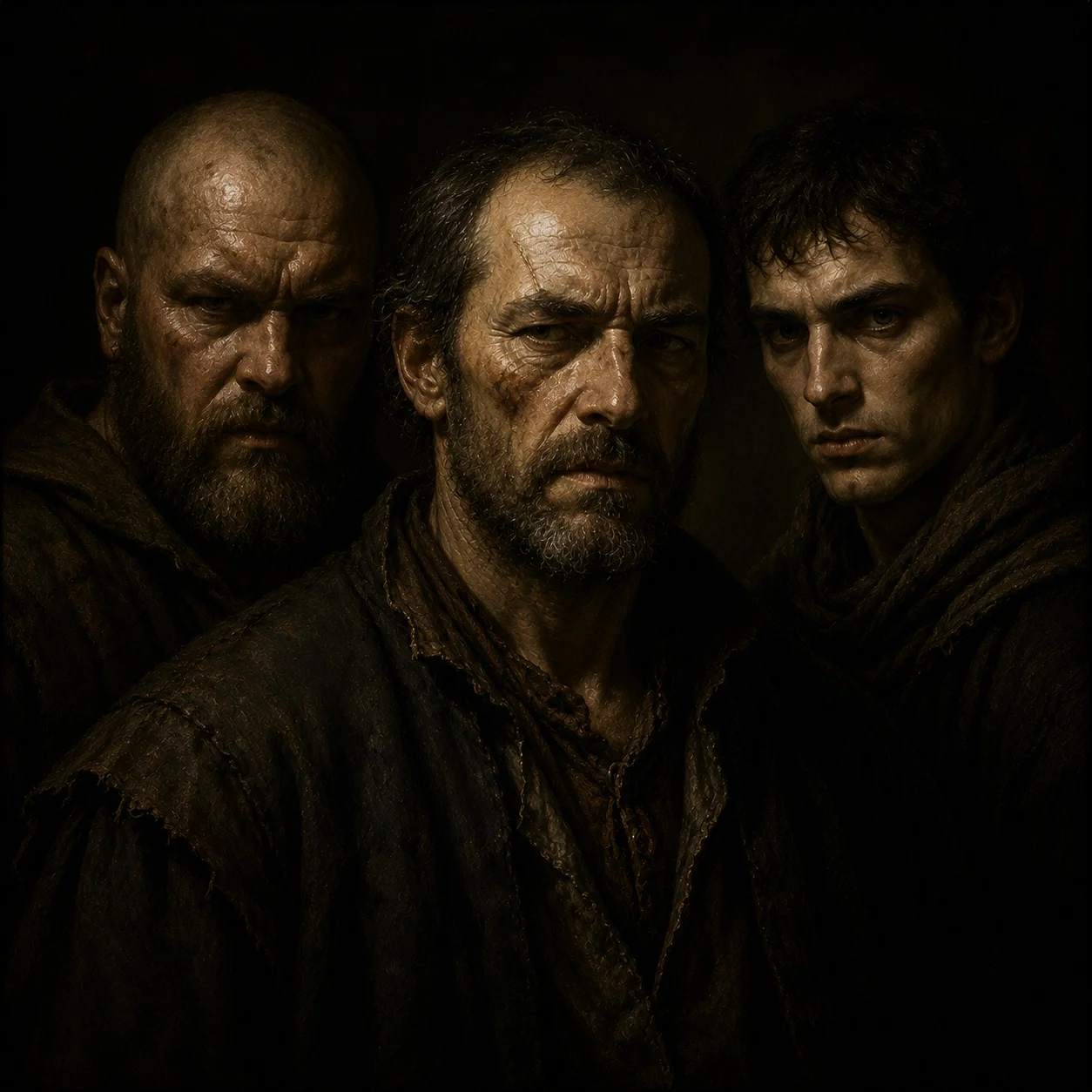
Murderers
The murderers are the instruments of Macbeth's descent into systematic violence. Each murder he orders through them marks a stage of his corruption - from the politically calculated killing of Banquo to the purely vindictive massacre of Lady Macduff's household.
Appears In
Who are Murderers?
The murderers - three in total - are men in Macbeth's service, persuaded by him to kill Banquo and Fleance, and later Lady Macduff and her household. They are not professional assassins but men whom Macbeth has convinced, through a combination of flattery and manufactured grievance, that Banquo is their enemy.
In Act III Scene 1, Macbeth briefs the First and Second Murderer. A Third Murderer appears unexpectedly at the ambush in Scene 3 - sent, it is implied, by Macbeth, who does not fully trust the other two. Their failure to kill Fleance alongside Banquo is the crack in Macbeth's plan that the witches' second prophecy exploits. The First Murderer reports back to Macbeth at the banquet (Scene 4), delivering news of Banquo's death and Fleance's escape.
In Act IV, the First Murderer leads the attack on Lady Macduff's castle, killing her son on stage before the women are dispatched offstage. The act is reported with no ceremony - hired violence, efficiently done. The murderers are instruments of Macbeth's will, with no inner life the play sees fit to explore.
Motivation
The First and Second Murderer have been persuaded by Macbeth that Banquo wronged them. The Third Murderer's motivation is unspecified. All three are operating for pay and at Macbeth's direction.
Personality
The murderers are functional characters rather than psychological ones. The First Murderer has the most lines and shows the most initiative; the others follow. They are defined entirely by what they do, not who they are - instruments of hired violence in a play that does not romanticise it.